- Title
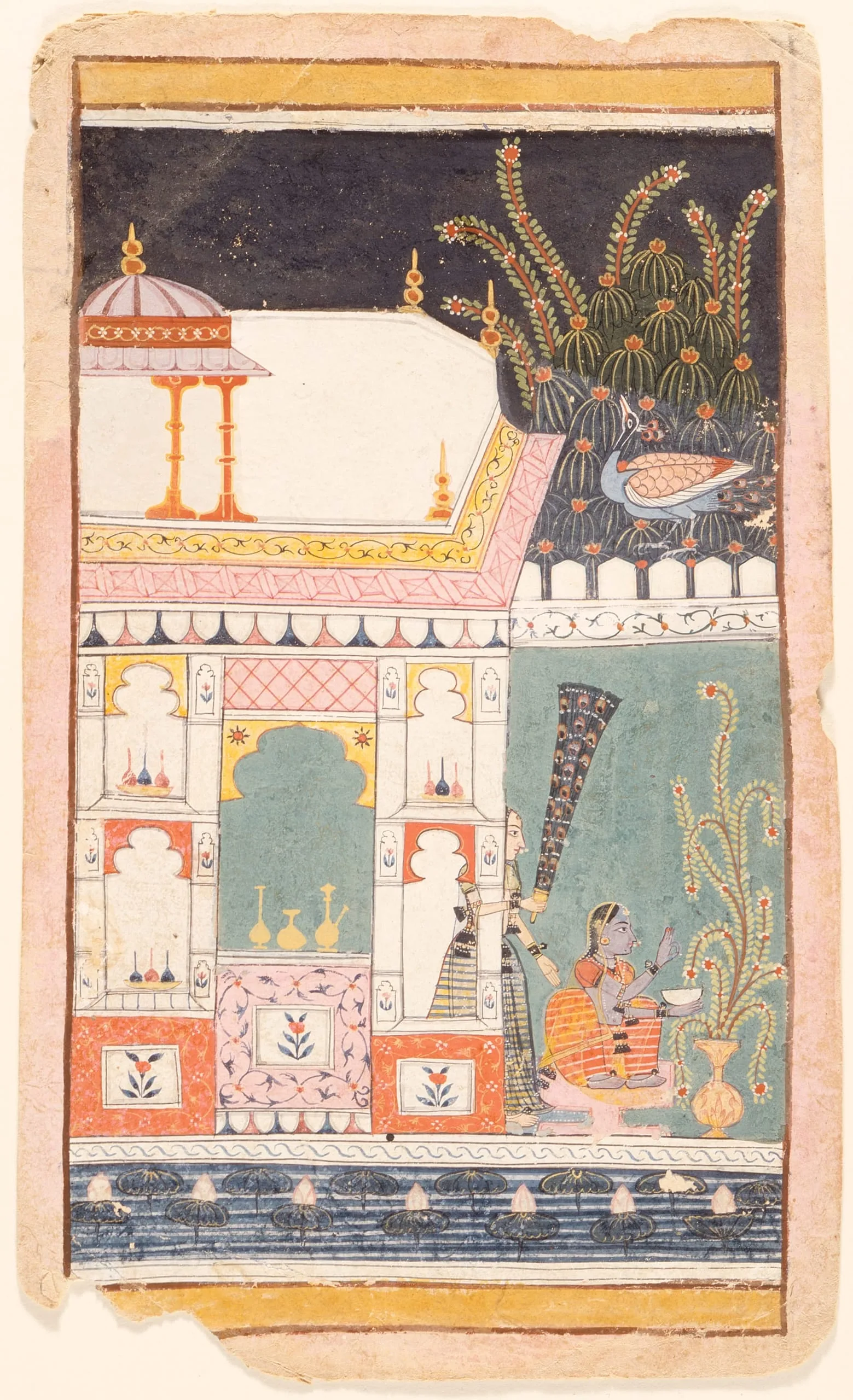
- Gunakali Ragini, Fifth Wife of Malkos Raga, Folio from a Ragamala (Garland of Melodies)
- Date Made
- circa 1660
- Medium
- Opaque watercolor on paper
- Dimensions
- 10 1/4 x 6 in. (26.04 x 15.24 cm)
- Accession Number
- AC1999.127.25
- Curatorial Notes
Gunakali Ragini is a morning melody associated with Autumn (September–November). It is typically portrayed as a lovesick woman arranging flowers or blooming branches in one or two vases. Although Gunakali is emotionally envisioned as a young woman overcome with desperation by her beloved’s absence, this painting suggests a more eager frame of mind as she imagines her lover’s return. She is depicted as plucking blossoms from a flowering plant in a vase, perhaps playing a variant of the “he loves me, he loves me not” game. The setting is a conventional palace courtyard with a peacock symbolic of courtship prominently positioned beyond the palace walls. The peacock’s erotic overtones are reiterated by the large peacock feather flywhisk held by the women’s attendant. Stylistically, the painting utilizes a flat perspective with depth primarily indicated by the receding diagonal lines of the pavilion overhang. An intriguing detail is the three-dimensional depiction of the attendant standing behind the portico’s corner post with her arm wrapped around it. See also M.72.12.
- Selected Bibliography
- Pal, Pratapaditya. Indian Paintings from Staff Collections. Los Angeles: Los Angeles County Museum of Art, 1973.