- Title
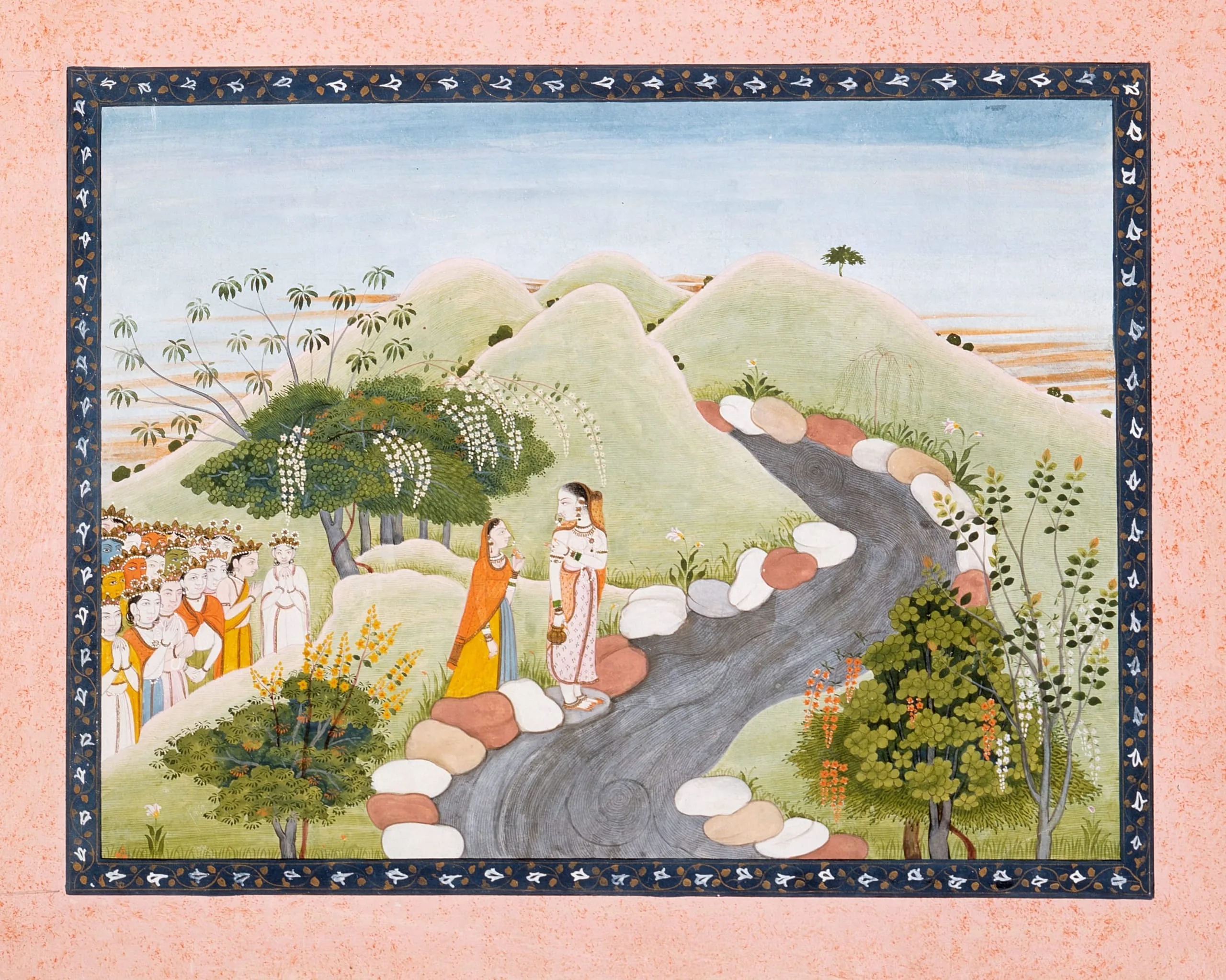
- The Emergence of Kaushiki, Folio from a Devimahatmya (Glory of the Goddess)
- Date Made
- circa 1700-1750
- Medium
- Opaque watercolor, gold, and silver on paper
- Dimensions
- Image: 8 3/4 x 6 7/8 in. (22.23 x 17.46 cm); Sheet: 9 1/2 x 11 3/4 in. (24.13 x 29.85 cm)
- Accession Number
- AC1999.127.21
- Curatorial Notes
Dating from circa 550 CE, the Devimahatmya (Glory of the Goddess) is a devotional text of 700 Sanskrit verses that extol the Goddess (Devi) as the supreme power and creator of the universe. The verses were interpolations to the earlier Markandeya Purana dating from circa 250 CE and then extracted as a stand-alone text.
This painting illustrates a tale from the final episode (Chapters 5-13) in which various male gods, shown in reverential postures on the left, were afflicted by two demonic brothers, Shumbha and Nishumbha. Unable to defeat them, the gods offered a hymn to the Devi Parvati (the highest form of the Goddess) in the hope that she would come to their aid. Parvati, portrayed standing on the riverbank in an orange shawl, did not know to whom the hymn was addressed. In answer to her confusion, an auspicious towering form arose from the sheath of her own body and proceeded to destroy the demons. Imbued with cosmic energy (shakti), this form of the goddess was known as Kaushiki. She is depicted standing above Parvati in a graceful aspect and holding an ascetic’s waterpot. Another rendition of this figural composition, albeit with a variant landscape, is in the Lahore Museum (E.12).