LACMA

ShopMembershipMyLACMATickets
LACMA
Los Angeles County Museum of Art
5905 Wilshire Blvd.
Los Angeles, CA 90036
info@lacma.org
(323) 857-6000
Sign up to receive emails
Subscribe
© Museum Associates 2025

Museum Hours

Monday

11 am–6 pm

Tuesday

11 am–6 pm

Wednesday

Closed

Thursday

11 am–6 pm

Friday

11 am–8 pm

Saturday

10 am–7 pm

Sunday

10 am–7 pm


  • About LACMA
  • Jobs
  • Building LACMA
  • Host An Event
  • Unframed
  • Press
  • FAQs
  • Log in to MyLACMA
  • Privacy Policy
© Museum Associates 2025
Collections

Unknown
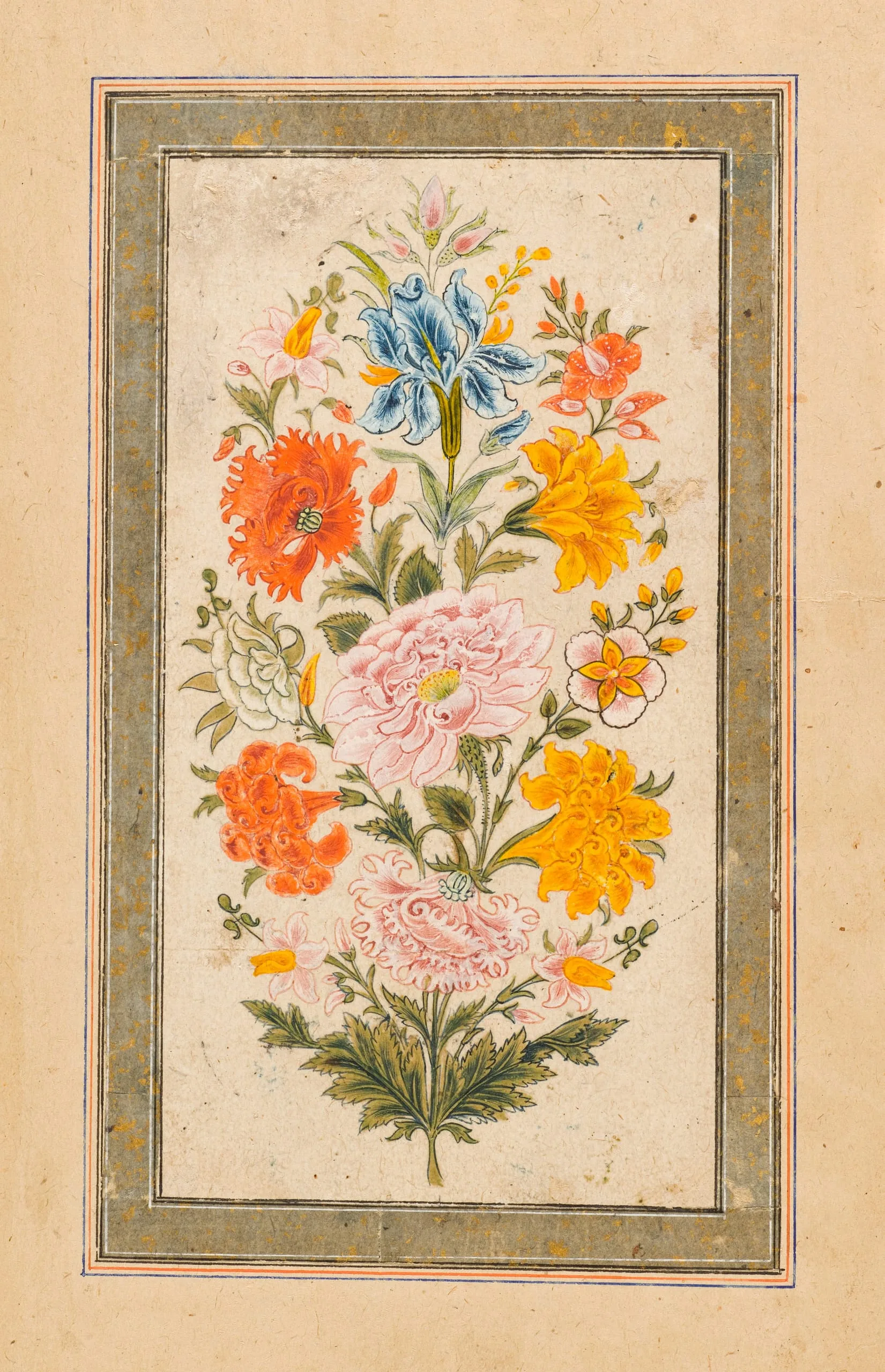
Exotic Flowering Plantcirca 1650-1700

Not on view
Vertical gouache or watercolor painting of a dense floral bouquet featuring pink peonies, a blue iris, coral-orange carnations, and yellow blossoms on a cream ground, framed with a narrow decorative border
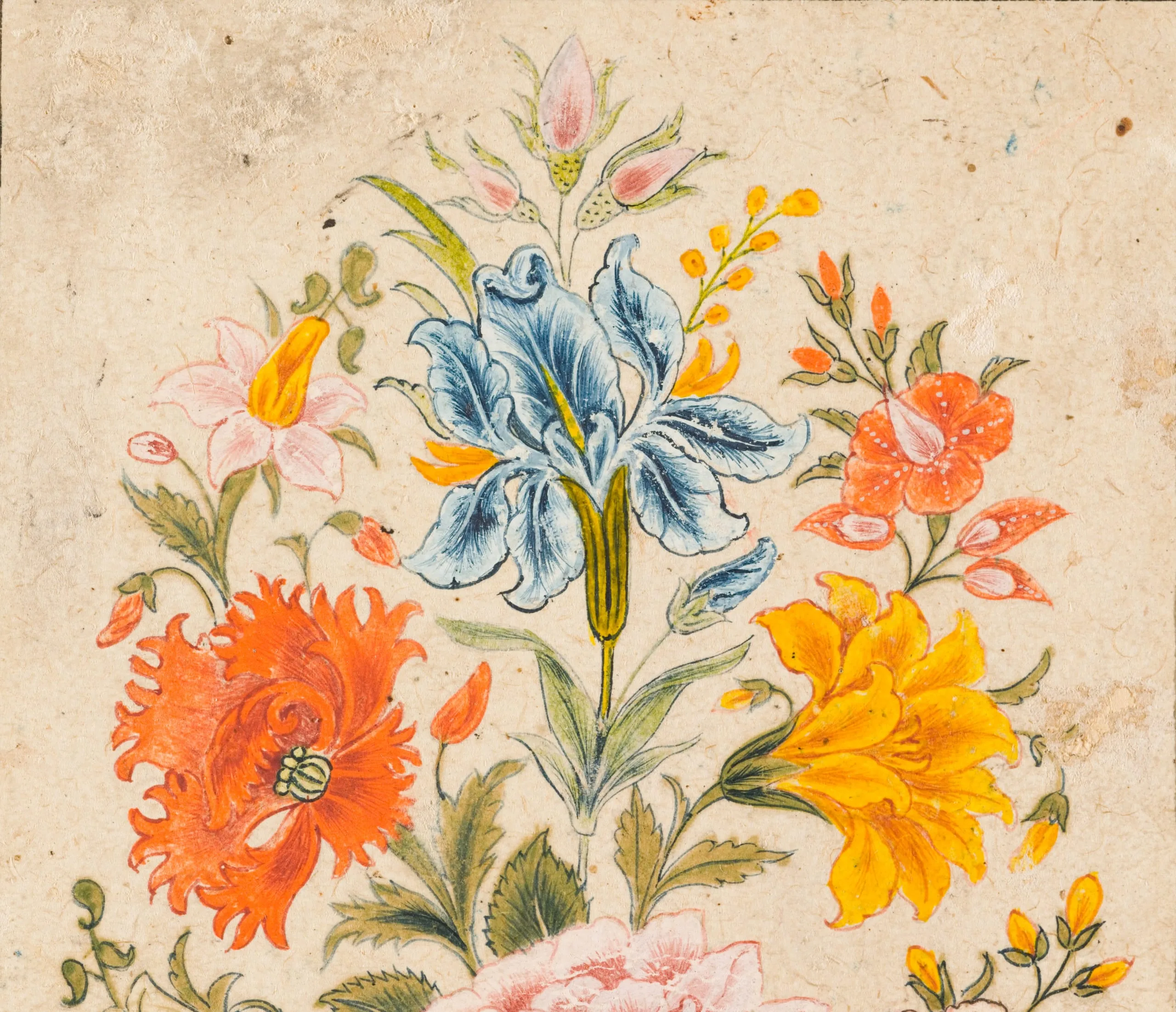
Opaque watercolor floral study on paper, depicting an iris, poppy, lily, and smaller blooms in blue, orange, yellow, and pink against a cream ground, with fine outlines and flat, decorative brushwork.
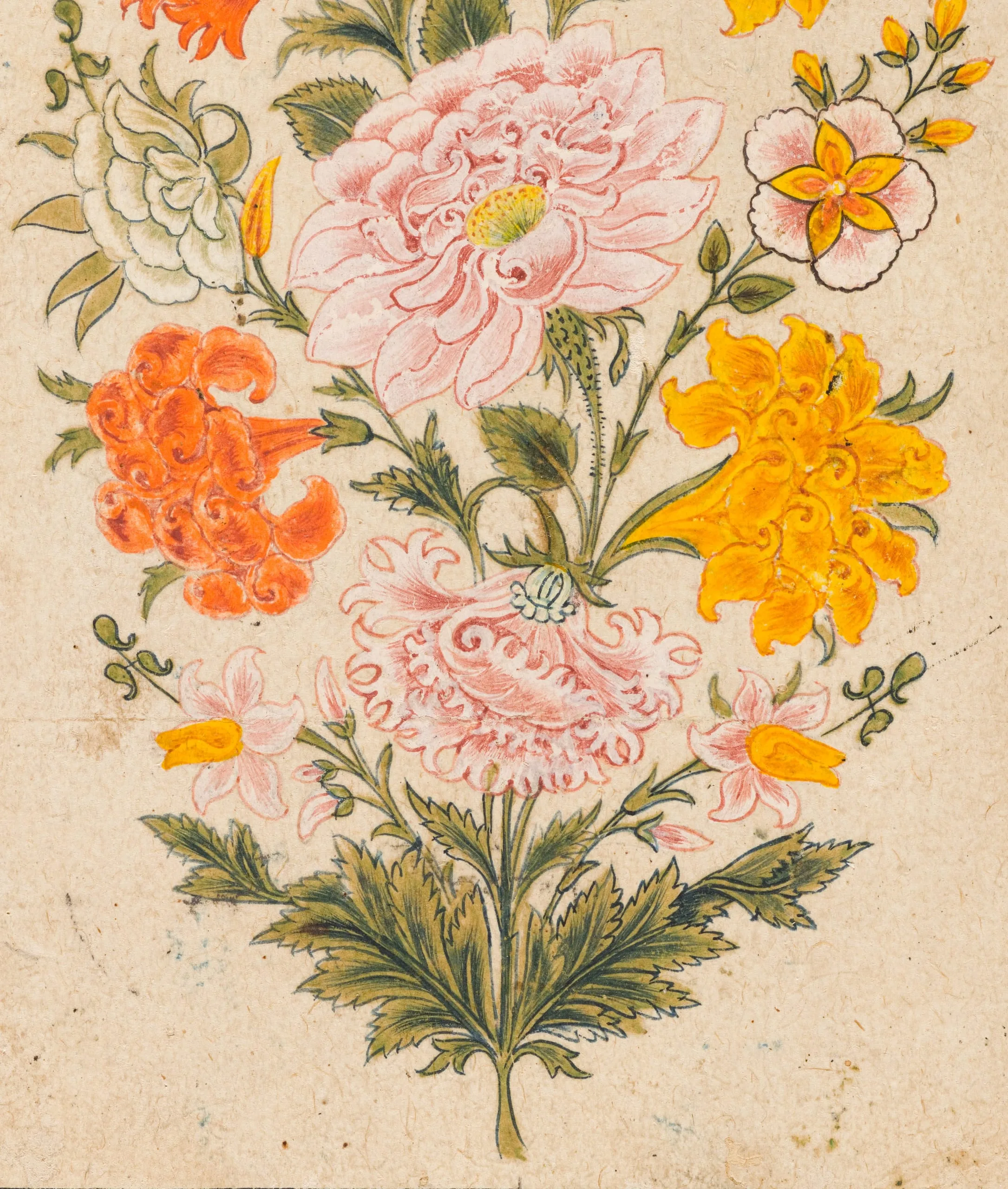
Opaque watercolor floral study on paper, a central bouquet of pink, orange, yellow, and white blooms with serrated green leaves, rendered with fine outlines and delicate shading on a cream ground.
Artist or Maker
Unknown
Title
Exotic Flowering Plant
Place Made
India, Deccan (?)
Date Made
circa 1650-1700
Medium
Opaque watercolor and gold on paper
Dimensions
Image: 6 3/4 x 4 1/8 in. (17.15 x 10.48 cm); Sheet: 11 1/4 x 7 3/8 in. (28.58 x 18.73 cm)
Credit Line
Gift of Jane Greenough Green in memory of Edward Pelton Green
Accession Number
AC1999.127.14
Classification
Drawings
Collecting Area
South and Southeast Asian Art
Curatorial Notes

Floral imagery is found in some of the earliest Mughal art and architecture, such as the exuberant flowering plants sculpted on the interior panels of the so-called House of the Turkish Sultana beside the Anup Talao tank at Fatehpur Sikri near Agra, which was built by the Mughal Emperor Akbar (r.1556-1605) in 1571-1585. During the reign of Emperor Jahangir (r. 1605-1627), the motif of naturalistic flowers formally arranged against a plain background first appeared in textiles and painting. The specific stylistic stimuli for Jahangir's flowers were twofold. First, the exposure of Jahangir and Mughal artists to the engravings and painted borders in northern European herbal books and religious manuscripts brought to India by early Western visitors to the Mughal court. Second, Jahangir’s awe-inspiring springtime visit to the lush, flower-filled valleys of Kashmir in March of 1620. By the early reign of Emperor Shah Jahan (r. 1628-1658), as epitomized on the Taj Mahal (1632-1643), the formalized flowering plant had become the Mughal dynastic leitmotif.

In the Deccan, however, more complex, hybrid, or imaginary flowers were popular, such as this exotic bouquet of sundry blossoms growing from a single stalk with assorted leaves. The flowers include a blue iris, poppy, carnation, trumpets, and daffodils. Deccani floral representations were typically intended for inclusion in albums and often feature perching birds or hovering insects.
Selected Bibliography
  • Markel, Stephen. Mughal and Early Modern Metalware from South Asia at LACMA: An Online Scholarly Catalogue. Los Angeles: Los Angeles County Museum of Art, 2020. https://archive.org/details/mughal-metalware (accessed September 7, 2021).
  • Desjardins, Tara. Mughal Glass: a History of Glassmaking in India. New Delhi: Roli Books, 2024.