- Title
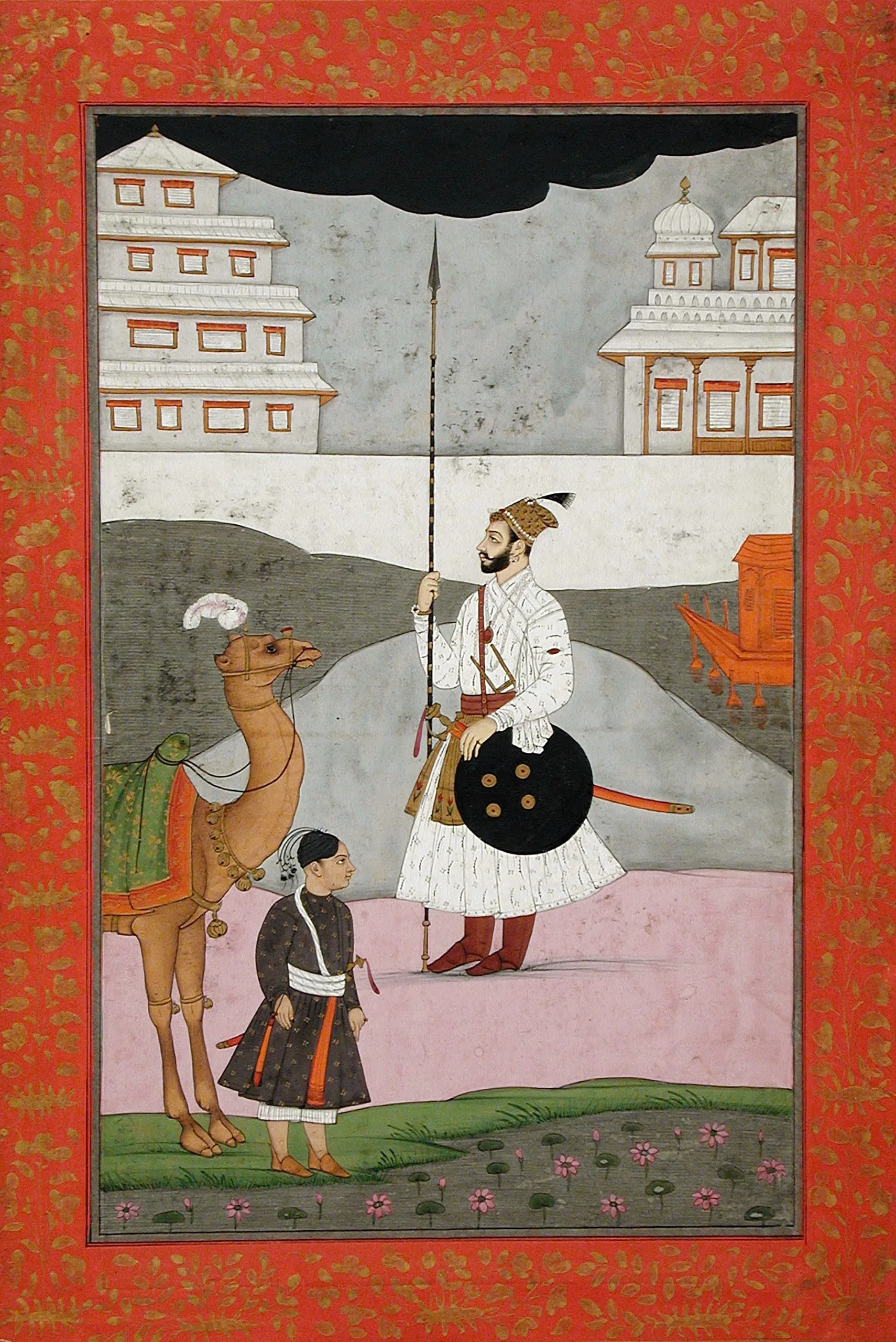
- Bhopali Ragini, Fifth Wife of Shri Raga, Folio from a Ragamala (Garland of Melodies)
- Date Made
- 18th century
- Medium
- Opaque watercolor, gold, and silver on paper
- Dimensions
- Sheet: 11 3/8 x 7 13/16 in. (28.89 x 19.844 cm); Image: 9 1/4 x 5 3/4 in. (23.5 x 14.61 cm)
- Accession Number
- AC1999.127.31
- Curatorial Notes
This painting likely represents the evening melody Bhopali Ragini, the Fifth Wife of Shri Raga. It has an identical composition as an inscribed rendition attributed to the Deccan, 18th century, published as in the Kankroli collection, Vadodara (formerly Baroda), Gujarat. The imagery used for Bhopali Ragini and several other melodies in this Deccani set of Ragamala paintings is unique, as in the Rajasthani artistic tradition it is generally envisioned as a man and a woman with the key iconographic feature of a flower garland being offered by the woman to the man or a female attendant. Klaus Ebeling offers a possible alternative identification of this scene as a portrait of the set’s patron. (Ragamala Painting, 1973, p. 212, no. 98.)
Here, the protagonist is a turbaned nobleman who can be presumed to be a Hindu because his white coat (jama) is tied on the left side according to custom. He stands holding a lance with a shield slung across his shoulder. He wears a sword suspended from his waistband and a punch dager (katar) tucked into it. A young male attendant waits with his master’s adorned camel. They are portrayed in a landscape with bodies of water and a houseboat. Two palatial structures are on the horizon. Dark clouds fill the upper sky.