- Title
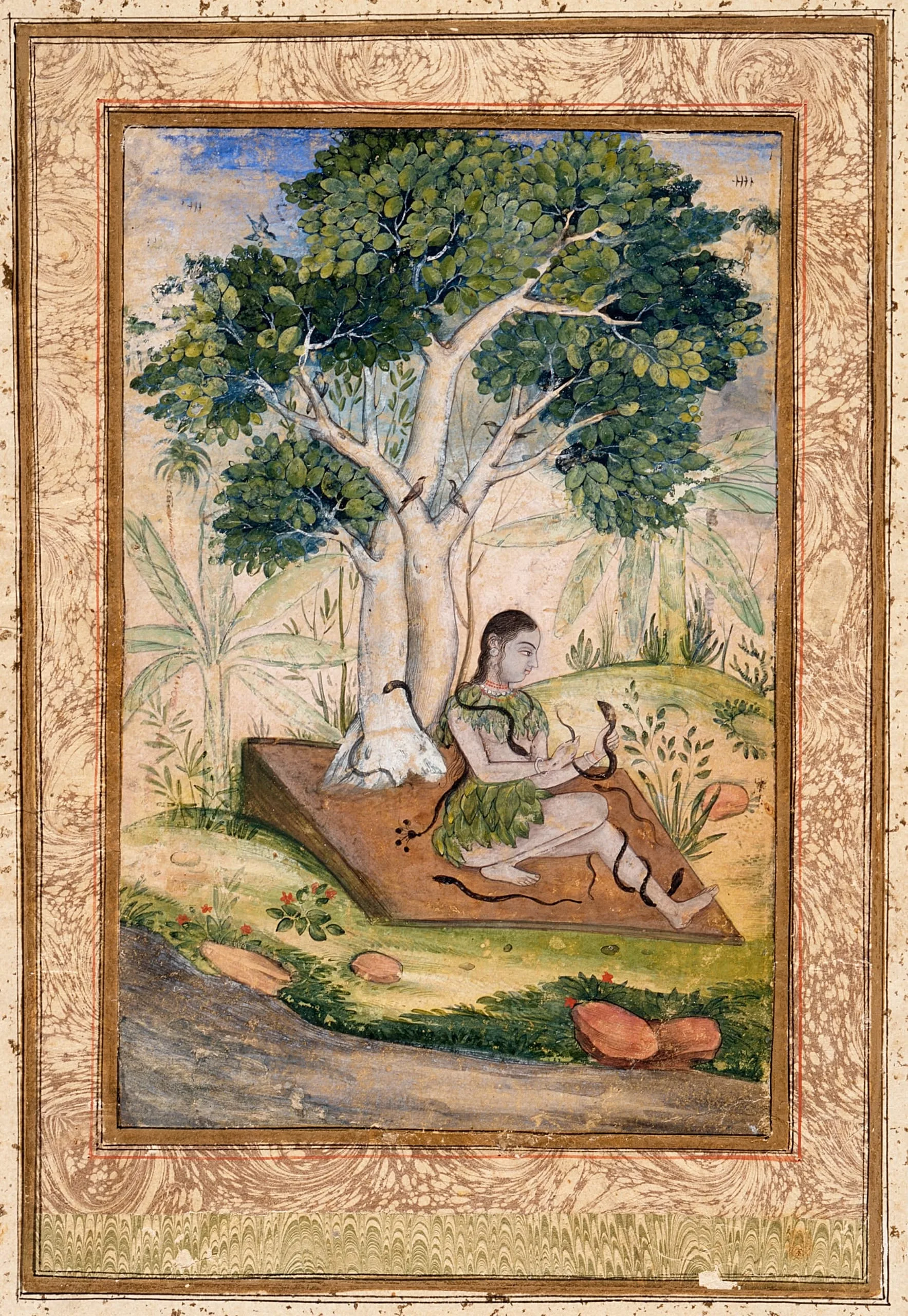
- Asavari Ragini, Fourth Wife of Shri Raga, Folio from a Ragamala (Garland of Melodies)
- Date Made
- circa 1625
- Medium
- Opaque watercolor and gold on paper; marbled paper inner border
- Dimensions
- Image: 7 1/8 x 4 5/8 in. (18.1 x 11.75 cm); Sheet: 9 1/2 x 7 1/8 in. (24.13 x 18.1 cm)
- Accession Number
- AC1999.127.29
- Curatorial Notes
Asavari Ragini is a somber melody of the early morning, generally considered to be a wife of Shri Raga. Indian name is taken from that of the Savaras, an ancient jungle tribe renowned for its snake-charming skills and from whose fluted melodies the ragini is said to derive. Paintings of Asavari Ragini display a consistent basic imagery with minor variations: a woman in the forest communing with cobras. The forest is traditionally identified as the snake-infested sandalwood groves of the Malaya mountains in Kerala. The woman is usually garbed in a leaf skirt; alternatively, she can be naked or dressed in aristocratic finery. The heroine displays a mastery over the serpents and interacts with them in several ways. She can be shown taming them by hand or through the use of a wind instrument, or instructing them by hand gestures or the movements of a small stick, usually shaped and brandished like an orchestra conductor’s wand. These movements of the stick, flute, or hands accord with the cultural belief that it is the hypnotic, serpentine movements of Indian snake-charmers’ flutes rather than their actual melodies that mesmerize cobras.
Here, a minimally adorned heroine sits in a forest of deciduous and plantain trees. She holds one cobra while others slither around her legs, tree trunk, and the wooden platform on which she sits. See also M.85.139.3, AC1999.127.28, and AC1999.127.30.
- Selected Bibliography
- Pal, Pratapaditya; Markel, Stephen; Leoshko, Janice. Pleasure Gardens of the Mind: Indian Paintings from the Jane Greenough Green Collection. Los Angeles County Museum of Art; Mapin Publishing Pvt. Ltd.: Los Angeles, 1993.