LACMA

ShopMembershipMyLACMATickets
LACMA
Los Angeles County Museum of Art
5905 Wilshire Blvd.
Los Angeles, CA 90036
info@lacma.org
(323) 857-6000
Sign up to receive emails
Subscribe
© Museum Associates 2025

Museum Hours

Monday

11 am–6 pm

Tuesday

11 am–6 pm

Wednesday

Closed

Thursday

11 am–6 pm

Friday

11 am–8 pm

Saturday

10 am–7 pm

Sunday

10 am–7 pm


  • About LACMA
  • Jobs
  • Building LACMA
  • Host An Event
  • Unframed
  • Press
  • FAQs
  • Log in to MyLACMA
  • Privacy Policy
© Museum Associates 2025
Collections

Unknown
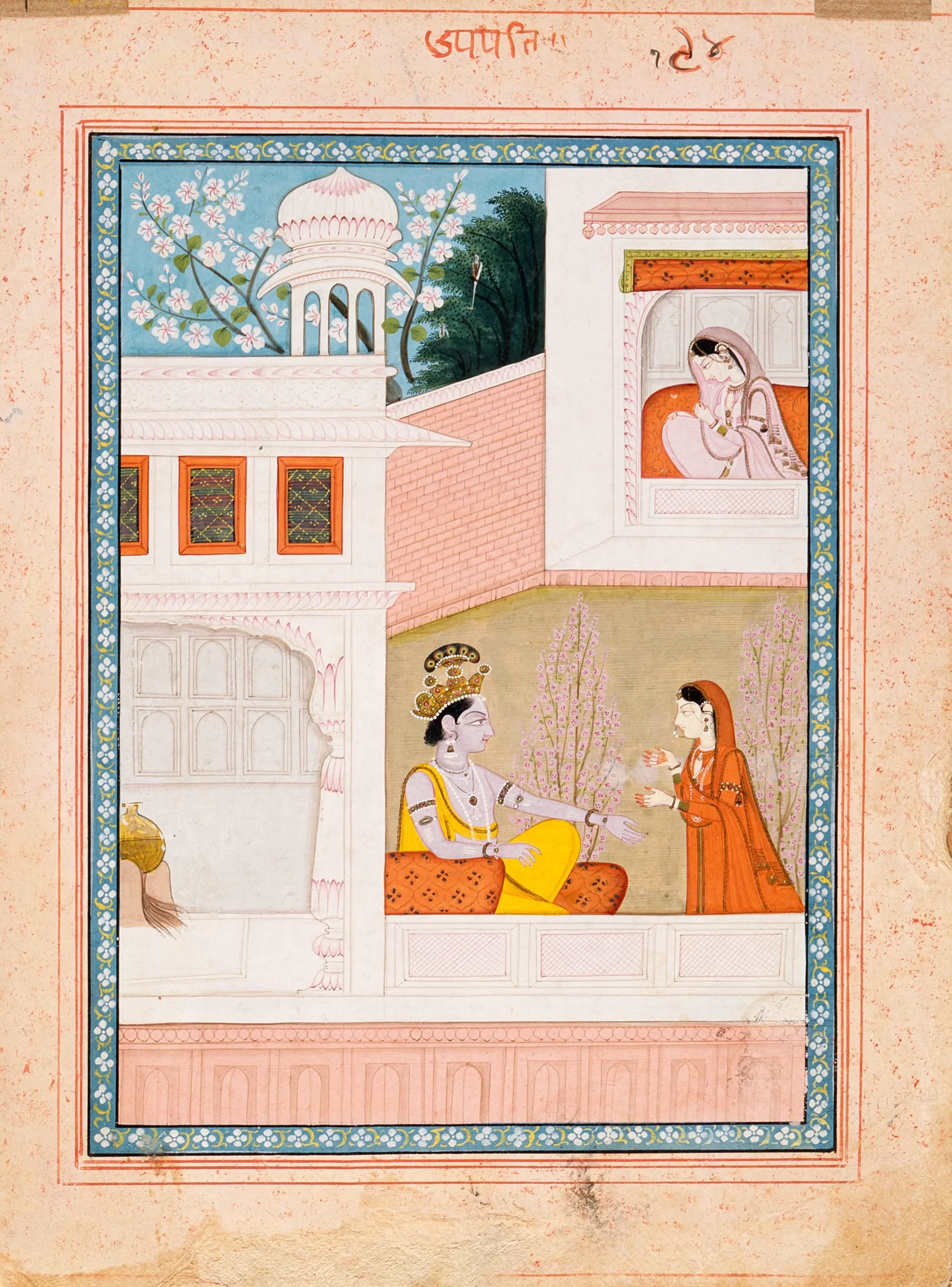
Krishna Talks to Radha's Maidservant, Folio from a Satsai (Seven Hundred Verses) of Bihari Lalcirca 1825

Not on view
Indian manuscript painting, blue-skinned crowned deity seated on a terrace conversing with a woman in orange, a second woman observing from a window above, with flowering trees and white architecture
Artist or Maker
Unknown
Title
Krishna Talks to Radha's Maidservant, Folio from a Satsai (Seven Hundred Verses) of Bihari Lal
Place Made
India, Himachal Pradesh, Kangra
Date Made
circa 1825
Period
19th century
Medium
Opaque watercolor, gold, and ink on paper
Dimensions
Image: 8 1/4 x 5 7/8 in. (20.95 x 14.92 cm); Sheet: 11 1/8 x 8 1/4 in. (28.25 x 20.95 cm)
Credit Line
Gift of Jane Greenough Green in memory of Edward Pelton Green
Accession Number
AC1999.127.5
Classification
Drawings
Collecting Area
South and Southeast Asian Art
Curatorial Notes
This painting illustrates a passage from the Satsai (Seven Hundred [Verses]), one of the four great jewels of Hindi literature. The standard Satsai is an anthology of 713 poetic verses, but numerous manuscripts vary in verse number and content. The poem primarily celebrates of the romance of Radha and Krishna, and also describes male lovers (nayakas) and female lovers (nayikas), and the romantic sentiments associated with the six seasons of the Indian climate. It was written in “Braj-Bhasha,” a dialect of Hindi, by Bihari Lal Chaube (1595–1664), who was born in Govindpur, near Gwalior in Madhya Pradesh, and later lived in Mathura, the home of Krishna. Bihari Lal subsequently worked at the court of Amber under Jai Singh I (r. 1625–67), for whom the Satsai was reportedly composed in 1662. Illustrations of the Satsai were popular in Pahari painting, especially in Kangra during the reign of Sansar Chand (r. 1775–1823), under whose patronage this work was produced.

Here, while Radha waits anxiously in her bedchamber in the upper right corner, in the palace courtyard near the kitchen her handmaid (sakhi) delivers an imploring message to Krishna on her behalf. A label in the border identifies the scene as Upapati (Paramour) 194 and an inscription on the back of the painting states, “having entangled her eyes with mine and [coyly] turning her face, she smiled and expressed her love a little; thus having come to fetch fire, she set fire in my heart.” (Translated by Naval Krishna.)
Selected Bibliography
  • Pal, Pratapaditya; Markel, Stephen; Leoshko, Janice. Pleasure Gardens of the Mind: Indian Paintings from the Jane Greenough Green Collection. Los Angeles County Museum of Art; Mapin Publishing Pvt. Ltd.: Los Angeles, 1993.