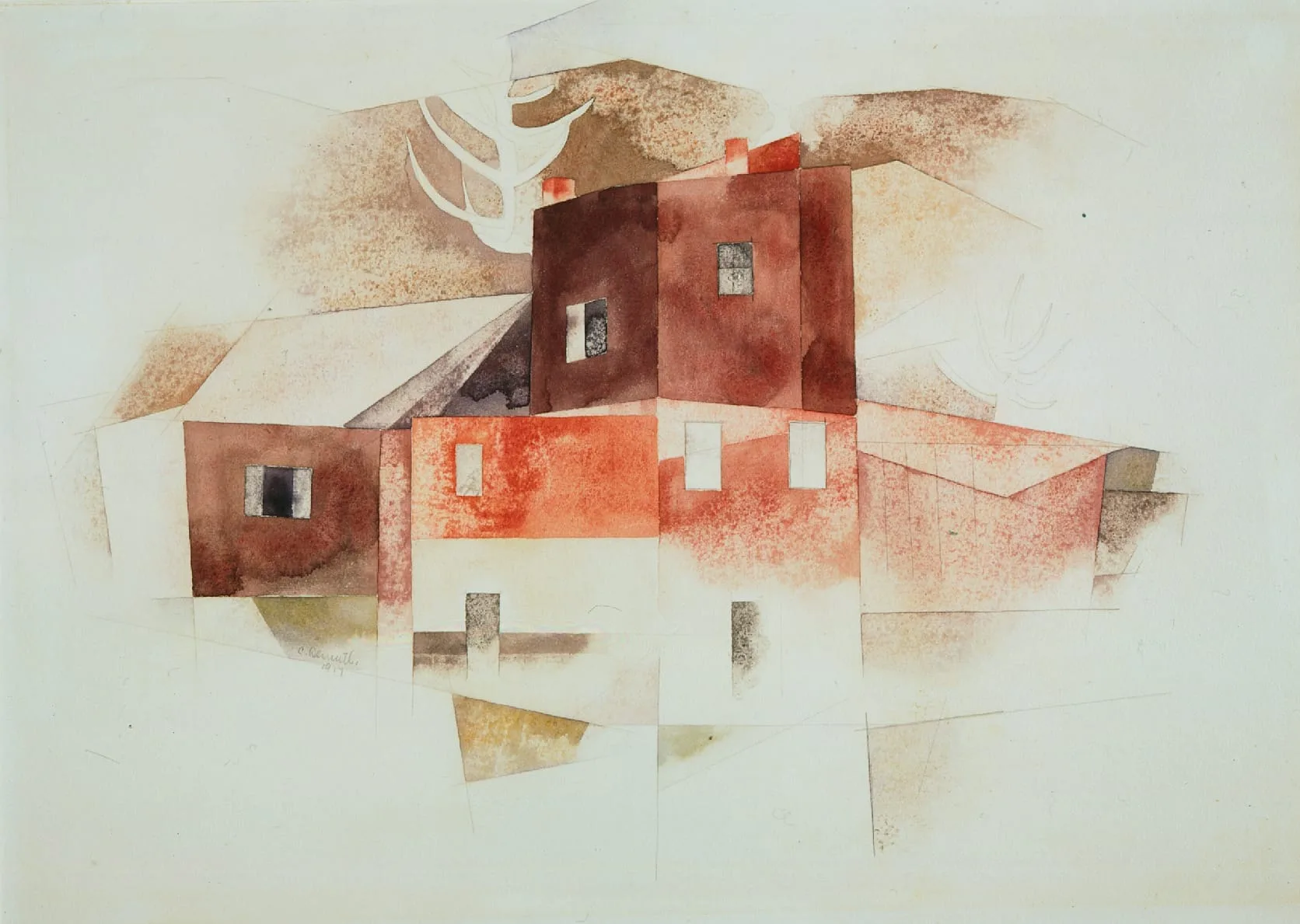
In the autumn of 1916 Demuth joined Marsden Hartley in Bermuda and while there produced a group of cubist watercolors that marked a crucial change in his work as he moved closer toward an intellectual, abstract art. Demuth had had ample opportunity to become acquainted with cubism during his stay in Paris and as a member of the Arensberg circle in New York. Moreover, the second-generation cubist Albert Gleizes (1881-1953) was in Bermuda during Demuth’s visit there. While on the island Demuth painted landscapes and the picturesque buildings in the town of Saint George. A classic example of Demuth’s Bermuda landscapes, Old Houses features the tower structure often included in the center of these paintings. Perhaps following the example of early cubist landscapes by Pablo Picasso (1881-1973) and Georges Braque (1882-1963), Demuth presents the buildings as a cluster of geometric shapes with nature limited to a few trees and the distant mountains represented by diagonals.
In the Bermuda watercolors Demuth for the first time controlled his previously rhythmic line, limited his forms to geometric shapes, and faceted objects into overlapping planes and directional lines. The landscape becomes a carefully composed arrangement of prismatic light and darker geometric areas. His new classicism of line and image usually is accompanied by a soft, hushed palette. Old Houses is more vivid than other Bermuda watercolors, its color restricted to earth tones with a strong orange rectangle in the center. Demuth took advantage of the white of the paper by allowing the colored planes to fade into the background and blotted the watercolor to achieve a mottled effect.
The Bermuda series resembles the late landscape watercolors of Paul Cézanne (1839-1906), whose work Demuth could easily have seen in New York or Paris. Cézanne also allowed the white of the paper to show through delicately applied, pale colors. Both artists shared a concern for abstract form, which may have determined their controlled approaches. Demuth, however, more actively manipulated the paper surface by contrasting not only light and dark planes but also textured and smooth surfaces.