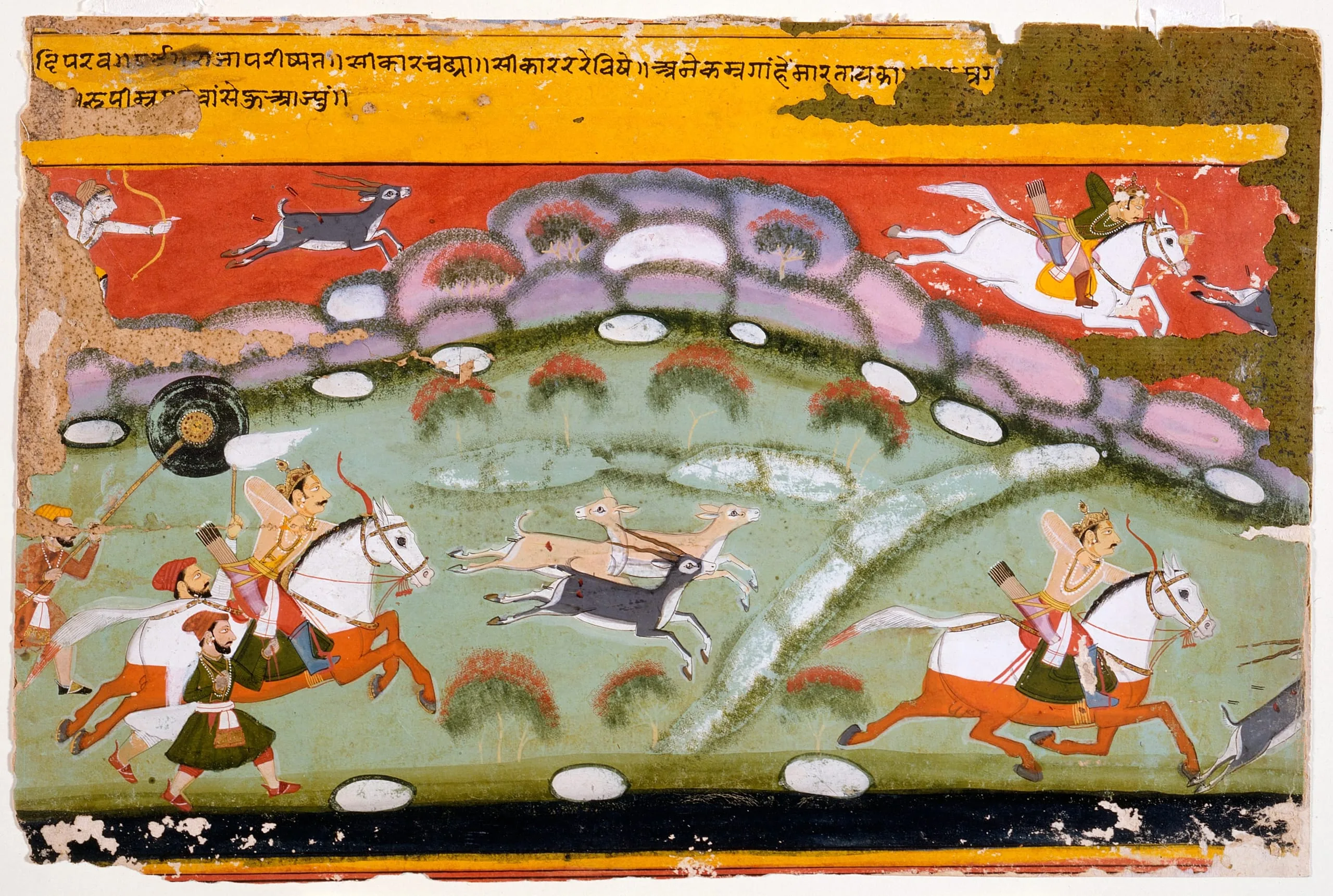
The Mahabharata ([War of the] Great Bharatas) recounts the struggle between two powerful branches of a ruling family descended from the legendary King Bharata, the Pandavas and the Kauravas, for the control of the Kuru Kingdom in northwestern India. It is traditionally believed to have been composed by the sage Vyasa between the 3rd century BCE and the 3rd century CE.
Among its many tales is that of Raja Parikshit, ruler of the Kuru Kingdom (circa 1200-900 BCE). He succeeded his grand uncle Yudhishthira, the eldest Pandava brother. According to the fragmentary devanagari inscription in the header, the illustration depicts an episode in Book 1 (Adi parva). Parikshit, who was renowned as a great archer, enjoyed hunting deer and other wild beasts. One day he shot a deer that fled wounded into the jungle. Parikshit pursued it until he came upon the hermit Samika, who had taken a vow of silence and would not respond when the king asked if he had seen the deer. Enraged, Parikshit draped a dead snake around the hermit’s neck and returned to his capital of Hastinapur, located near old Delhi. When the hermit’s son heard about Parikshit’s insult to his father, he cursed the king. Soon thereafter, Parikshit was bitten by a serpent and died (Mahabharata 1:5:36-40). Here, Parikshit is depicted hunting deer twice in continuous narration.
This folio is from a dispersed Mahabharata of over 3100 illustrations, most of which are in the Government Museum, Udaipur.