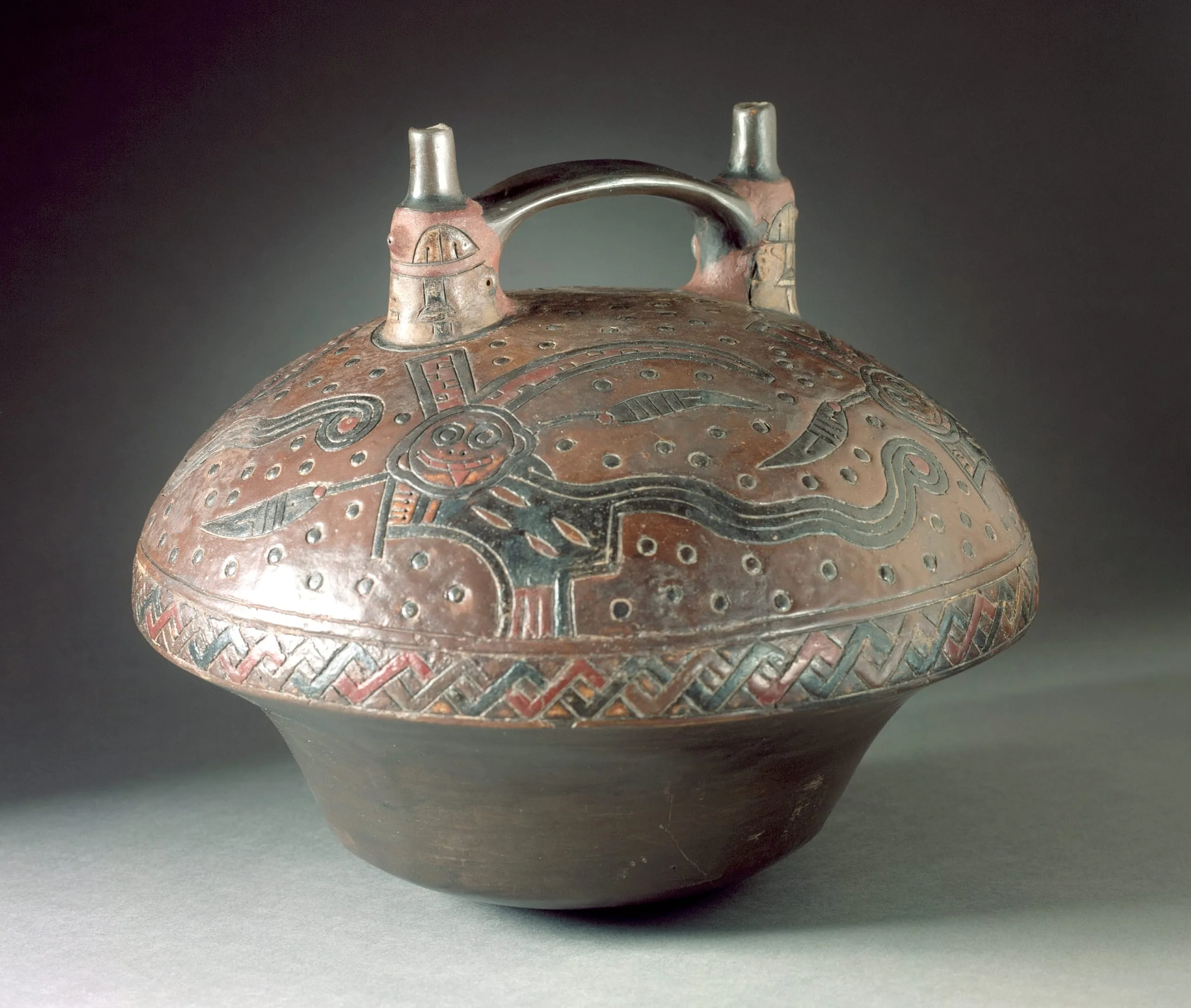
This vessel was created in the distinctive Paracas ceramic style. The outlines of the design were incised into the clay before firing, while colors were applied after the ceramic had been fired. The upper half is decorated with four identical mythical beings that seem to leap after one another. Their bodies, rendered in profile, might be those of felines or monkeys with long, exaggerated tails. Their heads, turned to face us, have grinning mouths with triangular tongues and large, circular eyes. Large appendages emanate from their heads and necks, some of which might represent seeds, a motif also seen on later Nasca iconography and generally thought to represent fertility and abundance. The remaining space is filled with small circles, tempting to interpret as a starry sky. The two spouts, joined by a so-called bridge handle, were modeled and incised to represent heads, which could imply that the rest of the scene appears on their clothing (tunics). Perhaps the entire vessel depicts a mummy bundle wrapped in layers and layers of cloth, as was typical of Paracas burials.
Smiling beings with protruding tongues and large, circular eyes are common in Paracas iconography, mostly on what appear to be mythological beings or beings in transformation, sometimes called the Paracas Oculate Being. The wide eyes are thought to represent the physical effects of consuming psychotropic / hallucinogenic substances, which were and are widely used by Indigenous ritual specialists or shamans in South America.
Paracas artists developed a distinctive technology of postfire paints, blending mixtures of binder with organic and mineral pigments. Chemical analyses of the pigments on this vessel have not been carried out, but based on studies of other pieces, we can assume that some of the same colorants were used: cinnabar for red (later replaced by red ochre and various iron oxides), copper-based minerals like atacamite and malachite for greens and grays, and arsenic sulphite pararealgar for yellow. (Indigo appears as a blue colorant in late Paracas ceramics.) Uniquely, the white pigments on some Paracas ceramics seem to have been derived from reptile excrement and urine.
The composition of the binder is less clear but certainly involved a complex process of acquiring, selecting, and mixing of different substances. A main component has been identified as tree resin; the species is unknown but could have been a product that was brought in by long-distance exchange.
Postfire pigments are susceptible to heat and water damage and thus not suitable for everyday use in domestic activities such as cooking. Items decorated with this technique must have been reserved for special uses, likely ritual and definitely funerary, as many such items have been found in tombs.
Julia Burtensaw
2025
Selected Bibliography
Kriss, D., et al. “A Material and Technical Study of Paracas Painted Ceramics.” Antiquity 92 (2016): 1492−1510.