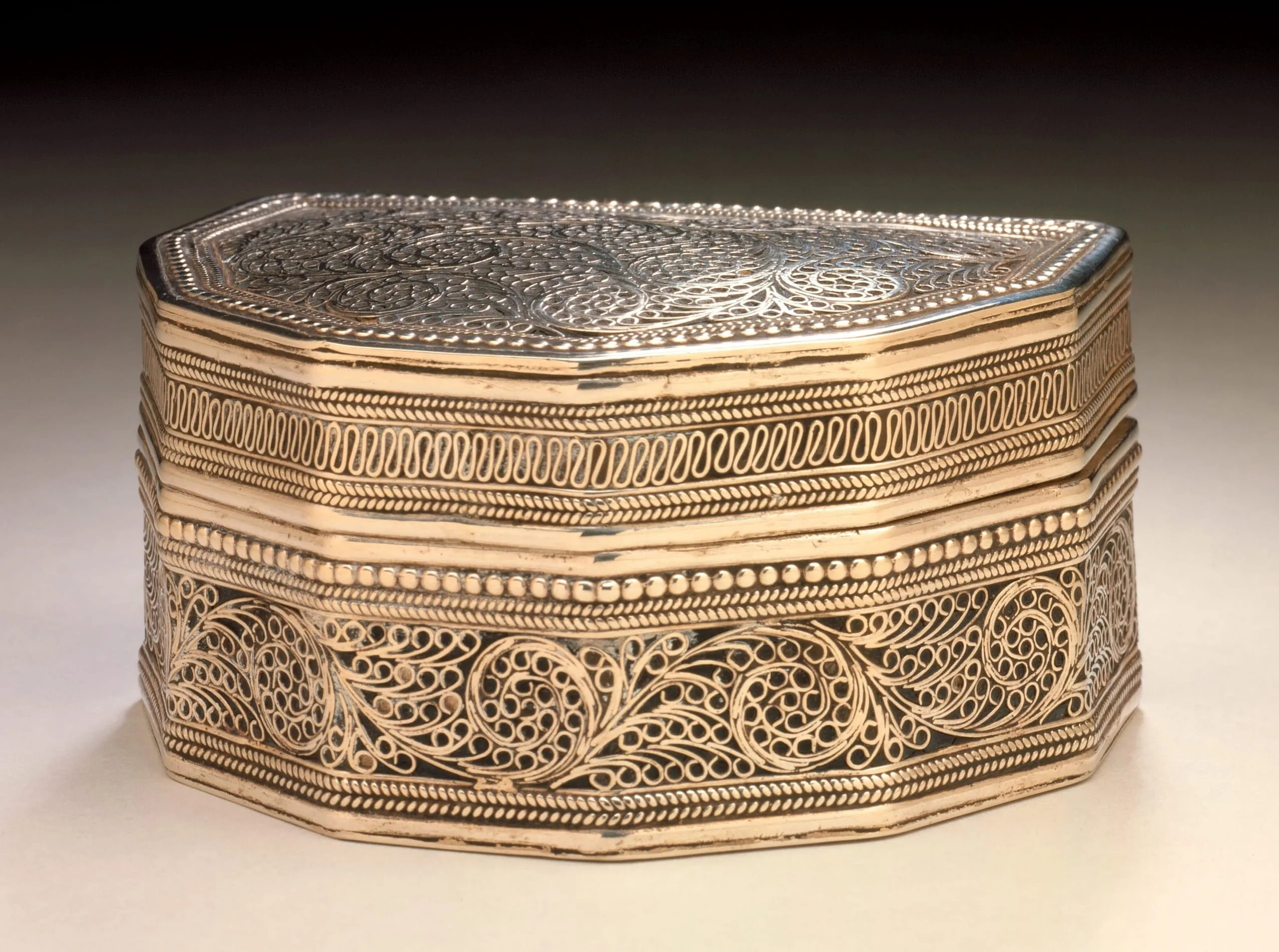
This laboriously crafted Box for Lime Paste is fashioned in the form of an eight-sided polygon. It was originally part of a set of spice boxes and other small containers with matching decoration arranged modularly on a serving tray. Sets such as this were used to prepare and offer betel nut (pan) to honored guests. Pan is a ceremonial amenity and digestif made of cut betel nut, mineral lime powder or paste, sundry spices, and sometimes tobacco and even gold or silver foil, all wrapped in a betel leaf (Piper betle). That this particular box was used for storing lime paste (chunam) is discernible by the white corrosion from the mineral lime on its interior.
Filigree work is a protracted process of making fine silver or gold wire by pulling it through a drawplate to the desired diameter, then positioning and soldering it into intricate foliate and geometric designs set within a framework of borders for stability. It was produced in only a few of the major regional metalworking centers in South Asia, principally in Karimnagar, Telangana (formerly part of Andhra Pradesh, in the Deccan); Cuttack, Odisha (formerly called Orissa, in eastern India); Dacca (formerly called Dhaka), Bangladesh; Chennai (formerly called Madras), Tamil Nadu (in southern India); and in the Kathmandu Valley, Nepal. The decorative program featured here consists primarily of lush scrolling leaves on the top and around the lower sides. They are framed by repeating plain, bead, and cable borders.