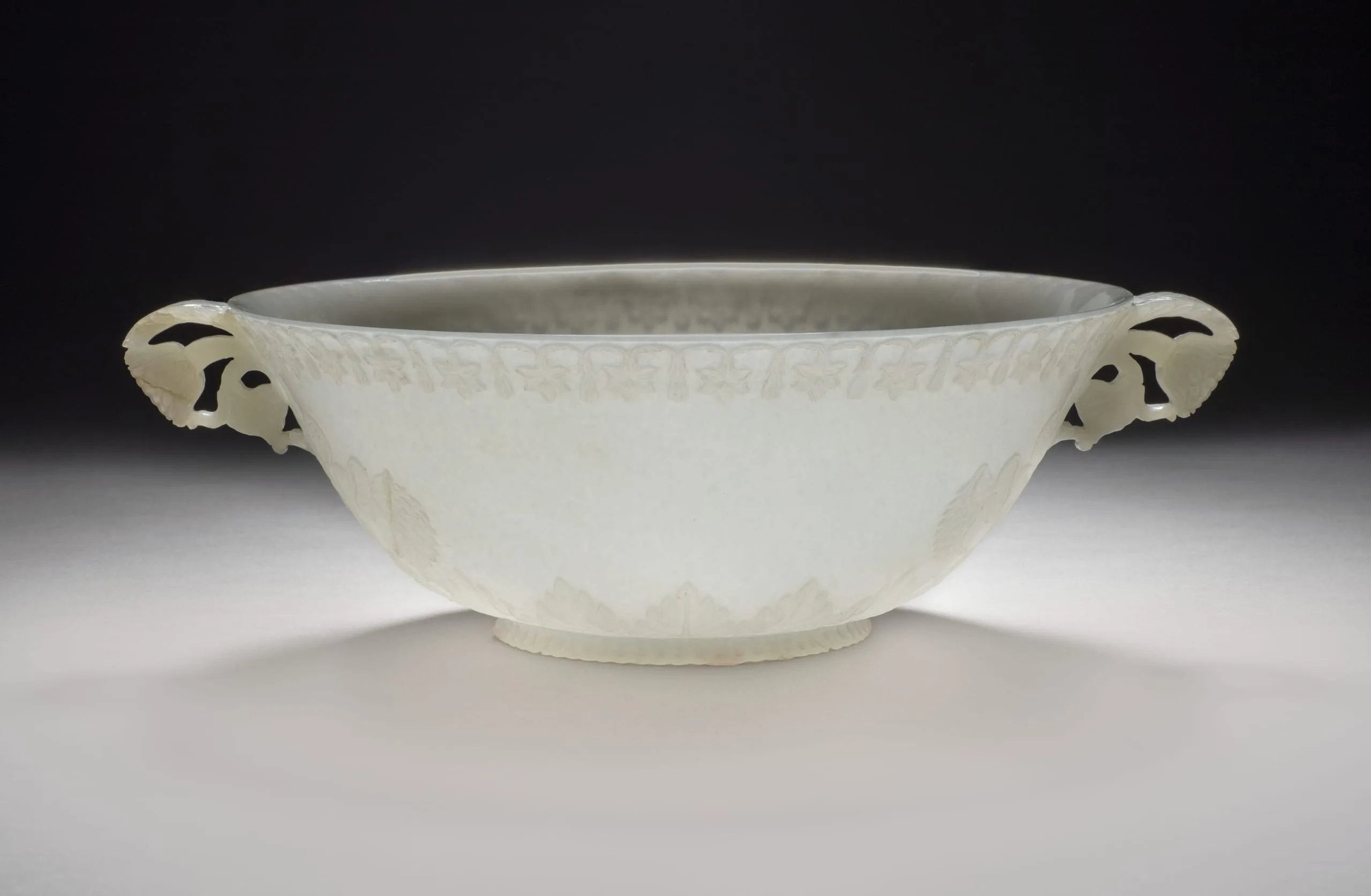
This subtly ornamented bowl made of white nephrite jade is crisply carved, technically abraded, with strong attention paid to symmetry. Its eclectic design program epitomizes the Mughals acculturative genius in harmonizing international artistic influences. The projecting handles, reminiscent of Chinese jade work, are actually clever three-dimensional continuations of the burgeoning poppy plants subtly depicted in low relief on the exterior sides of the bowl. The thin vessel walls are translucent, which dramatically enhances the poppies when they are viewed by transmitted light passing through the bowl. The slightly flaring rim is ringed with a border composed of alternating pendant lily blossoms and buds. A series of acanthus leaves inspired by European imagery articulate the bottom exterior edge of the bowl. The underside of the low foot is decorated with a Chinese chrysanthemum with overlapping petals in a radial design.
By the second half of the 18th century the popularity of Mughal jades had expanded well beyond the territorial boundaries of the Mughal Empire, especially to Ottoman Turkey, Central Asia, and China. They were most directly emulated by a class of Chinese jades made in the so-called ‘Mughal style’ with Mughal stylistic features assimilated and further evolved by the Chinese lapidarists, particularly the early reuse of Indian floral motifs, shallow relief decoration, pierced floral handles, and extreme thinness of the vessel walls. The Qianlong Emperor (r. 1735-96) regarded the almost egg-shell thinness of jades from Mughal India, known to him as Hindustan, as technically superior to contemporary Chinese ones. Chinese Mughal-style jades can be difficult to distinguish from genuine Mughal examples, but a detailed comparison of their formal design features, decorative motifs, figural style, and religious iconography with earlier Chinese jade and metalware traditions may aid in revealing their true origin.
See Stephen Markel, "Carved Jades of the Mughal Period," Arts of Asia 17:6 (November-December 1987): pp. 125-126, fig. 88.