Image
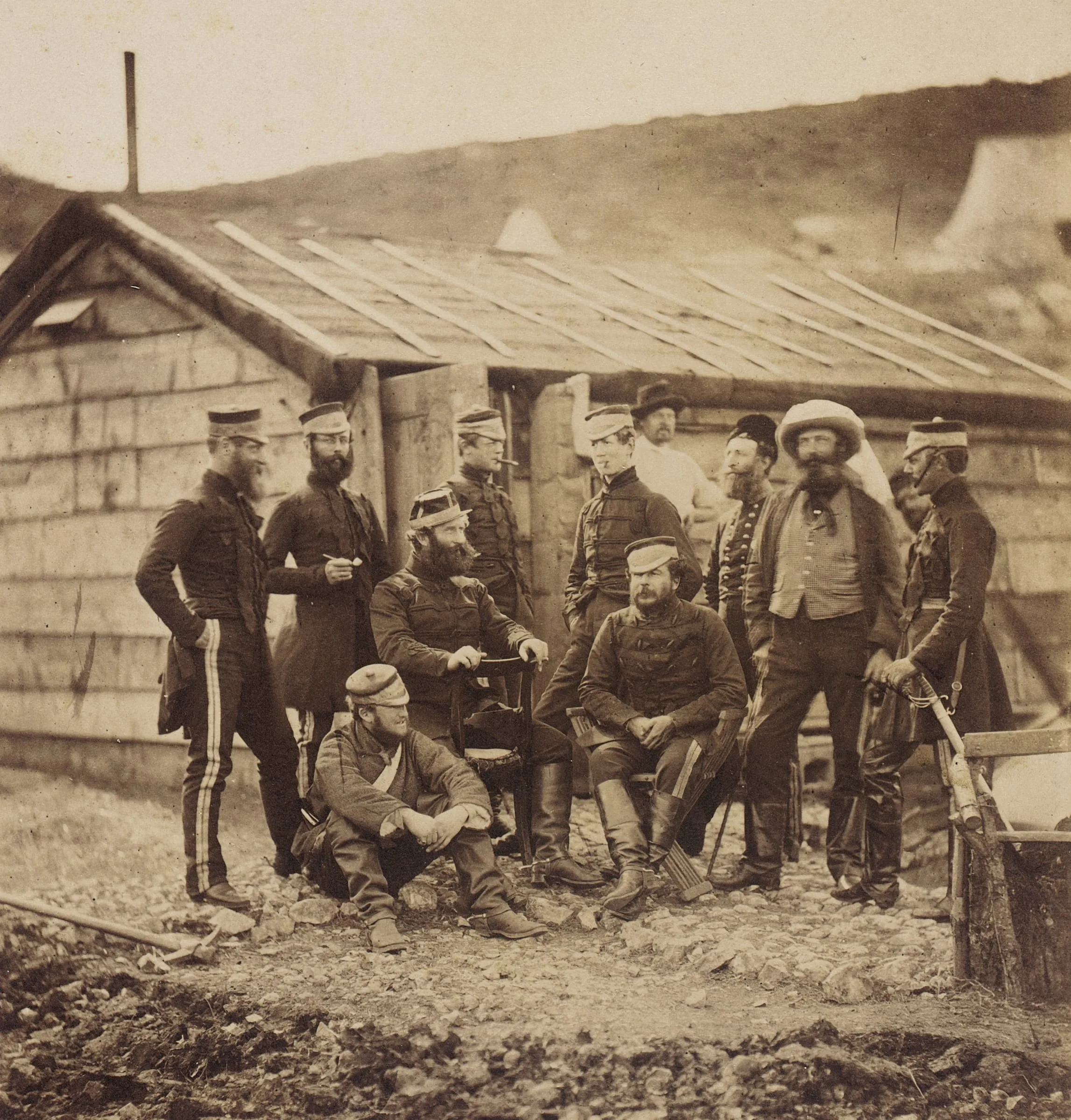
A group of officers is posed for the camera. The figures are carefully arranged to allow the viewer to see each figure, with the angles of their bodies and gazes turned to the center of the image. Two figures look into the camera while the rest fix their eyes on a horizon. The fine detail of the glass-plate negative is blurred where there is motion. Because the negative couldn't be adjusted to capture both the land and the light-filled sky, the blank gray sky is overexposed.
Technique
Roger Fenton traveled to the front lines in the Crimea in March 1855 prepared to use the complicated collodion on glass photographic process, which required precision and speed in order to capture and retain detailed images. (For more on the collodion process, see the Alinari Brothers' Campanile, Pisa.) He contact-printed on albumen paper, which had recently been invented. (For more on albumen paper, see Alfred Capel-Cure's St. Ouen, Rouen.)
Fenton went to the Crimea in a vehicle rigged for darkroom work, cooking, and sleeping; the words "Photographic van" were painted on its sides. Fenton's equipment included five cameras, seven hundred glass plates, chemicals, darkroom equipment, a tent, tools, and tinned food. The conditions were formidable, and the heat, dust, and flies made preparing, using, and processing materials difficult. The hot climate raised the temperature of the developing solution so much that he scalded his hands while working. In the summer, he took photographs at 4 am to avoid the glare and heat of the sun.
Context
Roger Fenton is often thought of as the first war photographer. The four months he spent documenting the Crimean War (1853—56) in 1855 created a new language for depicting war, which until then the British had seen represented historically and heroically in paintings. Viewers deemed Fenton's prints to be the most realistic portrayals of war, a belief in an inherent representational truth in photographs that still exists today.
Fenton, a former painter who had been an early experimenter with photography, was charged by his political and financial supporters (including the British government) to create positive depictions of an unpopular war. He avoided photographing the human consequences and hardship of battle. The limitations of the materials, such as the long exposure times, in addition to the morale-boosting expectations of his backers, did not allow him to capture battlefield action.
Despite the Crimea's difficult climate and his own injury and illness, Fenton made more than 350 negatives, photographing officers in full dress uniform, staff at headquarters, and pashas (nobles) and their attendants, groupings that were meant to give an idea of camp life. He also photographed ships in the harbor, mortar batteries, and battlefield landscapes, which would become standard in this genre.