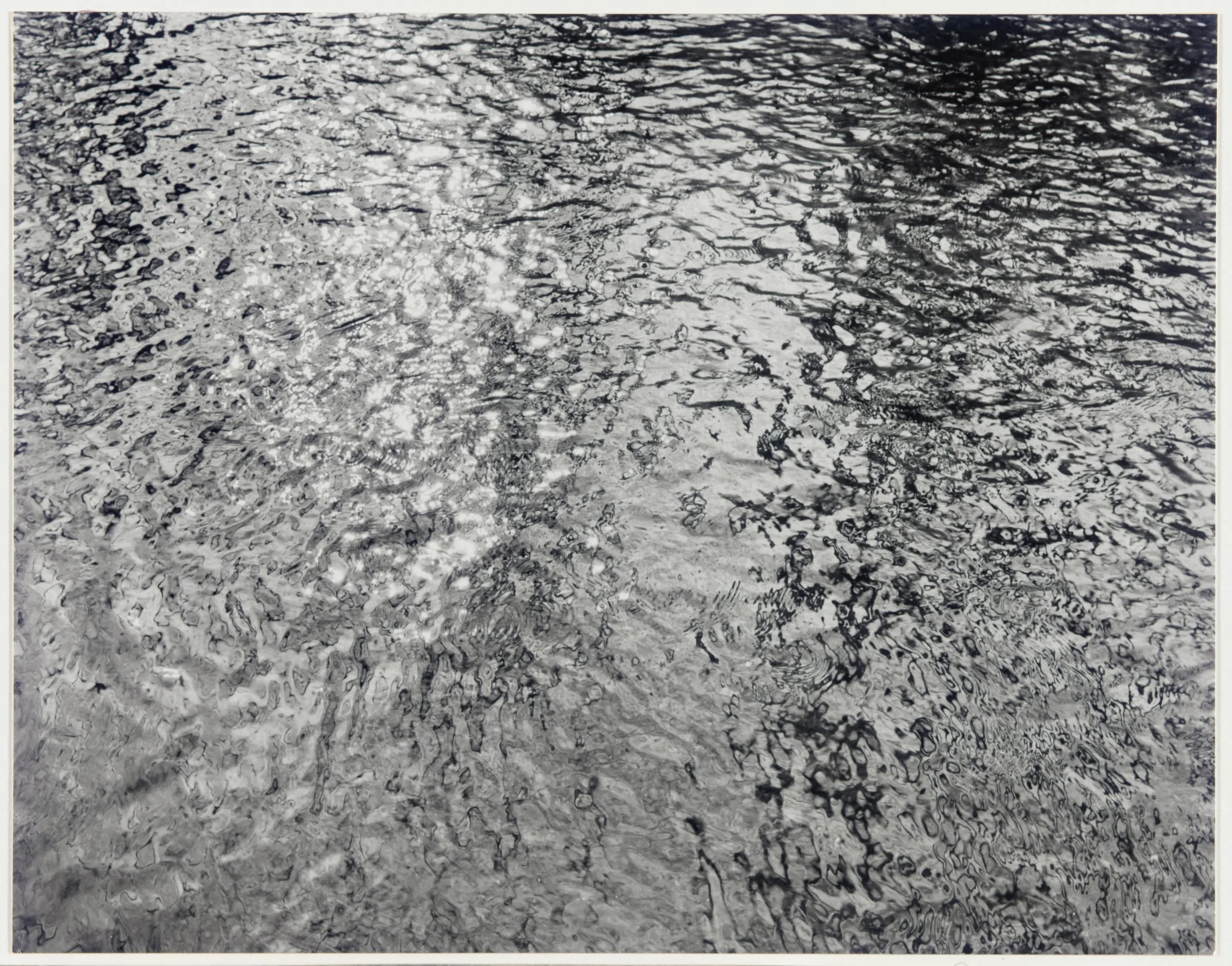
Paul Caponigro’s work is based on equal measures of spiritual awareness, music, and photography. Although he may photographically render a subject in the world, it is not a documentary image but rather a summation of his emotional response to the scene. Technique is put to the service of realizing a spiritually charged image. This approach leaves open the possibility of a metaphoric interpretation by the viewer. Redding, Connecticut is specific in its titling, but the image is a complex pattern of rippling tones across the water. The eye is led on a playful journey in which the mind can travel an unprescribed path.
Born in Boston in 1932, Caponigro studied piano before apprenticing in a commercial photography studio. It was with a musician’s sensibility that he began to approach art making, stating “photography, like music, must be born in the unmanifest world of spirit.” For him, the creative worlds of music and photography nurtured each other. In 1952, he was drafted into the army and stationed at the Presidio in San Francisco, where he worked in the photo lab with artist Benjamen Chinn. Chinn introduced Caponigro to the work of Minor White and Ansel Adams, including the latter’s method of determining the tones of a photograph through the Zone System. Pursuing his personal vision, Caponigro traveled between San Francisco and Boston, and later to Rochester, where he began serious study with White, whom he assisted in his West Coast workshops. Their shared interest in combining photography and the spiritual led to visually ambiguous, abstract images that activate free associations. Another important influence was Ilona Karasz (wife of improvisational pianist Willem Nyland), with whom he studied drawing, and together they explored the question, “Where do images come from?”
Rebecca Morse
2024
Bibliography
Fulton, Marianne. The Wise Silence: Photographs by Paul Caponigro. New York: New York Graphic Society Books, 1983.