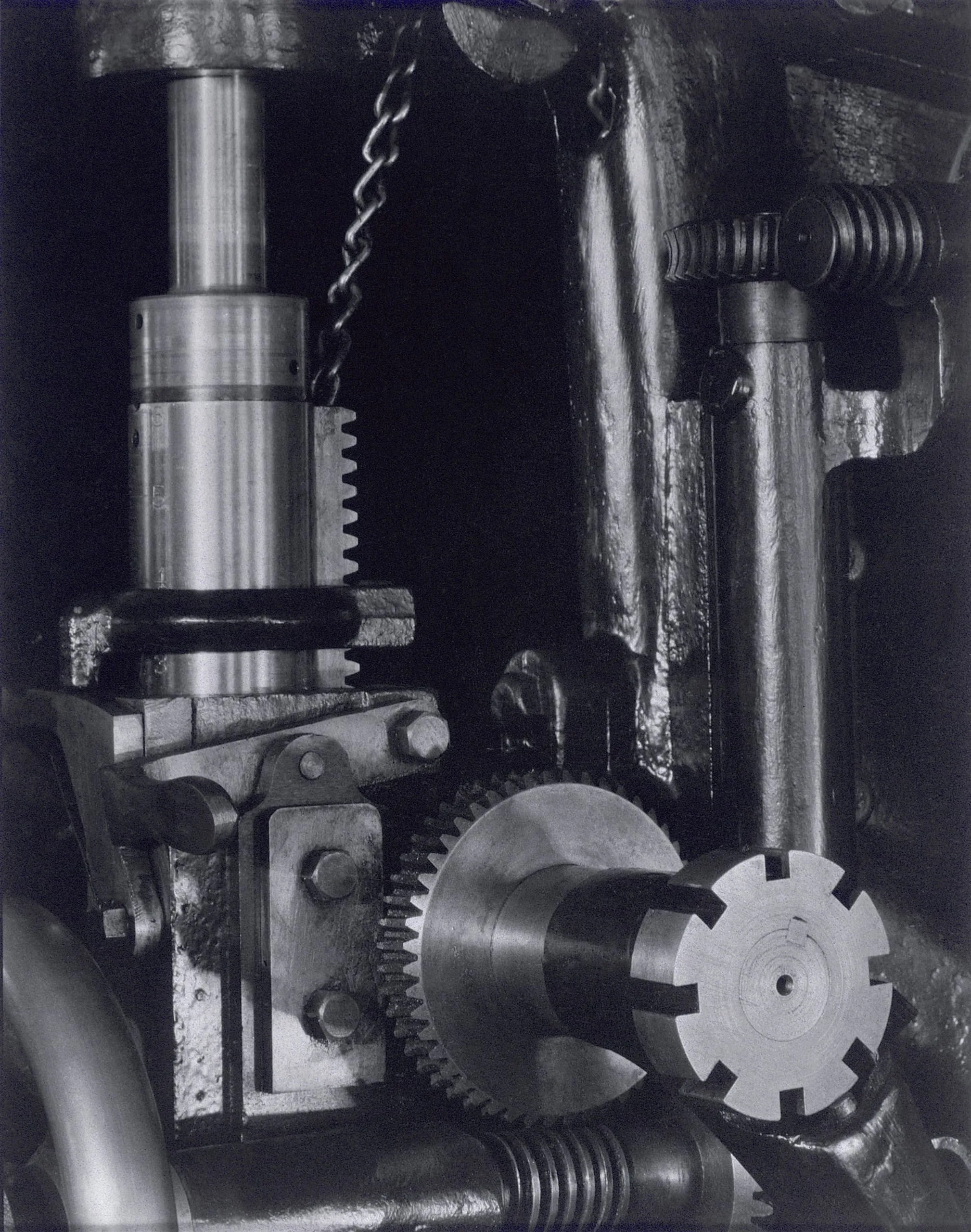
Paul Strand’s close-up photographs of machines, created in the early 1920s, are assertive works that highlight his ability to merge art and industry through the lens of modernist photography. Akeley Machine Shop, New York, for example, focuses on the intricate details and geometric forms of an industrial object, transforming it into a striking composition of line, shape, texture, and light. Strand had a particular interest in this machine shop, located at 244–250 West 49th Street in New York City: he had acquired an Akeley Motion Picture Camera in 1922. In the subsequent year or so, he made several photographs of the camera’s interior and of the shop’s equipment. By isolating the parts of this lathe and emphasizing their abstract qualities, Strand celebrated the beauty of mechanical design while exploring themes of progress and modernity.
Strand’s approach was influenced by his belief in “straight photography,” in which clarity, precision, and the intrinsic qualities of the subject take precedence. In these works, he rejected Pictorialist manipulation and soft focus, instead using sharp detail and high contrast to create images that are both documentary and artistic. His close-ups of machines capture the spirit of the Machine Age, reflecting the cultural fascination with technology and its role in shaping the modern world.
Britt Salvesen
2024