Image
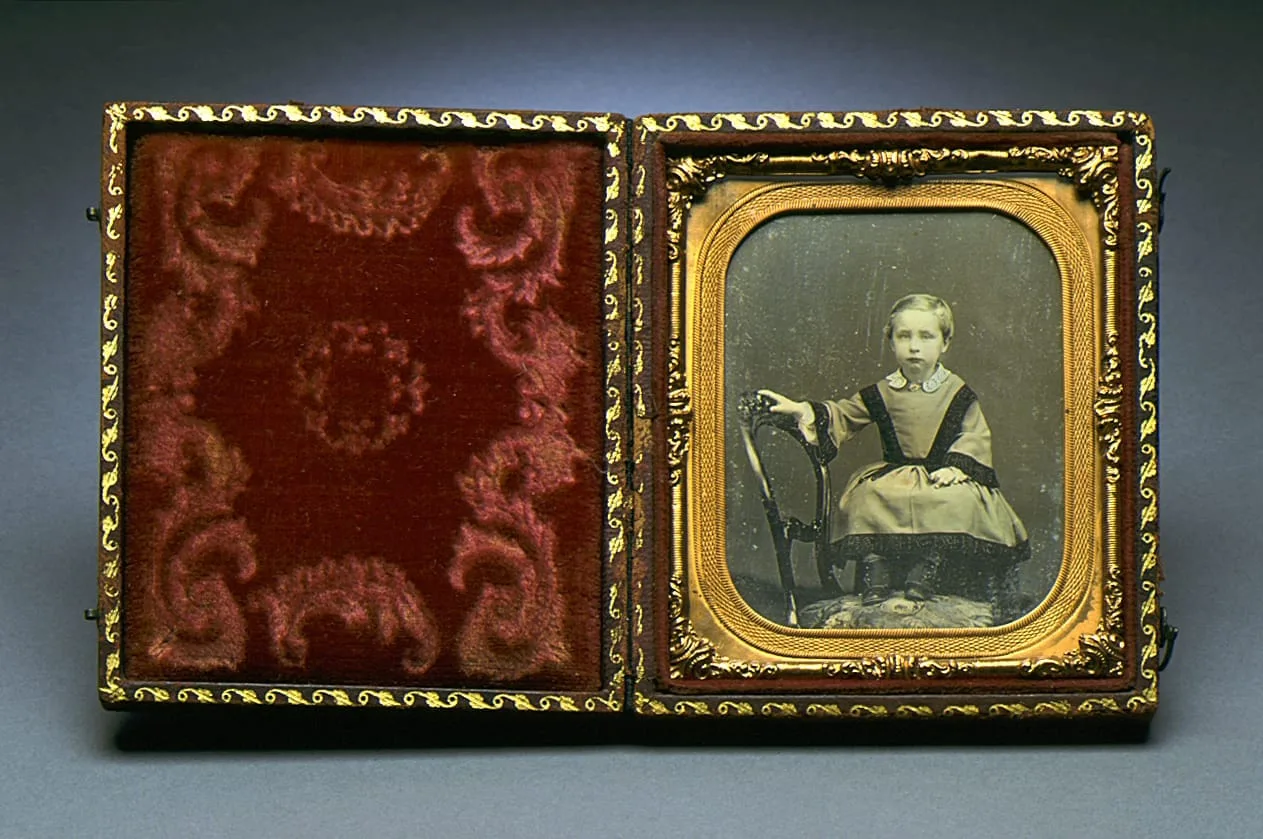
The unknown daguerreotypist has photographed a well-dressed child, most likely from an upper-class family, posed with a chair. The subject is younger than those typically photographed; children around this boy'ge often had trouble keeping still during the lengthy daguerreotype sessions. The whiteness of his face could have been achieved with dusting powder, which was used to catch the light. The exquisite detail and range in tonality is representative of a process that emphasized direct representation, without retouching. The child's direct stare and full-length pose reflect the desire for a true physical likeness.
Technique
A highly polished copper plate was coated with a sensitive silver-based compound and exposed in a camera to light. The intensity of the light and the sensitivity of the materials necessitated long exposure times during which the sitter had to be motionless. Sometimes iron clamps were used keep the sitter's back and neck steady. After the session, the exposed silver salts were developed with a heated mercury vapor, forming a positive image that seemed to be etched into the shiny surface of the copper plate. The image was fixed on the plate with a sodium solution before being sealed behind glass for handling.
Context
The daguerreotype, named after its creator Louis Jacques Mandé Daguerre (1787—1851), was introduced in 1839 by the French government. The invention caught on quickly in France, England, and America, and practitioners flourished in a trade that could be self-taught through a manual. Daguerreotype studios opened in towns and cities across these countries, giving the affluent the opportunity to buy likenesses of themselves and loved ones, which until then had been limited to painted portraits. Like a painting, the daguerreotype was a unique object—a positive image without a separate "negative." The expense and fragility of daguerreotypes meant that they were often housed in protective cases.
In addition to portraits, daguerreotype views of famous historical and architectural sites were made. The detailed images were traced by printmakers to be reproduced in newspapers and journals, forming an early alliance between photography and printmaking.


![Artists Represent Themselves: Frida Orupabo on “Untitled (sources unknown except Shadman Shahid [bottom left])”](/_next/image?url=https%3A%2F%2Funframed.lacma.org%2Fsites%2Fdefault%2Ffiles%2Fstyles%2Farticle_full%2Fpublic%2Ffield%2Fimage%2FM2020_265_1_1-4-20221012-Access.jpg%3Fitok%3DemgBGR8Z&w=828&q=75)


