- Title
- Atlantic City
- Date Made
- 1930, printed circa 1974
- Medium
- Gelatin silver print
- Dimensions
- Image: 6 7/16 × 3 15/16 in. (16.35 × 10 cm)
Primary support: 6 7/16 × 3 15/16 in. (16.35 × 10 cm)
Secondary support: 15 × 12 1/2 in. (38.1 × 31.75 cm)
Mat: 20 × 16 in. (50.8 × 40.64 cm)
- Accession Number
- M.83.315.5
- Curatorial Notes
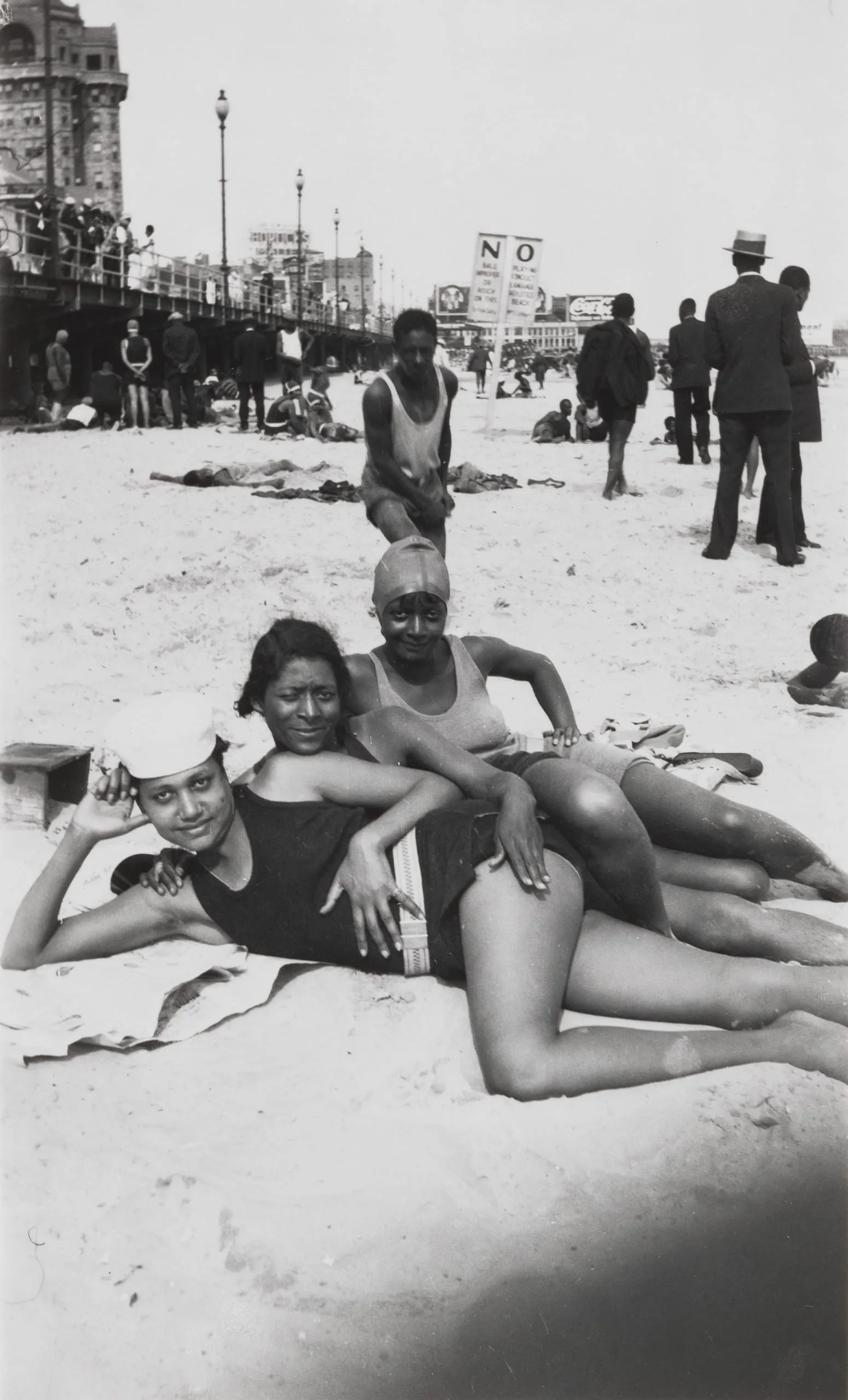
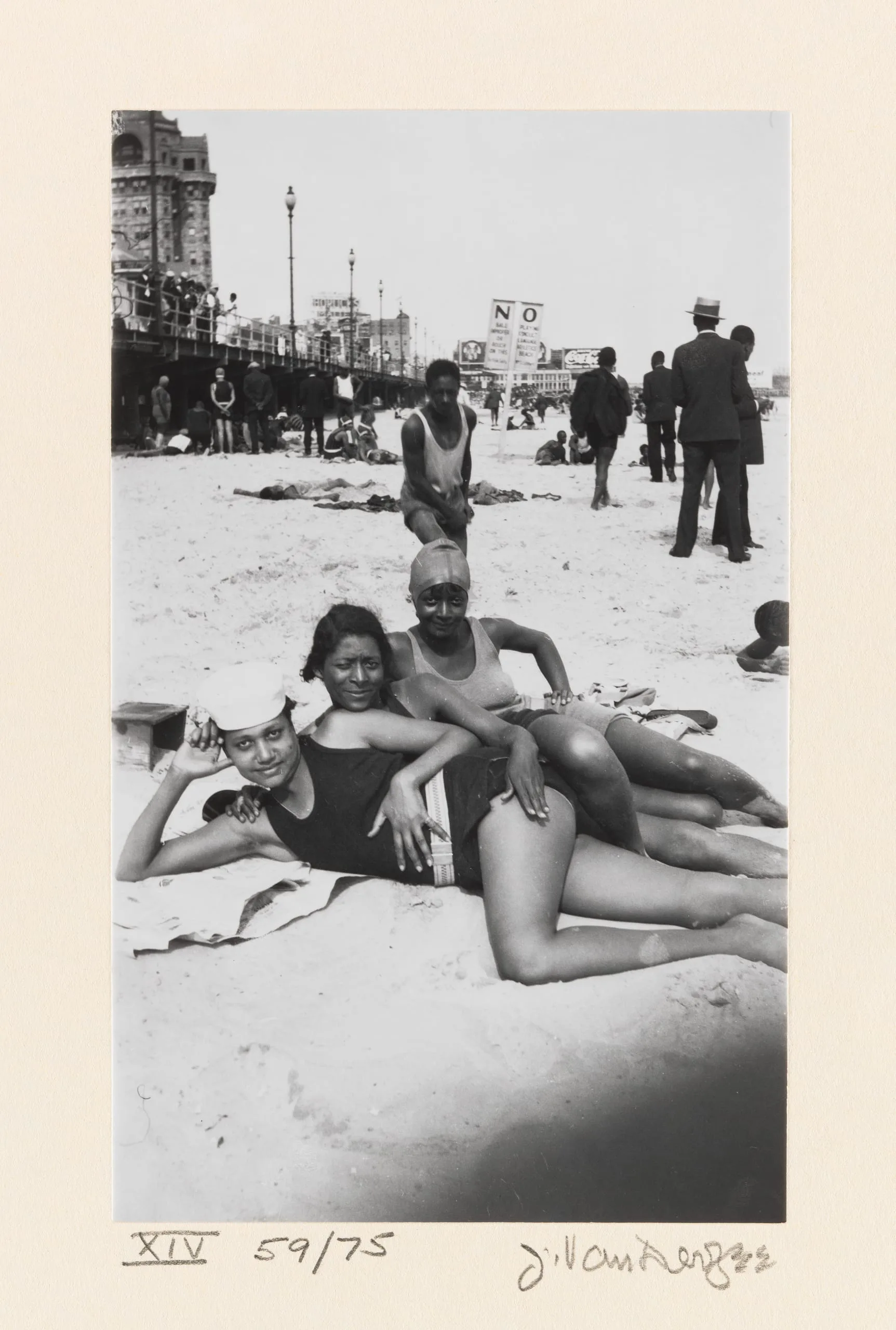
It is no hyperbole to say that James Van Der Zee’s photographs from the 1920s and 1930s stand as the documentary record of the Harlem Renaissance. Atlantic City, a vertically composed portrait of bathers on the shore, exemplifies the stylish poise of the “New Negro” movement, particularly in the experience of Black women. Van Der Zee arranged the three principal subjects in an ascending intermingling of bodies. At the center of the photograph is the woman farthest from his lens; she wears a swimming cap and rests her hand confidently on her hip. The two women in the foreground are more intimately entwined: one rests her hands on the hip and shoulder of the other, who spreads her fingers demurely across her stomach. The compositional line from the bathing cap to the man standing behind leads the eye to a sign in the distance listing the rules and regulations of beach activity below an emphatic NO. The setting is likely the Blacks-only Missouri Beach. Although the Atlantic City shoreline was never officially segregated, whites vacationing from the Jim Crow South in the early 1900s complained to hotel owners about Black people sharing “their” beaches, launching an unofficial campaign to restrict African Americans to Missouri Beach. By the 1930s, the beach had become a popular destination for Black celebrities and tourists.
Initially an aspiring musician, Van Der Zee turned to professional photography in the 1910s and opened a portrait studio in Harlem in 1917. Made more than a decade later, in 1930, Atlantic City reflects Van Der Zee’s move away from the formality imposed by the studio setting into the realm of documentary portraiture capturing Black social and cultural life. Photography has often been touted as among the most democratizing forms of image making, and Van Der Zee embodied this spirit in real time. He photographed luminaries in the Black community, such as the poet Countee Cullen and the Pan-Africanist leader Marcus Garvey, but he also found time for ordinary people such as these women on the beach.
2024
- Selected Bibliography
- Kim, Christine Y., and Myrtle Elizabeth Andrews, editors. Black American Portraits: From the Los Angeles County Museum of Art. Los Angeles: Los Angeles County Museum of Art; New York: DelMonico Books-D.A.P., 2023.
- Copyright
- © James Van Der Zee Archive, The Metropolitan Museum of Art, New York