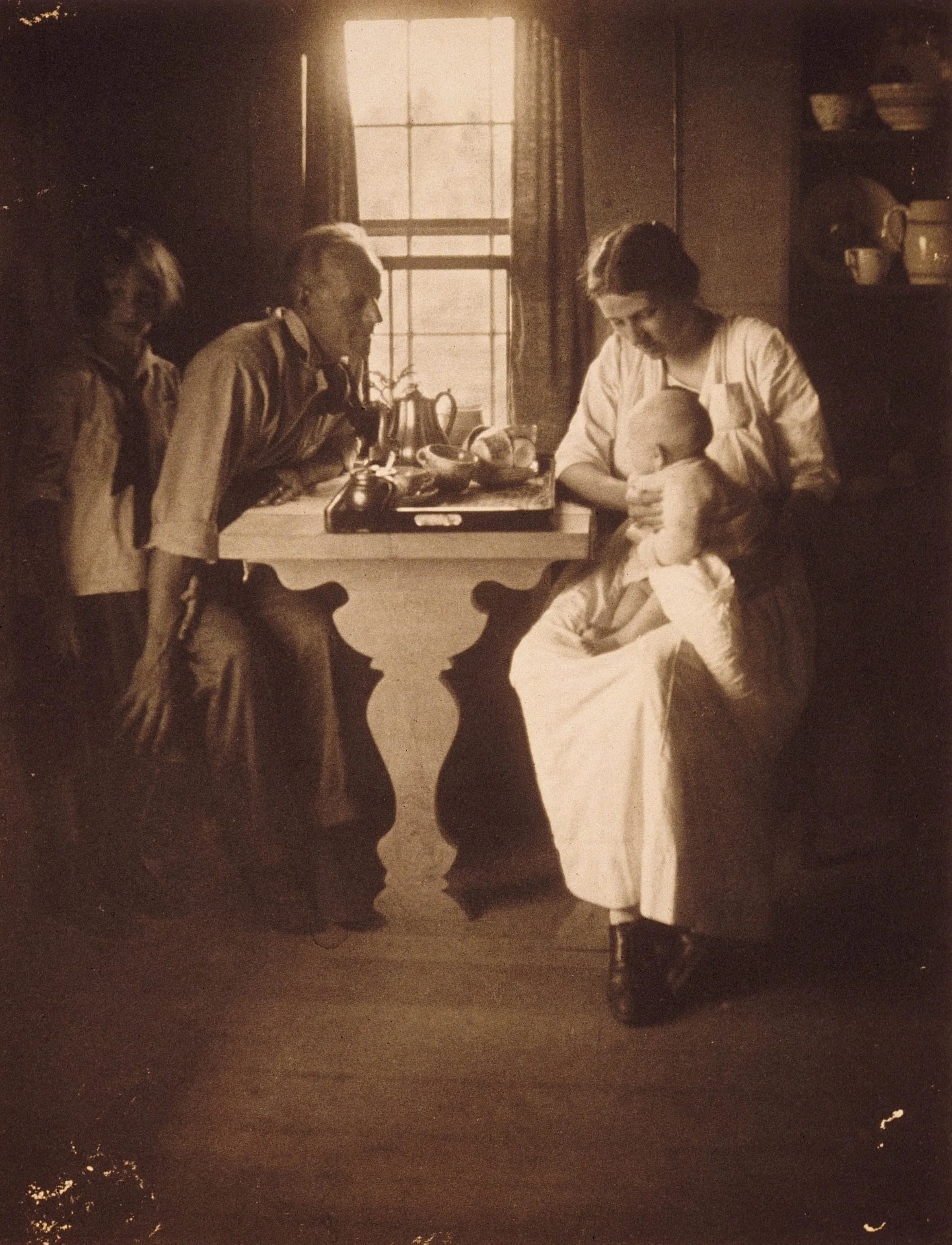
Gertrude Käsebier was an exceedingly creative photographer of people. She photographed family and friends and produced commercial portraits that were a stark departure from the stiff, overly detailed likenesses that dominated early twentieth-century studio output. Käsebier’s working method was similar to that of a portrait painter: she would spend two to three hours talking to the sitter and setting up the composition, often dressing women in vintage clothing and arranging their hair in traditional styles echoing old master paintings. She relied on natural side-lighting rather than the typical overhead skylights. Käsebier often focused on the theme of motherhood, as in Family Group at a Table. The scene is identical, save for the two figures on the left, to that of Käsebier’s well-known photograph The Widow (1913). The family pictured is the children’s book illustrator Beatrice Baxter Ruyl, her child Ruth, her baby Barbara, and her husband, at their home in Georgetown, Maine. By not naming the sitters specifically in the title, the artist offered an open narrative for the viewer.
Käsebier was born into a Quaker family that strongly believed in equal rights for women. At the age of thirty-seven, married with three teenage children, she enrolled at the Pratt Institute in Brooklyn to study portrait painting. Like many women of her generation, she documented her family with photography; two summers spent in France taking art classes with Frank Vincent DuMond gave her the confidence to switch full-time to the medium, and she sharpened her technical skills by studying under a German chemist in Wiesbaden. Returning to the U.S., Käsebier apprenticed in the photography studio of Samuel Lifshey and was an immediate success. Her sitters were Brooklyn socialites, mainly young women, and her work became known in international circles by way of the many salons and exhibitions she entered.
In 1901, she was offered membership in the Camera Club of New York and was the first woman elected to the Linked Ring, a London-based group of progressive Pictorialist photographers. That same year, Charles H. Caffin devoted a chapter to her work in his book Photography as Fine Art, alongside Alfred Stieglitz, Edward Steichen, and Clarence White—a testament to her achievement as an artist. She was a founding member of the Photo-Secession, and Stieglitz included her work in the inaugural issue of Camera Work in 1902. Disagreements with Stieglitz over commercialism in photography led to her resignation from the Photo-Secession in 1912, and she became more active in White’s Pictorial Photographers of America, which supported artists who worked commercially. Käsebier was extraordinarily prolific, making over 100,000 negatives in her lifetime.
Rebecca Morse, Curator, Wallis Annenberg Photography Department
2024
Bibliography
Michaels, Barbara L. Gertrude Käsebier: The Photographer and Her Photographs. New York: Abrams, 1992.
A Pictorial Heritage: The Photographs of Gertrude Käsebier. Wilmington: University of Delaware and Delaware Art Museum, 1979.