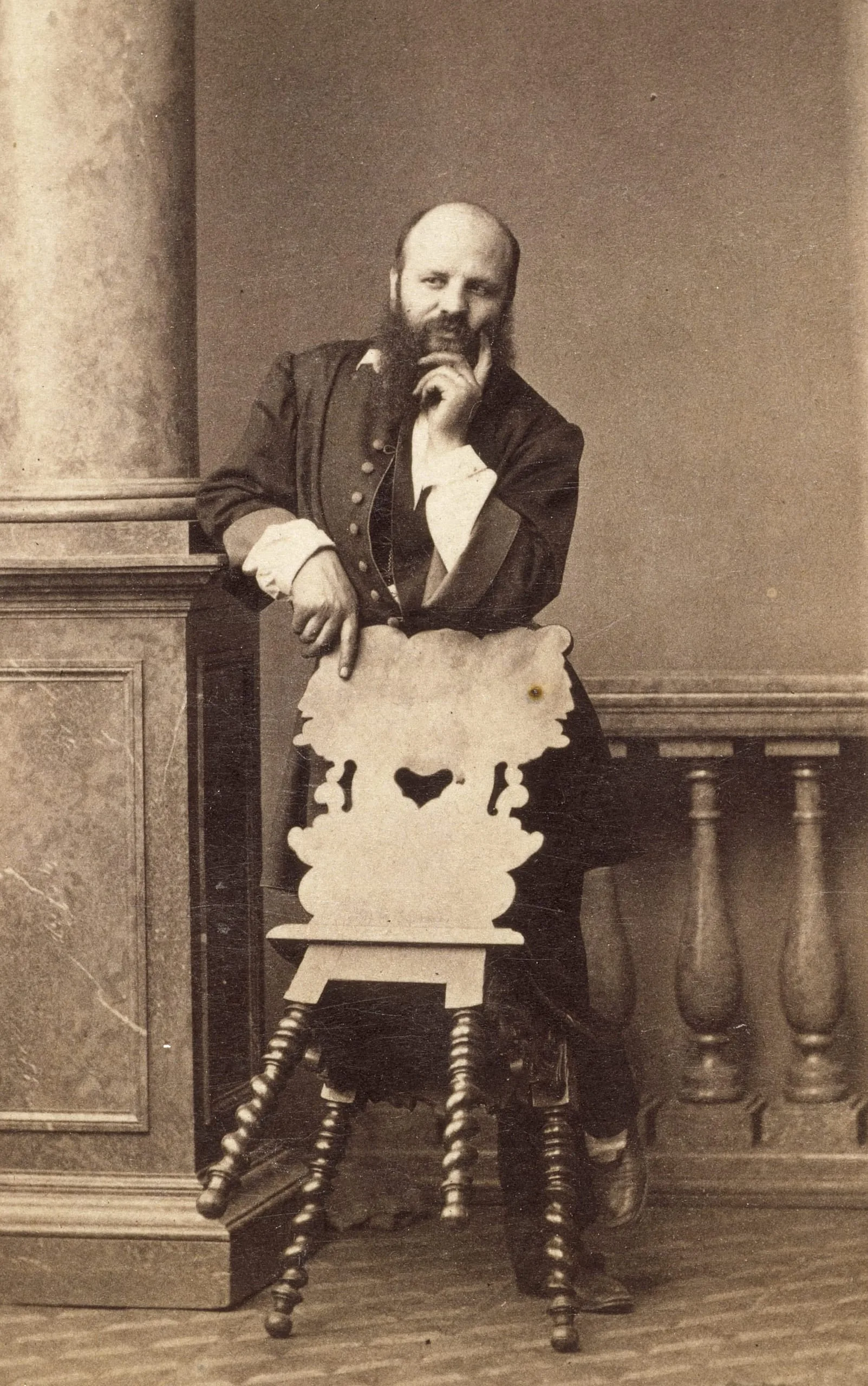
Primarily portraits, cartes de visite—small cards presented when making social calls or given to friends and relatives to keep in albums—announced the status or aspirations of the subject using socially understood cues of clothing, props, and body language. In this self-portrait, André Adolphe Eugène Disdéri, the inventor of the carte de visite, wanted to appear as a bohemian and an entertainer, fitting for a man described in Paris newspapers as an "egoist, a dandified dresser and poseur, and an extravagant spendthrift."¹ Disdéri was also the subject of caricatures in the press that emphasized his bald head, full beard, and the artist-style jacket and neck cloth he wore when operating the camera, emblematic of his theatrical personality. While using the typical props of a nineteenth-century portrait studio—the column, balustrade, and chairhe adopts a casual and self-assured body language. As was common in cartes de visite, Disdéri gazes away from the camera, appearing to be captured in thought, even as the viewer notes the conscious construction of the scene.
Technique
In 1854, André Adolphe Eugène Disdéri patented the carte de visite, which replaced visiting cards engraved with names. Disdéri's innovation to the collodion process was to use a multi-lens camera to make eight exposures on a single glass-plate negative, allowing the subject to vary the pose. (For more on the collodion process, see the Alinari Brothers' Campanile, Pisa.) After developing, Disdéri contact-printed the eight-exposure plate onto a single piece of albumen paper and cut it into individual images. (For more on albumen paper, see Alfred Capel-Cure's St. Ouen, Rouen.) The 2 1/4 x 3 1/2 inch images were then mounted onto 2 1/2 x 4 inch paper cards.
Context
The carte de visite was the first photographic portrait format that was widely available and popular. The expense for the customer and photographer was reduced because multiple photographs could be made from one negative. The photographer could print the negative many times over, producing sheets and sheets of cartes de visite.
Disdéri patented the carte de visite and introduced it to the Paris public in 1854, although it did not become popular beyond the wealthy or avant-garde until four or five years later. The 1850s were a time of prosperity and industrial expansion in Paris, and people were able to take advantage of this relatively inexpensive but still luxurious form of portraiture. During the golden age of the carte de visite, from 1859 to 1862, Disdéri's Paris studio (he had three others in Europe) grew to ninety employees and made thousands of prints a day.
The format caught on in England in 1860, when John Jabez Edwin Mayall published a royal album with fourteen carte portraits of the royal family, prompting people to collect photographs and keep them in albums. This phenomenon created a huge demand for photos of famous people, and hundreds of thousands were sold. Photographers began to compensate their famous sitters for posing, although the sitters benefited as well, becoming more famous as distribution increased. Images of politicians, actors, artists, and people in the news were highly desirable.


![Artists Represent Themselves: Widline Cadet on “Seremoni Disparisyon #1 (Ritual [Dis]Appearance #1)”](/_next/image?url=https%3A%2F%2Funframed.lacma.org%2Fsites%2Fdefault%2Ffiles%2Fstyles%2Farticle_full%2Fpublic%2Ffield%2Fimage%2FM2023_47_1-20221007-Access.jpg%3Fitok%3DDEdu6xhk&w=828&q=75)


