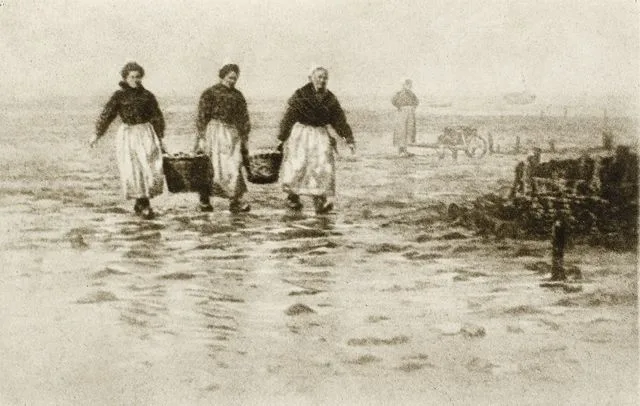
The photographer has created a soft, dreamlike image of women gathering oysters by the shore. The women's simple clothes and competent demeanor imply that this is a common chore for them. The romantic style of the photograph emphasizes the pre-industrial, timeless nature of the women's labor.
Technique
The bromoil process, a derivative of a nineteenth-century oil print process, was popular with photographic pictorialists in the early twentieth century for its soft, painterly quality. With a normally developed print on gelatin silver paper (made with silver bromide), the gelatin hardened into dark and light tones depending on exposure through the negative. The photographer took a completed gelatin silver print and washed it in water so that the gelatin that was exposed to the most light (the hardened darkest tones) rejected the water while the gelatin exposed to the least light (the less-hardened highlights) absorbed the water. Afterward, while the print was still moist, the photographer applied oily lithographic ink that clung to the darkest tones and separated from the watery highlights, creating a positive image.
Context
The introduction of the hand-held camera in the late 1880s led to an exponential growth in amateur photography. Professional photographers lost their status as keepers of proprietary knowledge and skills, and photography studio business declined. As more people took pictures as a hobby, some professional photographer were determined to distinguish themselves from the amateurs. Known as pictorialists, they promoted photography as an art form equal to painting and printmaking. Pictorialists saw themselves as artists using a technological tool to make art, interpreting rather than merely recording their subjects. They used a soft- or out-of-focus approach to distinguish their images from those that documented reality, and they used alternative processes that showed their crafting of a photograph.
Between 1889 and World War I, photographers around the world adopted the pictorialist philosophy and style, forming professional associations, presenting artist portfolios, and organizing exhibitions that displayed photography as art outside academic institutions. In Los Angeles, camera clubs began forming at the turn of the twentieth century and in 1915 the Camera Pictorialists of Los Angeles emerged, modeled after a larger East Coast organization. Its purpose was to "assist and stimulate art through demonstrating the lens' artistic possibilities and to assist the members of the club in their pictorial work by supplying the means of comparing their efforts with those of the recognized photographers in America." Although far removed from the photographic discourse of the East Coast, which centered on Alfred Stieglitz's Photo-Secession, the club adopted an expansive attitude and incorporated a diverse group of work in its annual salons at the Los Angeles Museum of History, Science, and Art (LACMA's parent institution) from 1918 to 1947.