- Title
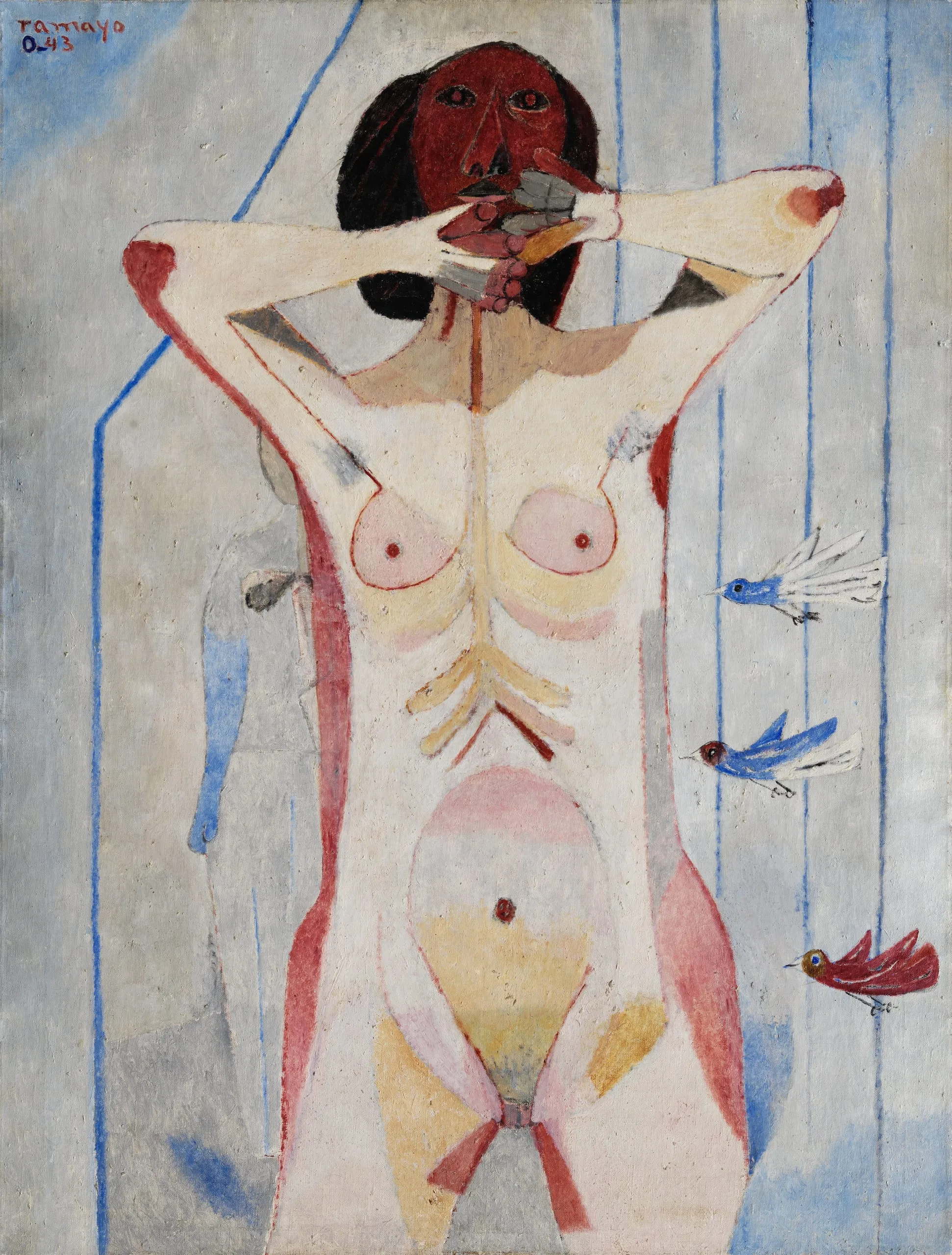
- White Nude (Desnudo blanco)
- Date Made
- 1943
- Medium
- Oil on canvas
- Dimensions
- 41 1/8 × 31 1/4 in. (104.5 × 79.4 cm)
- Accession Number
- AC1997.LWN.44
- Curatorial Notes
Following an initial trip to New York in 1926, Rufino Tamayo divided his time between Manhattan and Mexico over the next two and a half decades. By the early 1940s he was showing in New York galleries alongside other artists who explored the boundaries and intersections between abstraction and figuration, such as Henri Matisse (1869–1954) and Pablo Picasso (1881–1973).
White Nude coincides with this period, executed while the artist’s wife, Olga Flores Rivas, was undergoing medical treatment for issues related to a series of miscarriages. Painted at an emotionally fraught time, White Nude has traditionally been understood as a representation of Olga. Lending further weight to a biographical interpretation of the work, Tamayo added an “O” before the date in his signature at the upper left corner of the canvas. This inscription functions as a dedication to Olga, who actively managed her husband’s career and enabled him to focus fully on his art. Tamayo continued to sign and date his paintings with this tribute—appearing here for the first time.
For more information see the catalogue entry by Rachel Kaplan in Rufino Tamayo: The Essential Figure, 2019, pp. 28–29.
- Selected Bibliography
- Kaplan, Rachel. Rufino Tamayo: The Essential Figure. Los Angeles: Los Angeles County Museum of Art, 2019.
- Copyright
- Art © Tamayo Heirs/ Mexico/ Licensed by VAGA, New York, NY