LACMA

ShopMembershipMyLACMATickets
LACMA
Los Angeles County Museum of Art
5905 Wilshire Blvd.
Los Angeles, CA 90036
info@lacma.org
(323) 857-6000
Sign up to receive emails
Subscribe
© Museum Associates 2025

Museum Hours

Monday

11 am–6 pm

Tuesday

11 am–6 pm

Wednesday

Closed

Thursday

11 am–6 pm

Friday

11 am–8 pm

Saturday

10 am–7 pm

Sunday

10 am–7 pm


  • About LACMA
  • Jobs
  • Building LACMA
  • Host An Event
  • Unframed
  • Press
  • FAQs
  • Log in to MyLACMA
  • Privacy Policy
© Museum Associates 2025
Collections

Rufino Tamayo
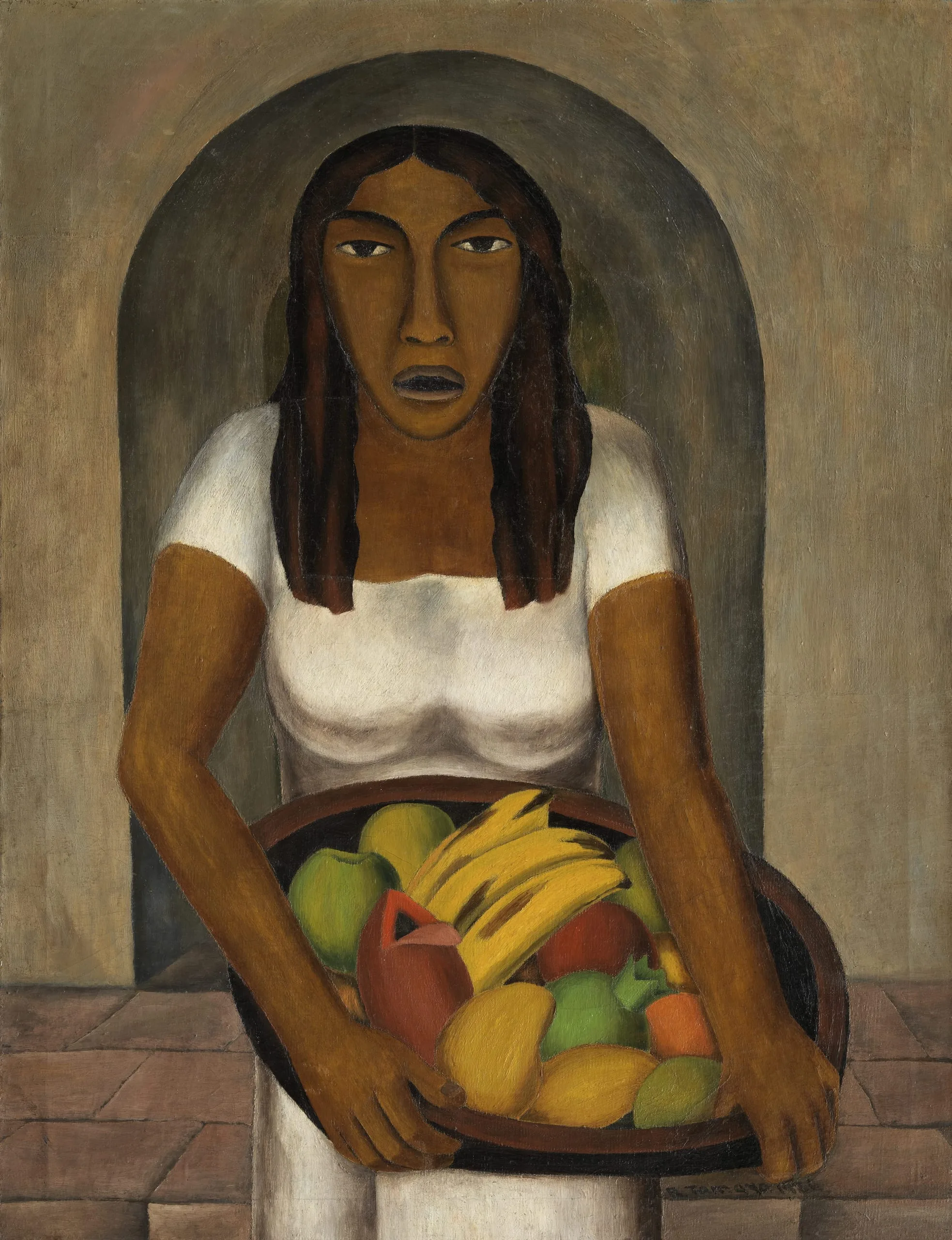
Indian Fruit Seller (India frutera)1926

On view:
Geffen Galleries, Indigenismo in Latin America
Oil painting portrait of a woman with brown skin and long dark hair holding a wooden basket of colorful fruit, rendered in broad, simplified forms against a stone arch
Artist or Maker
Rufino Tamayo
Mexico, 1899-1991
Title
Indian Fruit Seller (India frutera)
Place Made
Mexico, Mexico City
Date Made
1926
Medium
Oil on canvas
Dimensions
34 3/4 × 26 3/4 in. (88.27 × 67.95 cm); frame: 42 × 34 1/2 in. (106.68 × 87.63 cm)
Credit Line
The Bernard and Edith Lewin Collection of Mexican Art
Accession Number
M.2006.213.3
Classification
Paintings
Collecting Area
Latin American Art
Curatorial Notes

Following the death of his mother, the eleven-year-old Rufino Tamayo moved from his birthplace of Oaxaca to Mexico City to live with extended family. While studying accounting and working in the family’s fruit shop, young Tamayo began taking classes at the National School of Fine Arts. Tamayo soon committed himself to painting full time and set out to forge his own connections. On April 10, 1926, in an open storefront next to the Zócalo (Mexico City’s main square), he inaugurated his first solo exhibition of twenty paintings, including Woman with Fruit Basket.

Tamayo’s subject holds a bounty of fruits—apples, mameys, mangos, bananas, and pomegranates—perhaps a nod to the family business. Piled together, the brightly colored fruits introduce a still-life element to the painting, the mamey peeled open to glimpse its inside. In contrast, the stoic female figure confronts the viewer directly, her firm stare disallowing any further entrance into the scene.


For more information see the catalogue entry by Rachel Kaplan in Rufino Tamayo: The Essential Figure, 2019, pp. 12–13.

Selected Bibliography
  • Kaplan, Rachel. Rufino Tamayo: The Essential Figure. Los Angeles: Los Angeles County Museum of Art, 2019.