- Title
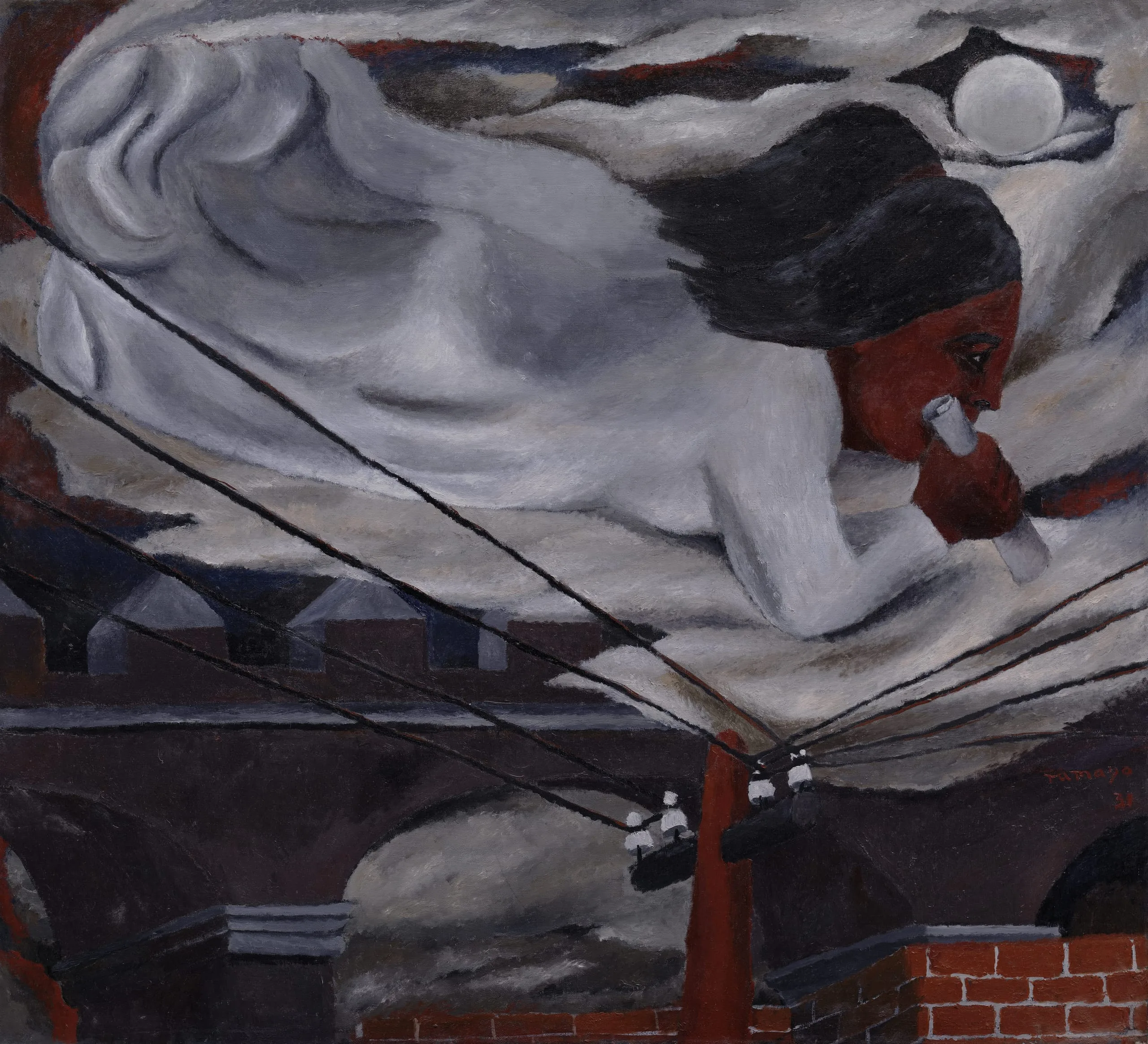
- Messengers in the Wind (Mensajeras en el viento)
- Date Made
- 1931
- Medium
- Oil on canvas
- Dimensions
- Unframed: 31 × 34 1/8 in. (78.74 × 86.68 cm); framed: 38 × 41 1/2 × 2 in. (96.52 × 105.41 × 5.08 cm)
- Accession Number
- AC1997.LWN.36
- Curatorial Notes
Messengers in the Wind (Mensajeras en el viento) exemplifies Rufino Tamayo’s interest in combining the dreamlike and the commonplace in his depictions of modern Mexico. Tamayo transforms two Indigenous women into allegorical figures that bridge his country’s rich past and present. The painting is full of movement and dynamic energy, as the women fly through the night sky and their billowing dresses merge into the windswept clouds. They are delivering a message, visible in the right hand of the woman closest to the viewer. This act of transmission is echoed by the telephone wires that traverse the painting, pointing to another form of communication and a visual cue of Mexico’s modernization.
Born in Oaxaca, Rufino Tamayo lived and worked in Mexico City, traveling frequently to New York. In the 1920s, he became increasingly interested in folk art and themes of everyday life. Unlike many of his contemporaries, Tamayo believed that art should have an aesthetic, rather than an ideological, function.
Rachel Kaplan and Ilona Katzew
2024
- Provenance
Bernard and Edith Lewin, Rancho Mirage, California; LACMA, 1997.
- Selected Bibliography
- Los Angeles County Museum of Art. New York: Thames and Hudson, 2003.
- Gifts on the Occasion of LACMA's 50th Anniversary. Los Angeles: Los Angeles County Museum of Art, 2015.
- Kaplan, Rachel. Rufino Tamayo: The Essential Figure. Los Angeles: Los Angeles County Museum of Art, 2019.
- Copyright
- Art © Tamayo Heirs/ Mexico/ Licensed by VAGA, New York, NY