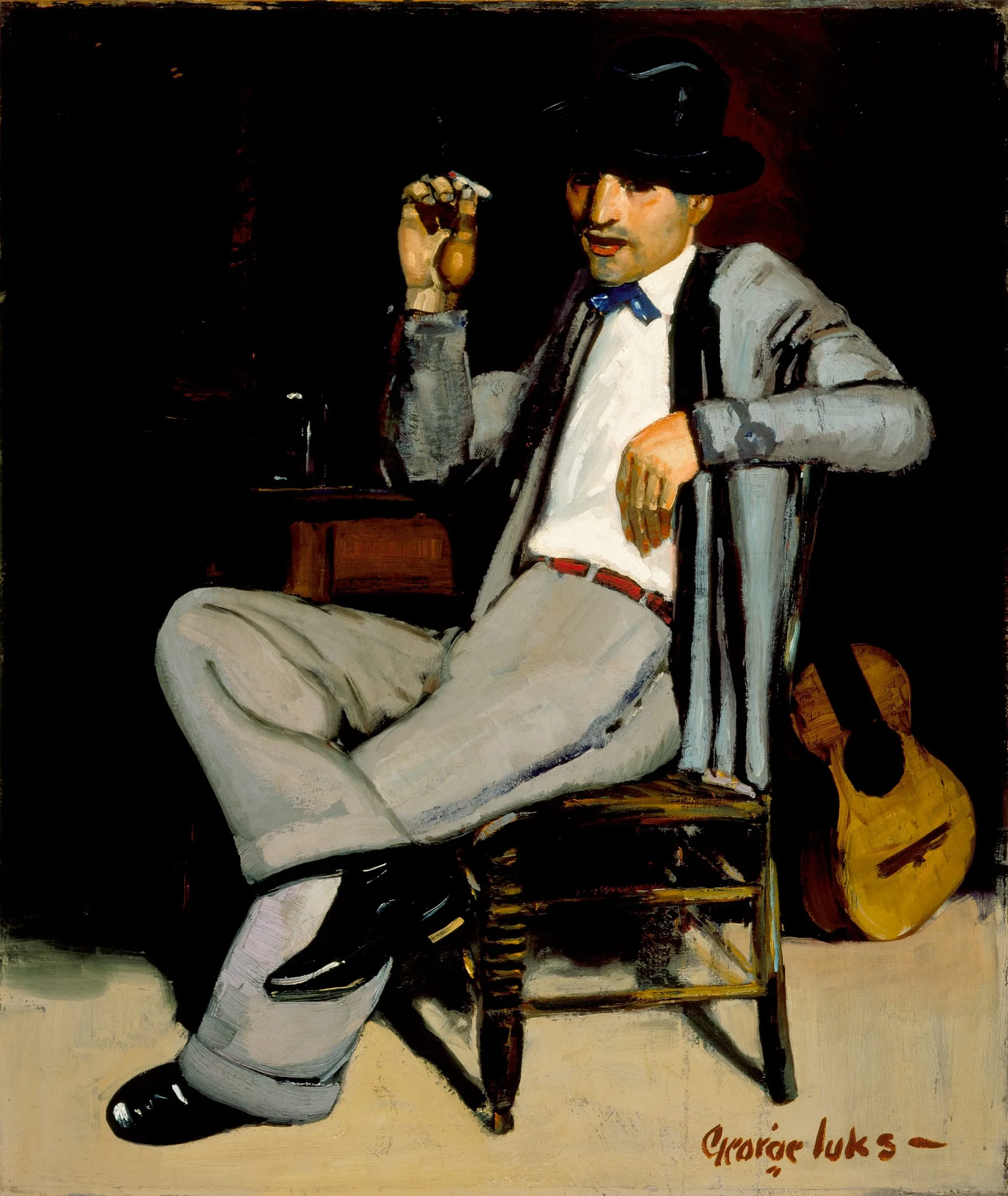
The collector William Preston Harrison purchased Pedro directly from Luks after examining all the works in his studio. He was delighted with the acquisition, considering it a prime museum piece and definitely portraying a modern character. Harrison even preferred it to the artist’s The Polish Dancer, c. 1927 (Pennsylvania Academy of the Fine Arts, Philadelphia), which had been exhibited at the Los Angeles Museum’s Pan-American exhibition in 1925-26 and which Harrison thought to be one of the greatest works in the show. His purchase of the painting out of the artist’s studio may explain why the painting was not mentioned in any of the early literature on Luks.
Luks painted the café scene in a somber palette of metallic blue, gray, dark brown, and black. It is enriched by a bravura surface, the paint being laid on so thickly and with such flat, broad strokes that the artist probably built it up with a palette knife. The brushwork is almost coarse in appearance, a treatment complementary to the low-life character that Luks portrayed. As Harrison so perceptively noted, the painting is a "character study" of "a queer looking type of chap with guitar alongside."