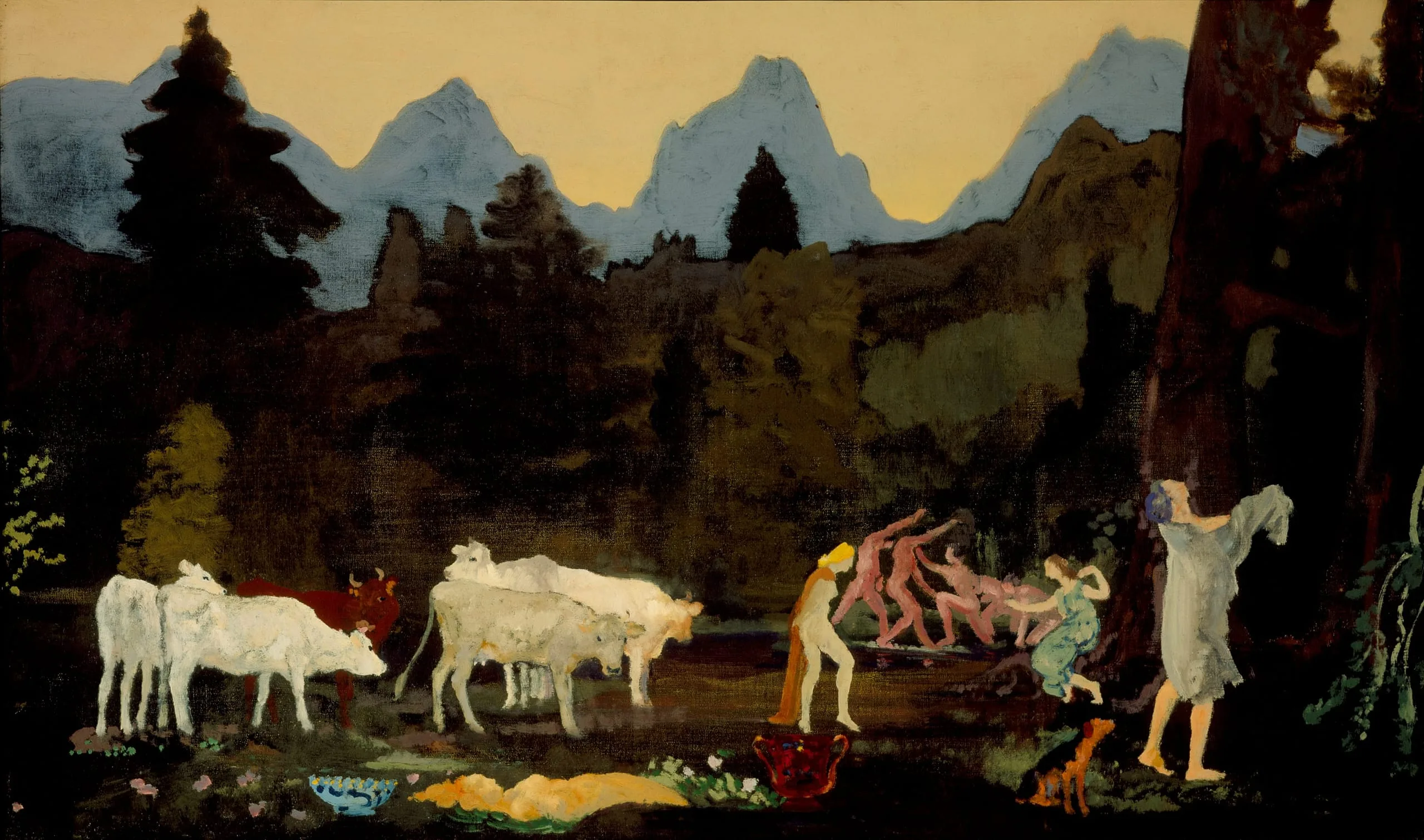
In her list of her husband’s paintings included in Royal Cortissoz’s book Arthur B. Davies (1931), Dr. Virginia M. Davies assigned this painting to 1908. However, this list is not always accurate. Davies rarely dated his paintings himself and did not develop in a linear manner, so the dates of many of his works have never been clearly determined.
Pastoral Dells and Peaks relates to Davies’s experience of the American West. In 1905 he traveled to Colorado, Nevada, Utah, and California and made several oil sketches of the dramatic, high-peaked mountains. After this trip West he abandoned the more domestic, arcadian landscapes of his earlier pastorals in favor of looming, powerful mountain ranges. It was Davies’s memory of the Sierras and the soaring evergreens that inspired the background composition of Pastoral Dells and Peaks, although the artist simplified the setting, reducing its specificity.
Davies was acquainted with ancient art and mythology and had visited southern Italy and Greece in 1897, 1910, and 1911. He often depicted his figures as classically robed shepherds and herders. While this scene probably was not intended to illustrate a specific story, it recalls the myth of Io, a beautiful maiden who was turned into a heifer for being loved by Jupiter. Davies follows the tradition of Greek vase painting by presenting the female figures in a paler color than the male figures. In 1908 the artist began to arrange his figures in dancers’ poses in long, friezelike processions along a shallow foreground in what he referred to as "continuous compositions." Pastoral Dells and Peaks does not have as many figures, nor is it as stringently composed along a processional line as Davies’s more mature paintings from about 1913. Consequently, it may be an early example of Davies’s continuous composition, perhaps inspired by one of his trips to Greece. So Pastoral Dells and Peaks may date as early as 1908 but probably not later than 1911.