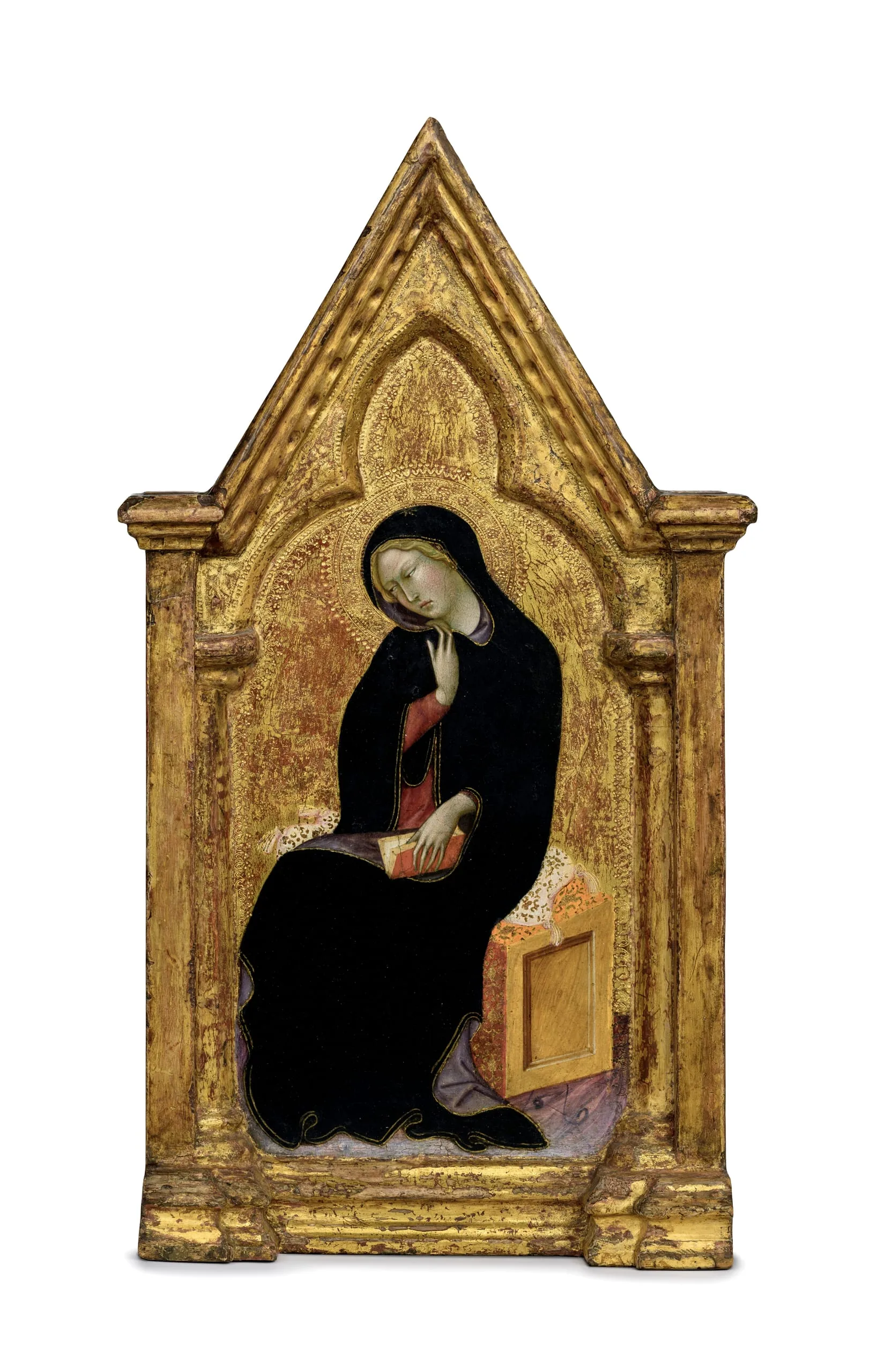
The Virgin Mary, seated on a decorative gold cushion, pauses from her reading as she receives word that she will be the mother of God. In its original context, this painting faced a separate panel, also in LACMA’s collection, in which the archangel Gabriel delivers the news of Mary’s miraculous pregnancy (see M.44.2.1). Together, these panels form a pivotal scene from the Christian Gospels: the Annunciation. In Bartolo di Fredi’s interpretation of the scene, settings are kept to a minimum: Mary and Gabriel fill and almost overwhelm their frames, while a solid gold background emphasizes each figure’s holiness. Bartolo’s composition takes inspiration from Simone Martini’s famous Annunciation (1333), which at the time was housed in Siena’s cathedral above the altar of Saint Ansanus, where Bartolo was likely to have seen and admired it.
LACMA’s panels were once part of an altarpiece made by Bartolo for the church of San Francesco in Montalcino, just outside of Siena. Although now dismantled and dispersed—with extant pieces preserved in the Palazzo Municipale in Montalcino and the Pinacoteca Nazionale in Siena—the elaborate altarpiece consisted of scenes from the Virgin’s life set under decorative architectural forms and punctuated by vertical pilasters featuring standing saints. The pointed engaged frames of our Annunciation panels suggest that they were pinnacles set at the top of the altarpiece, likely flanking the central scene of the Coronation of the Virgin. It was common in medieval art to divide Annunciation scenes, which helped create balanced compositions across the popular multipaneled polyptychs.
2024