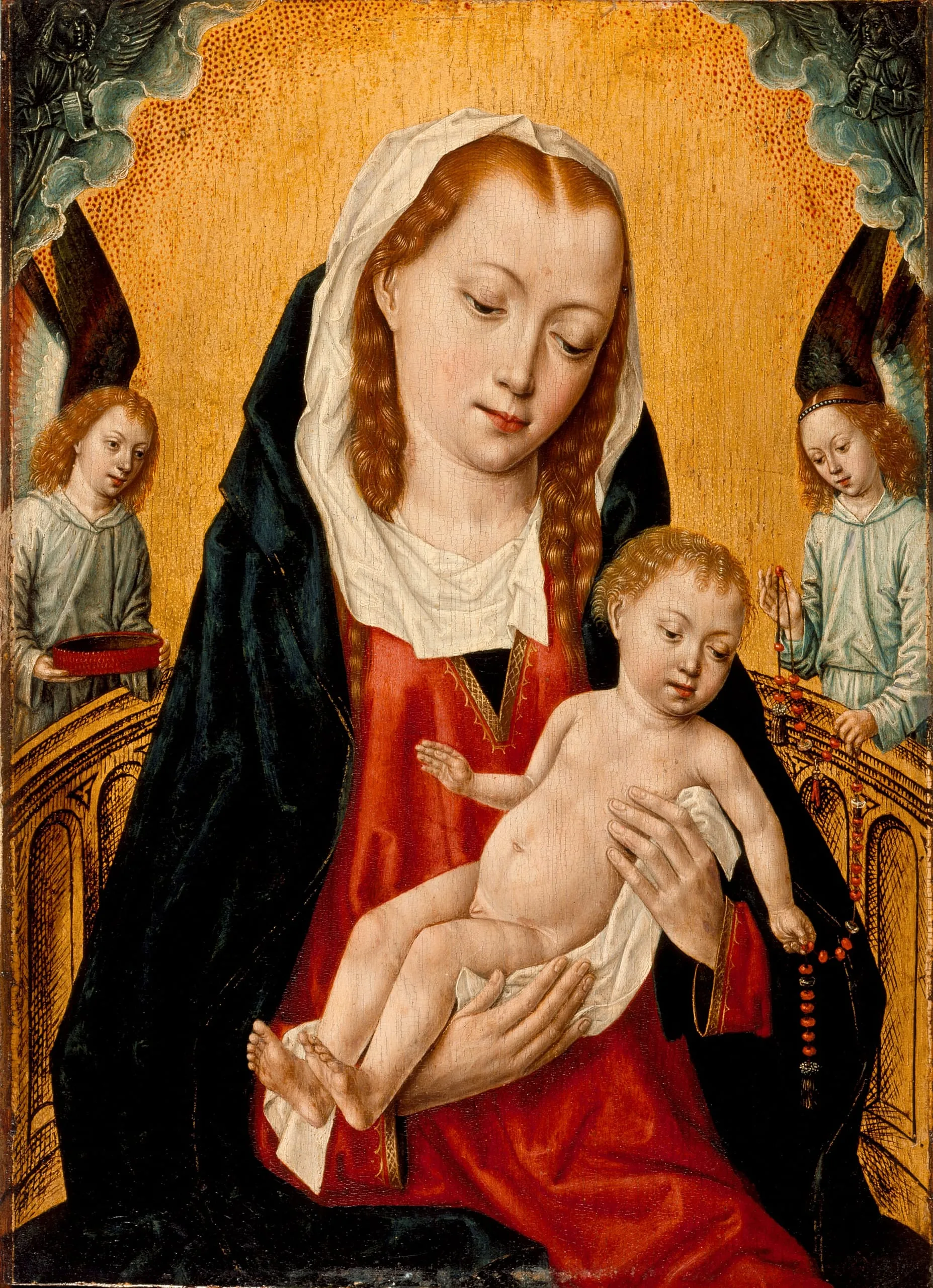
Layers of religious signification unfold in this Virgin and Child composition that emphasize Christ’s humanity and Mary’s role as an affectionate mother. She cradles her infant son, not with her bare hands, but with a white cloth, reminding viewers of Christ’s future burial shroud, and perhaps the practice of reverently holding the Eucharist with cloth-covered hands. Seated on her lap, the child grasps a rosary offered by one of the angels. Rosaries are implements of prayer, certainly familiar to and likely used by the owner of this painting. Here it consists of red coral and transparent beads, probably signifying the two major prayers: Hail Mary and Our Father. A single branch of coral hangs from the rosary. Coral, believed to have apotropaic and medicinal powers, was frequently worn by children to keep them safe and appears in countless paintings of the Christ Child. Most of the typical reddish orange or reddish pink coral used for jewelry and amulets was Corallium rubrum, sourced from the Mediterranean since antiquity. All of these details are typical of Netherlandish verisimilitude, which helped devotees form a more immediate emotional connection to the scene at hand.
The painting was likely intended as one-half of a diptych, a set of hinged panels that could be closed and transported, allowing its owner to create a private sacred space. Often the facing painting in these pairs featured the commissioner and/or family members positioned in perpetual prayer, evidenced by other extant diptychs by the Master of the Saint Ursula Legend. Artist workshops frequently prepared panels with sacred imagery, as here, in advance of this type of personalized commission. The ability to visualize and emotionally connect to holy figures and narratives was an essential component of fifteenth-century religious practice in northern Europe, driven by spiritual movements like Devotio Moderna. Diptychs were tools for this type of affective meditation.
2024