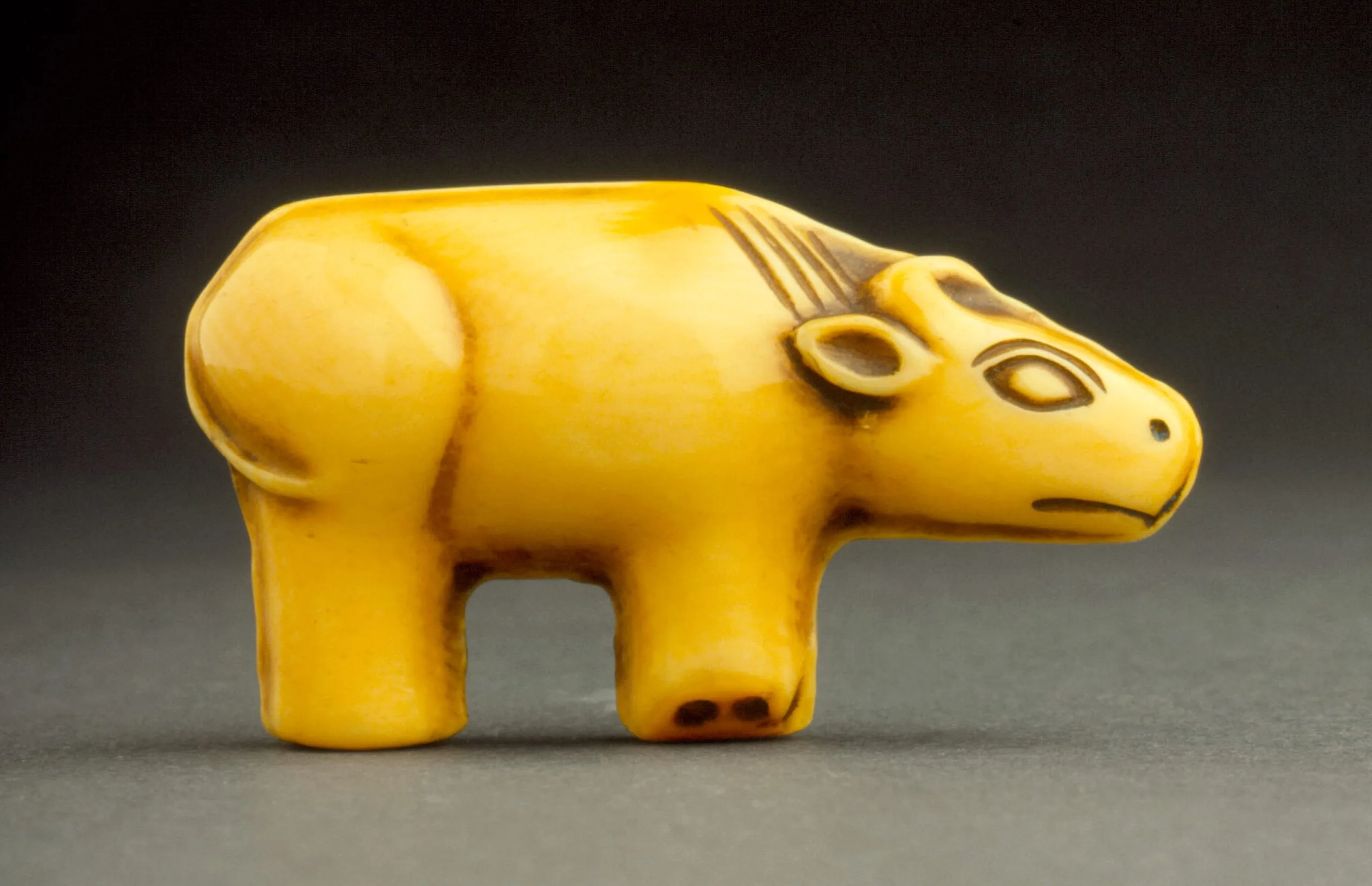
Ōhara Mitsuhiro (1810−1875) was a talented and well-regarded carver who worked in the city of Osaka. In addition to his netsuke, he left a journal of his ten-year apprenticeship that includes more than 250 of his netsuke designs, including some based on Fushimi pottery dolls or toys. Considered the precursor of all clay doll forms in Japan, Fushimi figurines were made at potteries located on the road to the Fushimi Inari Shrine in Kyoto. During the Edo period (1615−1868), visitors to the shrine would purchase these figurines as souvenirs. Made of clay pressed into a mold, fired, and then painted with mineral pigments, Fushimi figurines took countless forms based on court traditions, folklore, the zodiac, and motifs associated with seasonal festivals, good luck, and health. In Mitsuhiro’s journal, descriptions of designs based on Fushimi dolls or toys stipulate that the netsuke should be an exact copy.
Although Mitsuhiro likely worked alone, there is evidence that he took on apprentices, among them Ōhara Mitsusada, the maker of this toy cow. Here, the seam where the two parts of the mold came together is clearly visible. Mitsusada skillfully employed stains to give this ivory toy a strong yellow hue akin to the bright colors of an actual Fushimi doll. Cows are associated with protection against smallpox or wishes for a good harvest, and various cow-shaped dolls were produced in the Fushimi potteries.
2024