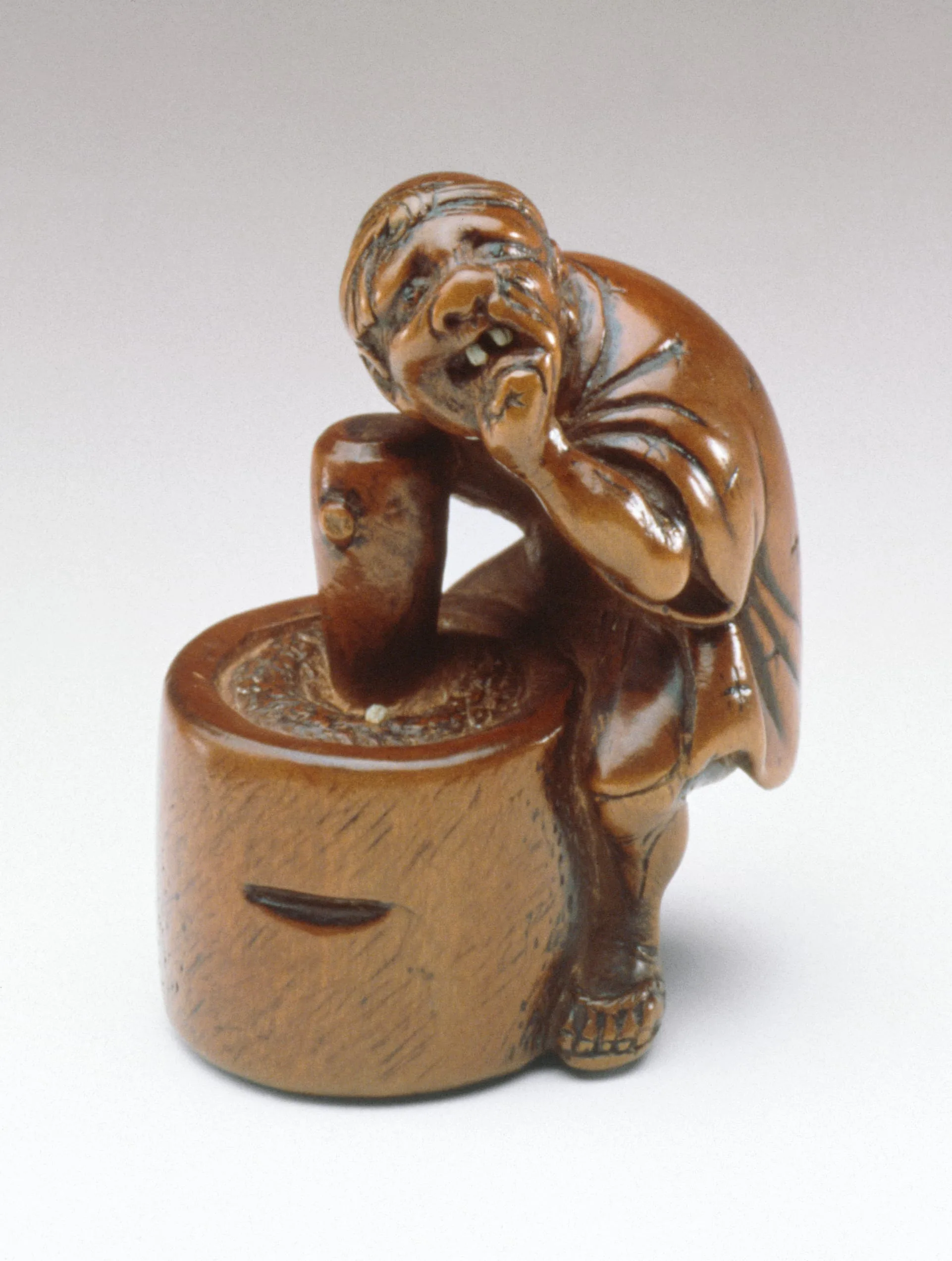
Netsuke are small items—most often carvings—that were attached by a cord to inrō or other hanging containers. They sat atop or were tucked into a kimono sash (obi) to secure the suspended objects. Netsuke were produced in a wide variety of forms, katabori (in the round) being the most abundant and familiar type. Carved and finished on all sides, katabori represent a limitless variety of subjects, in simple designs or complex groups, including figures from history, religion, mythology, and folklore; animals and mythical beasts; talismanic motifs, insects, plants, and objects from daily life; and genre scenes, such as this tiny sculpture of a laborer worrying a loose tooth with one hand while pounding rice with the other.
Jobun, the carver, worked in Edo and was known for his humorous figural netsuke (see M.90.186.20). He favored portraying people engaged in everyday activities, often revealing the unseen or less glamorous aspects of life. Working almost exclusively in boxwood, he usually inlaid the pupils of the eyes in a darker material. The teeth of this figure are inlaid with ivory.
For the carver, one of the challenges of designing a katabori-type netsuke was to create a composition that would be functional as well as attractive. The cord hole (himotoshi) had to be carefully positioned so as not to interrupt the overall composition and to allow the netsuke to rest upright on the kimono sash. The design needed to be compact with no protrusions that might break or catch the garment’s sleeve. All the parts of Jobun’s worker with a toothache—feet, mallet, hand raised to mouth—are carefully placed to form a functional object.
2024