LACMA

ShopMembershipMyLACMATickets
LACMA
Los Angeles County Museum of Art
5905 Wilshire Blvd.
Los Angeles, CA 90036
info@lacma.org
(323) 857-6000
Sign up to receive emails
Subscribe
© Museum Associates 2026
  • About LACMA
  • Jobs
  • Building LACMA
  • Host An Event
  • Unframed
  • Press
  • FAQs
  • Log in to MyLACMA
  • Privacy Policy
© Museum Associates 2026
Collections

Unknown
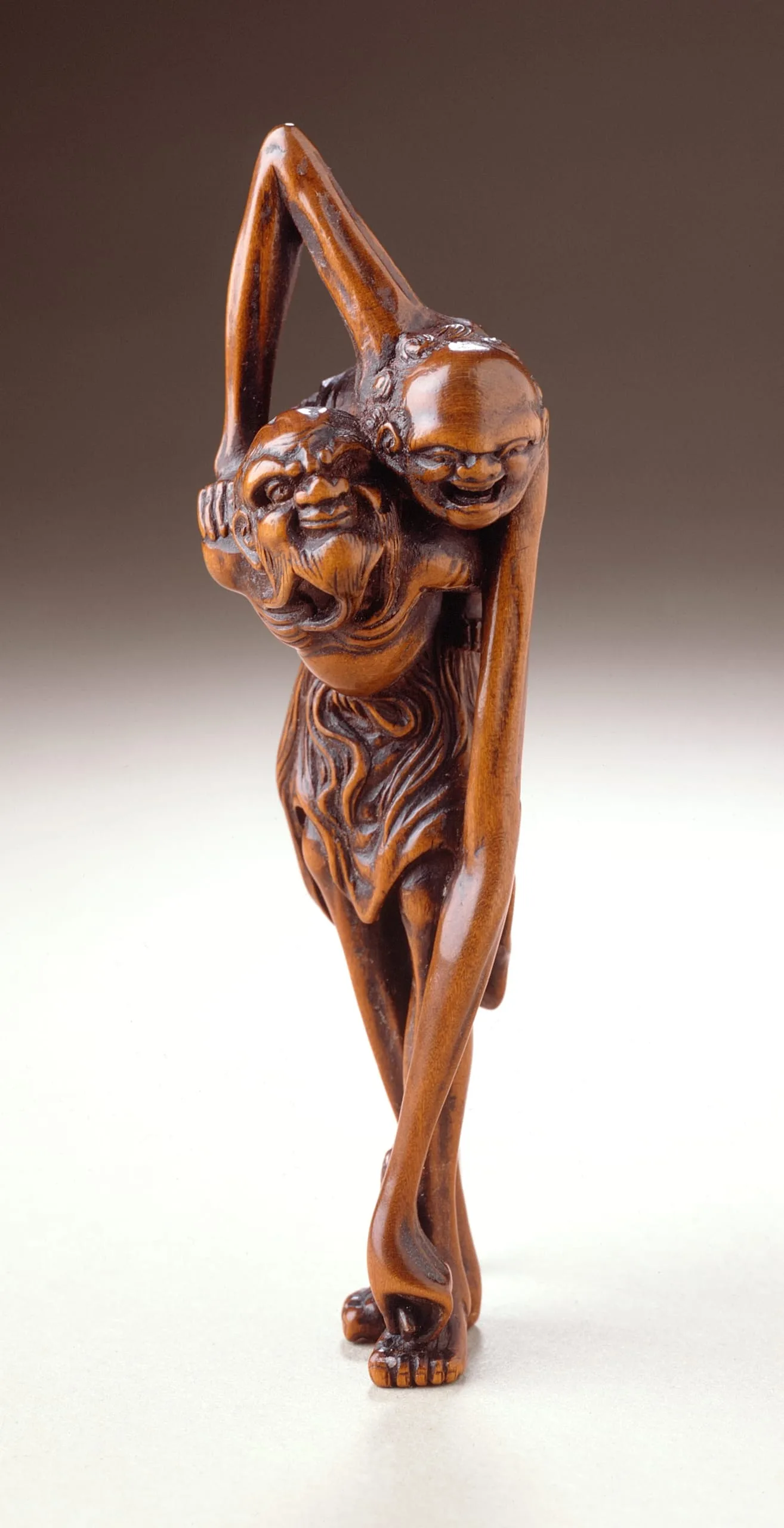
Ashinaga and Tenagalate 18th-early 19th century

Not on view
Small wood netsuke sculpture of a stooped, bearded figure with arching arms, a smaller smiling figure riding on its back, polished honey-brown finish

Unknown, Ashinaga and Tenaga, late 18th-early 19th century, Los Angeles County Museum of Art, Raymond and Frances Bushell Collection, photo © Museum Associates/LACMA

Artist or Maker
Unknown
Title
Ashinaga and Tenaga
Place Made
Japan
Date Made
late 18th-early 19th century
Period
Edo period (1603-1868)
Medium
Wood with metal
Dimensions
4 7/16 x 1 5/16 x 1 1/4 in. (11.2 x 3.3 x 3.2 cm)
Credit Line
Raymond and Frances Bushell Collection
Accession Number
M.91.250.112
Classification
Costumes
Collecting Area
Japanese Art
Curatorial Notes

Ashinaga (Long Legs) and Tenaga (Long Arms) are among the many strange beings represented in netsuke, where they usually appear together, barefoot and wearing only cloth skirts, as in this small sculptural group. Hoisted on Ashinaga’s shoulders, Tenaga reaches down with his long arms for whatever sea creature lays at his companion’s feet, typically an octopus or some type of fish, but occasionally a crab or an eel. In the nineteenth century, the subject found favor with some Japanese painters and print designers, such as Katsushika Hokusai, Utagawa Kuniyoshi, and Kawanabe Kyōsai, but the pair appear far more frequently in netsuke than in any other Japanese medium. They were originally among the many foreign lands and peoples recorded in the ancient Chinese text Shanhaijing (Classic of Mountains and Seas). Copies of this volume and other Chinese texts made their way to Japan, where they were incorporated into publications and encyclopedias throughout the Edo period (1615−1868), providing Japanese artists with a plethora of bizarre creatures, humanlike figures, and foreign beings from which to draw inspiration. In early Chinese sources, Ashinaga and Tenaga are variously described as fishing together—with Long Legs carrying Long Arms on his shoulders—or as individual beings. The pairing of the two seems to have developed in Japan during the Edo period, when it became the standard depiction, emblematic of cooperation, mutual support, and the benefits of contributing to the greater good.

2024
Selected Bibliography
  • Bushell, Raymond. An Exhibition of Netsuke from the Raymond Bushell Collection. Tokyo: Mikimoto World Jewelers, 1979.
  • Goodall, Hollis, Virginia G. Atchley, Neil K. Davey, Christine Drosse, Sebastian Izzard, Odile Madden, and Robert T. Singer. The Raymond and Frances Bushell Collection of Netsuke: A Legacy at the Los Angeles County Museum of Art. Chicago: Art Media Resources, Inc.; Los Angeles: Los Angeles County Museum of Art, 2003.
  • Bushell, Raymond. Netsuke: Japanese Scultpure in Minature from the Collection of Raymond and Frances Bushell, Part II. Los Angeles: Los Angeles County Museum of Art, 1985.
  • Drosse, Christine. "Netsuke Basics from A to Z: L." International Netsuke Society Journal 30, no.1 (2010): 34-39.