- Artist or Maker
- Kenya
Japan, Kyoto, active 1825-1889 - Title
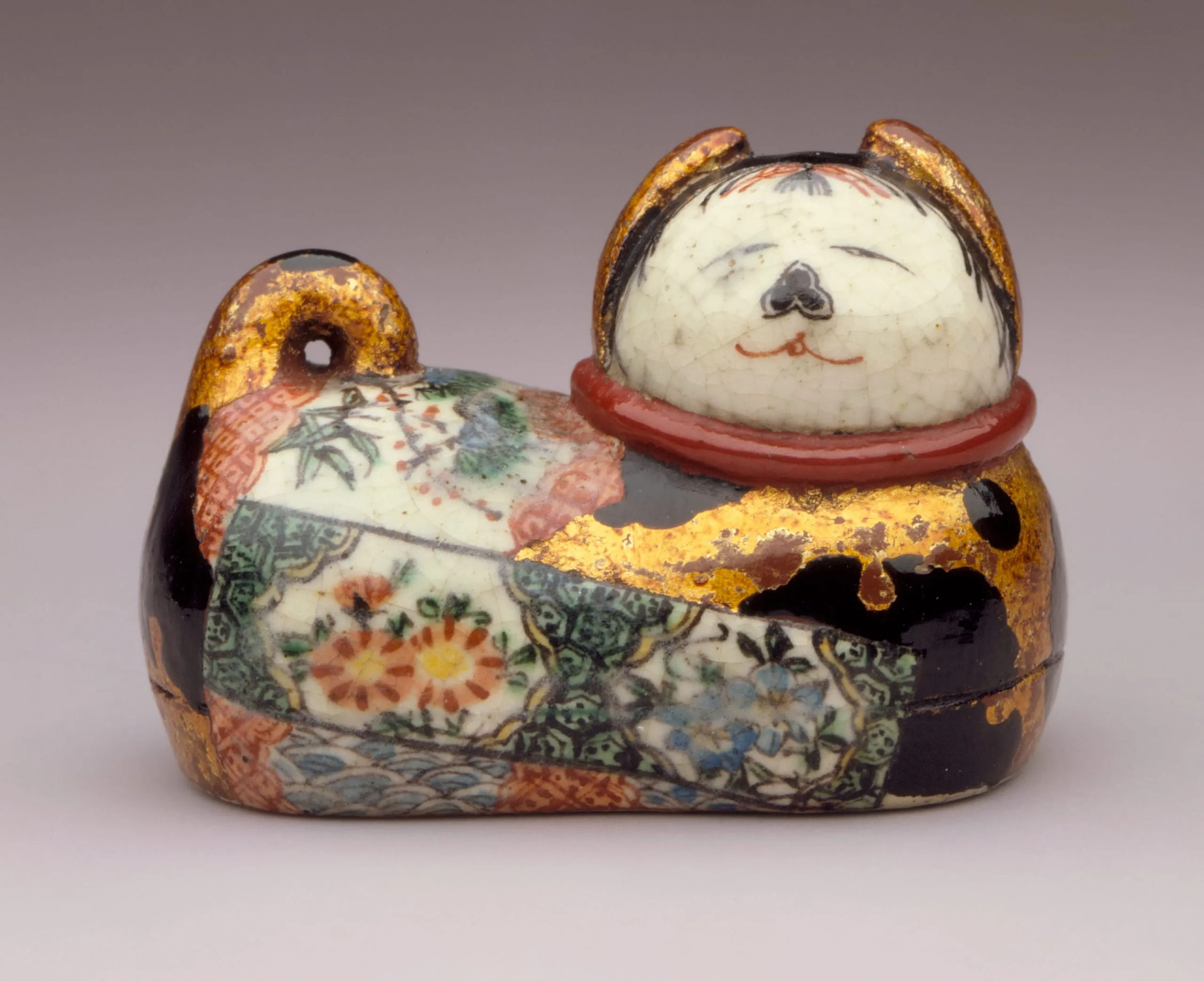
- Dog-Shaped Box
- Date Made
- mid-19th century
- Medium
- Pottery with glazes and overglaze enamels
- Dimensions
- 1 7/16 x 1 x 15/16 in. (3.7 x 2.6 x 2.3 cm)
- Accession Number
- M.87.263.63
- Curatorial Notes
As functional objects that were worn and handled repeatedly through daily use, netsuke needed to be crafted from a durable material. Ceramic netsuke such as this dog-shaped faux box, though more prone to damage as compared to ivory or wood examples, are not uncommon. Some potters fabricated entire ensembles of inrō, ojime, and netsuke. As here, clay netsuke were typically moldmade, and surface decoration was applied using glazes and overglaze enamels. The collar around the dog’s neck was likely added to the form after it was removed from the mold and before firing. A thin line has been incised around the lower part of the dog to suggest the meeting of the box bottom and its removable lid. The underside bears the signature Kenya.
The bright colors and decorative designs seen here are trademarks of Kyoto ceramics, dating back to the work of potters Nonomura Ninsei (active c. 1646–94) and Ogata Kenzan (1663−1743). The former was famed for his use of overglaze enamels, the latter for his innovative and colorful surface patterns. Termed “Kenzan style,” these treatments were applied to a variety of ceramic forms by workshops in both Kyoto and Edo throughout the eighteenth and nineteenth centuries.
2024
- Selected Bibliography
- Bushell, Raymond. Netsuke: Japanese Sculpture in Miniature from the Collection of Raymond and Frances Bushell, Part III. Los Angeles: Los Angeles County Museum of Art, 1986.
- Goodall, Hollis, Virginia G. Atchley, Neil K. Davey, Christine Drosse, Sebastian Izzard, Odile Madden, and Robert T. Singer. The Raymond and Frances Bushell Collection of Netsuke: A Legacy at the Los Angeles County Museum of Art. Chicago: Art Media Resources, Inc.; Los Angeles: Los Angeles County Museum of Art, 2003.