LACMA

ShopMembershipMyLACMATickets
LACMA
Los Angeles County Museum of Art
5905 Wilshire Blvd.
Los Angeles, CA 90036
info@lacma.org
(323) 857-6000
Sign up to receive emails
Subscribe
© Museum Associates 2026
  • About LACMA
  • Jobs
  • Building LACMA
  • Host An Event
  • Unframed
  • Press
  • FAQs
  • Log in to MyLACMA
  • Privacy Policy
© Museum Associates 2026
Collections

Unknown
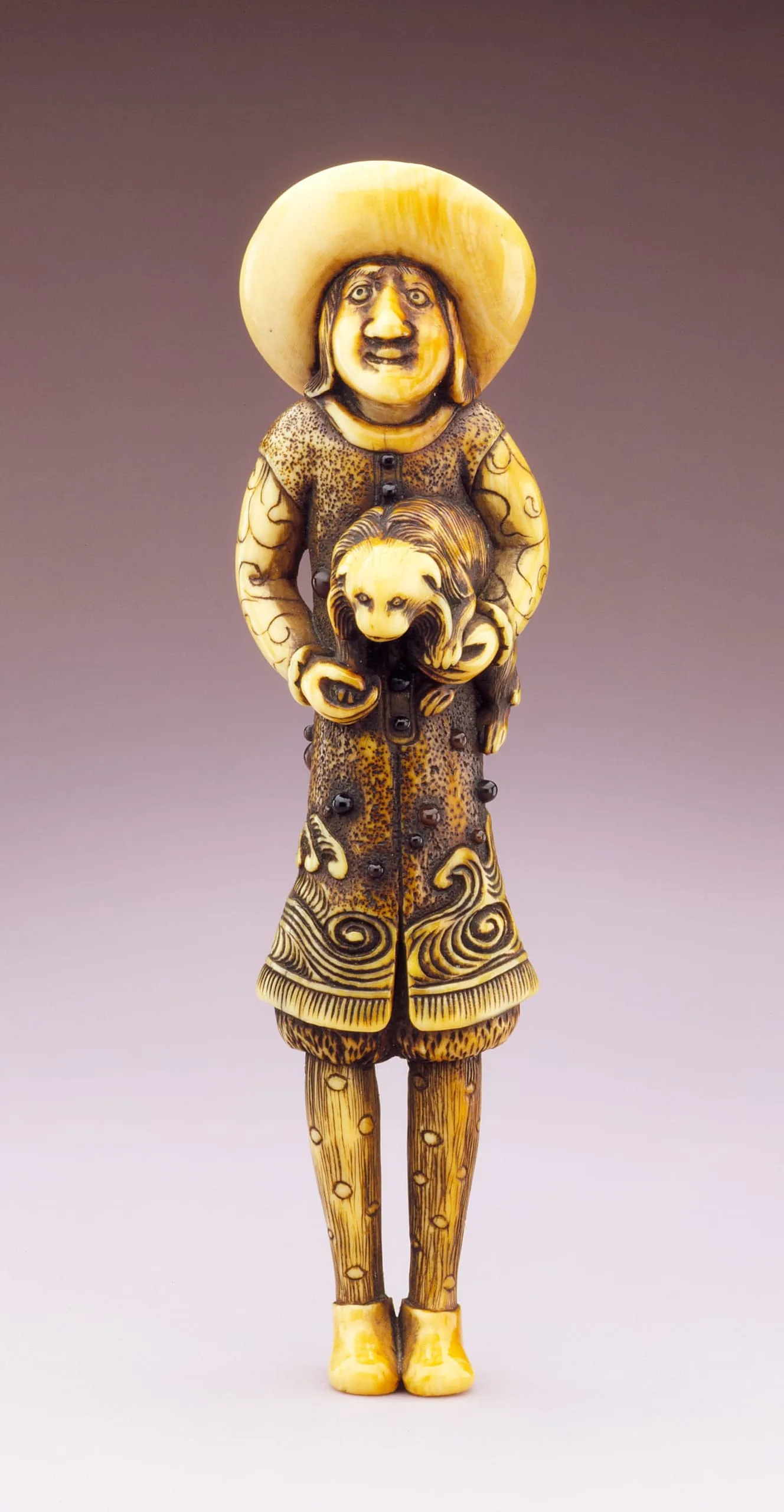
Dutchman Holding Dog18th century

On view:
Geffen Galleries
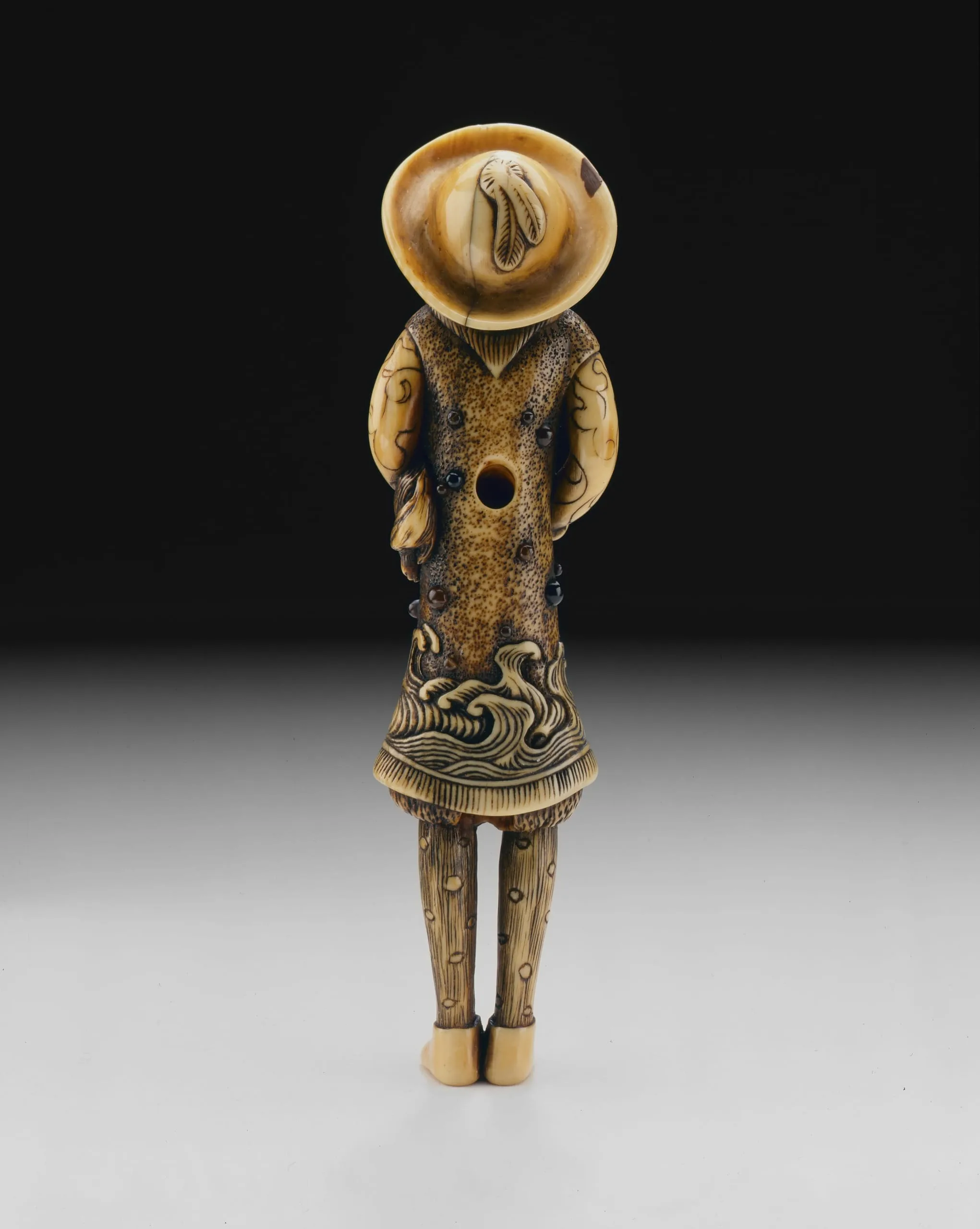
Small ivory netsuke figure of a standing man in a wide-brimmed hat and fur-textured coat, holding an animal head, with deeply carved decorative details
Ivory netsuke of a standing figure seen from the back, wearing a wide-brimmed hat and robe with finely carved wave patterns at the hem; stained and incised surface details throughout, with inlaid dark eyes visible at the sides.

Unknown, Dutchman Holding Dog, 18th century, Los Angeles County Museum of Art, Raymond and Frances Bushell Collection, photo © Museum Associates/LACMA

Artist or Maker
Unknown
Title
Dutchman Holding Dog
Place Made
Japan
Date Made
18th century
Period
Edo period (1603-1868)
Medium
Ivory with staining, sumi, inlays
Dimensions
3 15/16 x 1 x 7/8 in. (10.0 x 2.6 x 2.3 cm)
Credit Line
Raymond and Frances Bushell Collection
Accession Number
M.87.263.1
Classification
Costumes
Collecting Area
Japanese Art
Curatorial Notes

For much of the Edo period (1615−1868), foreign trade in Japan was very limited. From roughly 1640 to the mid-nineteenth century, the only Westerners permitted official trade privileges with Japan were the Dutch, who were confined to a small man-made island in the bay at Nagasaki. The Japanese were fascinated with all things foreign, and objects decorated with images of foreigners were popular. With few opportunities for firsthand observation, renderings of Dutchmen were primarily based on existing pictorial works such as paintings, prints, or printed books. Over time, however, the much-repeated physical features, attire, and associated objects of the Dutch became formulaic. With few exceptions, Dutchmen were depicted with large noses, large round eyes, and long curly hair. In polychrome works, their hair would be red. They sported long coats often decorated with a design of water, the waves alluding both to the sea from which they arrived and to their professions as seafaring traders. Hats were common attributes, and the buttons running down the front of their coats were invariably emphasized with the use of inlays. They were frequently portrayed holding a small animal or bird, particularly a rooster or dog, as here, or an item associated with their foreign origins such as a matchlock gun, spyglass, or trumpetlike horn. The majority of netsuke portraying foreigners were fashioned from ivory, an imported material that further emphasized the figures’ overseas origins.

2025
Selected Bibliography
  • Bushell, Raymond. The Wonderful World of Netsuke. Rutland, VT: Charles E. Tuttle Co., Inc., 1964.
  • Bushell, Raymond. Netsuke: Japanese Sculpture in Miniature from the Collection of Raymond and Frances Bushell, Part III. Los Angeles: Los Angeles County Museum of Art, 1986.
  • Goodall, Hollis, Virginia G. Atchley, Neil K. Davey, Christine Drosse, Sebastian Izzard, Odile Madden, and Robert T. Singer. The Raymond and Frances Bushell Collection of Netsuke: A Legacy at the Los Angeles County Museum of Art. Chicago: Art Media Resources, Inc.; Los Angeles: Los Angeles County Museum of Art, 2003.
  • Drosse, Christine. "Netsuke Basics from A to Z: H." International Netsuke Society Journal 29, no.2 (2009): 50-55.
  • Goodall, Hollis. "Beyond Ivory: the Colorful World of Netsuke, Part 1." International Netsuke Society Journal 24, no.4 (2004): 14-22.