- Artist or Maker
- Kishōsai
Japan, active late 19th century - Title
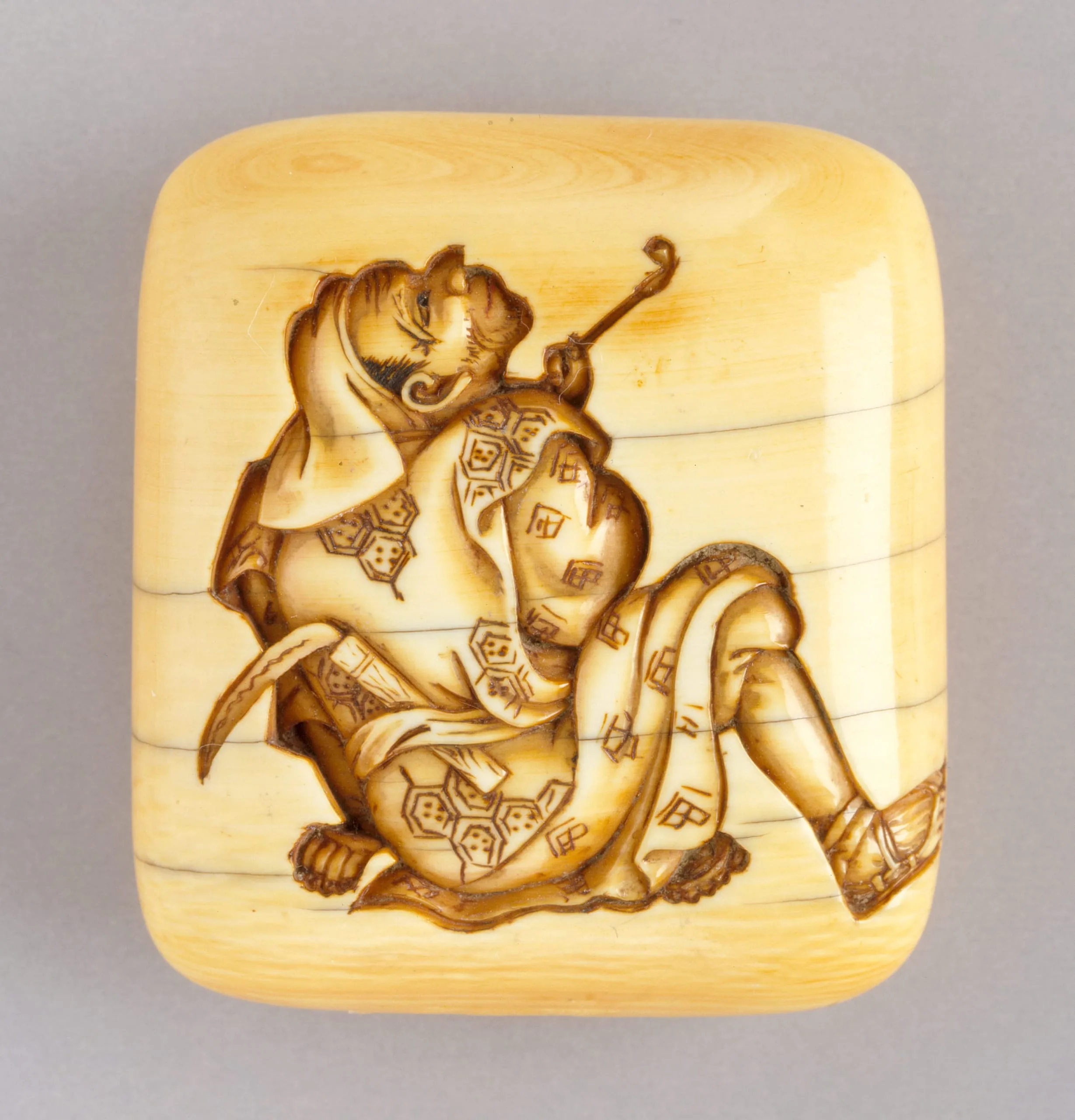
- Peasant Viewing the Moon
- Date Made
- late 19th century
- Medium
- Ivory with staining, sumi, red pigment; manjū type
- Dimensions
- 1 5/8 x 1 5/16 x 9/16 in. (4.1 x 3.4 x 1.5 cm)
- Accession Number
- M.87.263.23
- Curatorial Notes
Netsuke are small items—most often carvings—that were attached by a cord to inrō or other hanging containers. They sat atop or were tucked into a kimono sash (obi) to secure the suspended objects. Netsuke were produced in a wide variety of forms, manjū being the most compact, named after the traditional bean-paste bun, a popular Japanese confection. A manjū can be fabricated as a solid piece of material or two pieces that fit together and, though typically round in form, may take other shapes.
This square, solid manjū depicts a seated peasant viewing the moon. Tsukimi (moon-viewing) was a favorite festival in the Edo period (1615−1868). It dates back to ancient times when it was a means of giving thanks for an abundant harvest and offering prayers for future prosperity. On the back side of this manjū, in addition to a pair of holes through which the inrō cord was tied, are the artist’s signature and an incised drawing of a pair of rabbits, alluding to the animal’s lunar symbolism. In Japan, the moon is said to present a picture of a rabbit pounding mochi cakes with a mallet. Another connection is the homonym for “full moon” (mochizuki), which sounds like the phrase for pounding rice. Images of rabbits are routinely employed during or in reference to the moon-viewing season.
2024
- Selected Bibliography
- Bushell, Raymond. Netsuke Familiar and Unfamiliar: New Principles for Collecting. New York: Weatherhill, 1975.
- Bushell, Raymond. Netsuke: Japanese Sculpture in Miniature from the Collection of Raymond and Frances Bushell, Part III. Los Angeles: Los Angeles County Museum of Art, 1986.
- Goodall, Hollis, Virginia G. Atchley, Neil K. Davey, Christine Drosse, Sebastian Izzard, Odile Madden, and Robert T. Singer. The Raymond and Frances Bushell Collection of Netsuke: A Legacy at the Los Angeles County Museum of Art. Chicago: Art Media Resources, Inc.; Los Angeles: Los Angeles County Museum of Art, 2003.