- Title
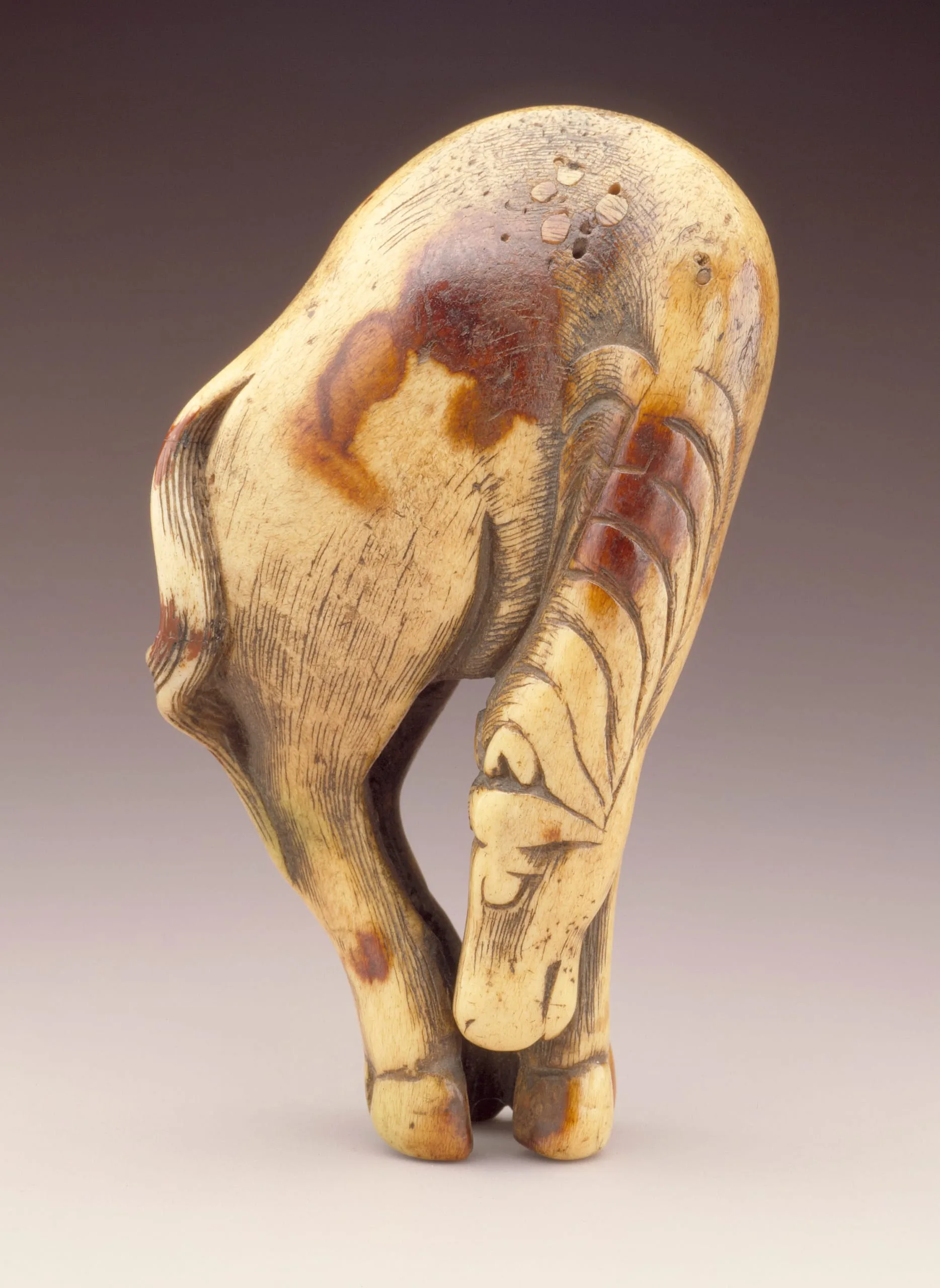
- Grazing Horse
- Date Made
- late 18th-early 19th century
- Medium
- Stag antler with staining, sumi
- Dimensions
- 3 x 1 5/8 x 15/16 in. (7.7 x 4.2 x 2.3 cm)
- Accession Number
- M.87.263.14
- Curatorial Notes
Netsuke were produced in a wide variety of materials native to Japan as well as imported and fabricated ones. Indigenous materials included numerous types of wood, marine ivory, boar tusk, and stag antler, as in this small sculpture of a grazing horse. While abundant and inexpensive, antler has its limitations: its texture is uneven, its porous center is brittle thus difficult to carve, and its natural form limits the sculpted object’s size and shape. A carver must choose a suitable subject or otherwise design a motif within these confines. The antler’s long, slender form lends itself to tall, figural subjects (sashi and obihasami types of netsuke) and pipe cases. Additionally, the juncture of two prongs forms a distinct shape that carvers typically incorporated into the design and is often discernible in the finished netsuke (see M.87.263.12). Plugs were often used to cover or fill in the unsightly and weak core. Typically, the artist would hide the plug by working it into the design. On figural netsuke, it is often disguised as the top of a hat. Here, rather than attempting to conceal the plugs, the artist used them to create the horse’s spotted coat. Some carvers also integrated the antler’s grooved surface into the final netsuke design.
2024
- Selected Bibliography
- Bushell, Raymond. An Exhibition of Netsuke from the Raymond Bushell Collection. Tokyo: Mikimoto World Jewelers, 1979.
- Bushell, Raymond. Netsuke: Japanese Sculpture in Miniature from the Collection of Raymond and Frances Bushell, Part III. Los Angeles: Los Angeles County Museum of Art, 1986.
- Goodall, Hollis, Virginia G. Atchley, Neil K. Davey, Christine Drosse, Sebastian Izzard, Odile Madden, and Robert T. Singer. The Raymond and Frances Bushell Collection of Netsuke: A Legacy at the Los Angeles County Museum of Art. Chicago: Art Media Resources, Inc.; Los Angeles: Los Angeles County Museum of Art, 2003.
- Phillips, Phoebe, ed. The Collectors' Encyclopedia of Antiques. New York: Crown Publishers, Inc., 1973.
- Bushell, Raymond. Netsuke Familiar and Unfamiliar: New Principles for Collecting. New York: Weatherhill, 1975.
- Drosse, Christine. "Netsuke Basics from A to Z: A." International Netsuke Society Journal 27, no.3 (2007): 58-63.
- Goodall, Hollis. "Beyond Ivory: the Colorful World of Netsuke, Part 1." International Netsuke Society Journal 24, no.4 (2004): 14-22.