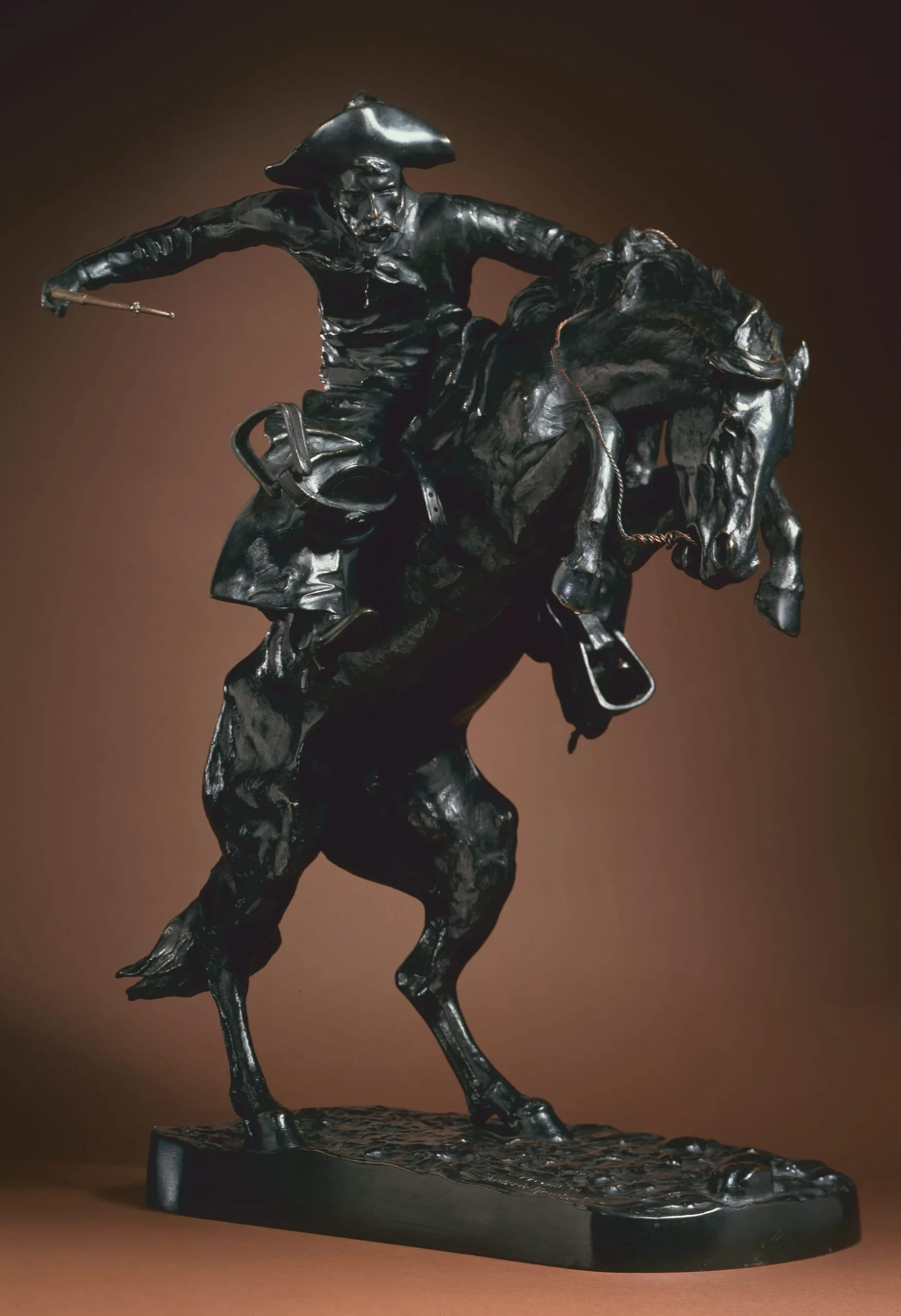
Remington was the first artist to specialize in Western sculpture. With the encouragement of the sculptor Frederick Wellington Ruckstull (1853-1942), who was then working on an equestrian monument, Remington set to work on his first sculpture, The Bronco Buster, in the late fall of 1894. He took his subject from A Pitching Bronco, one of his illustrations that had been published in the April 30, 1892, issue of Harper’s Weekly. He completed the sculpture by the third week of August 1895.
Remington’s direction in sculpture was probably inspired by his admiration for the animal bronzes of the great French sculptor Antoine-Louis Barye (1796-1875) and of the bronzes of the numerous French animal sculptors Barye inspired. Remington also had some contact with Augustus Saint-Gaudens, Frederick MacMonnies, the animalier Edward Kemeys (1843-1907), and other leading American sculptors. In the most important respects, however, Remington’s bronzes are distinctly his own. Especially characteristic is the almost photographic quality of suspended, violent movement and his interest in freeing the figure from the support of the base so that the work truly seems to be in motion.
The Bronco Buster was the most popular of Remington’s sculptures and had a long and active casting history. Because of the technical aspects of the sand-casting technique used by the Henry-Bonnard Bronze Company, the approximately seventy casts of the first edition were identical. Around 1900 Remington began to use Roman Bronze Works to cast sculpture. The lost-wax method used by this foundry permitted Remington to modify the model of The Bronco Buster to bring it closer to his evolving objectives. Between 1903 and 1907 he made numerous individual and permanent adjustments both in the plaster model and in the wax models used for each cast to give the sculpture a greater unity and more vivid sense of motion. Remington reached the final, perfected version of the model in 1907, in about cast number sixty, which all subsequent casts resemble. The museum’s cast is number sixty-nine, recorded with nine other numbers in the firm’s ledger on December 31, 1907. Roman Bronze Works cast about 307 examples of the statuette. The foundry also produced approximately twenty-two casts of a larger statue (see National Museum of American Art, Cast and Recast, pp. 92-99 for casting history and ownership of both sizes).