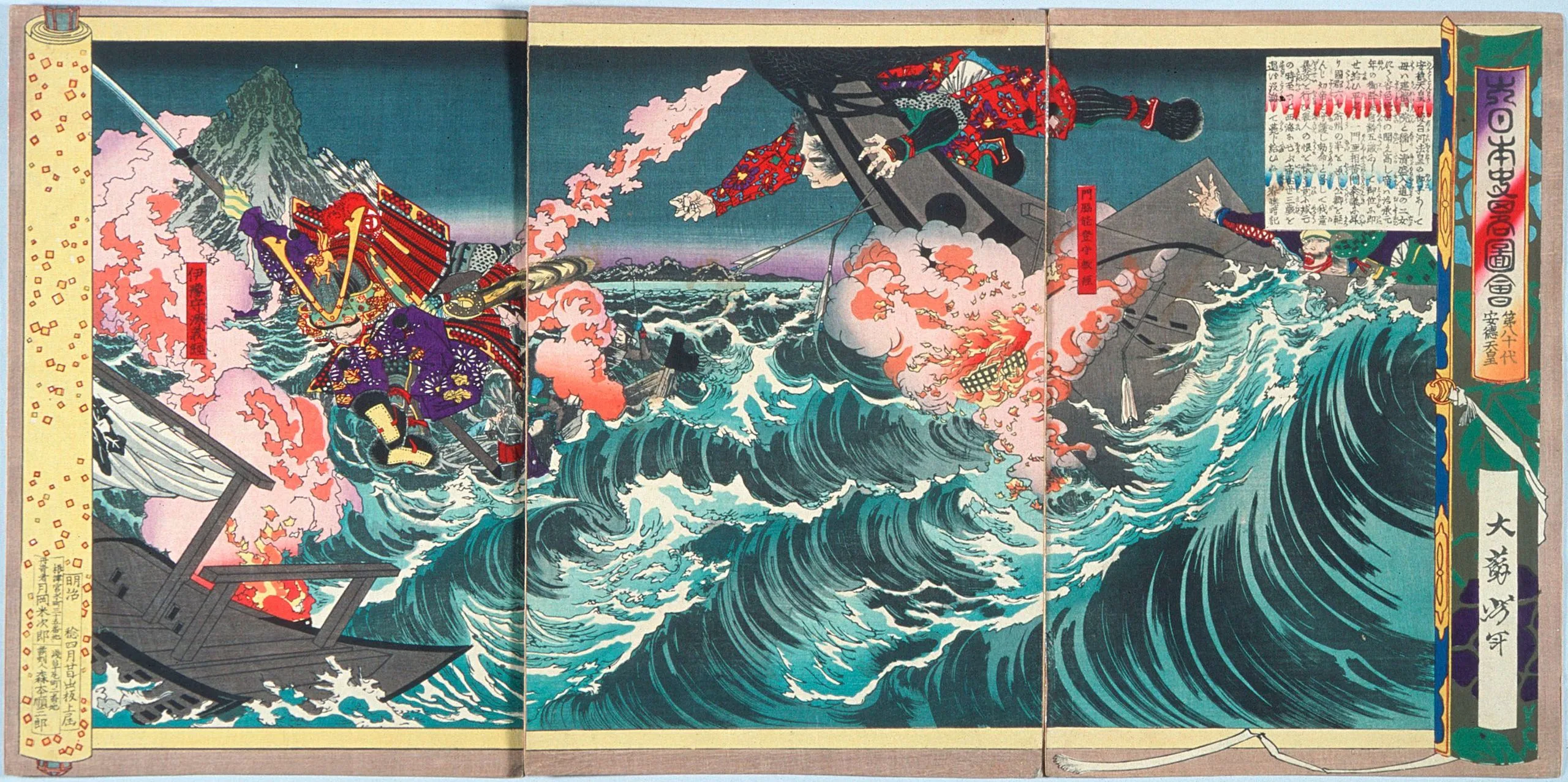
The great battles in 1185 at Yashima and Dannoura, two port cities located along the strait between Honshū and Kyushū, constituted the turning point in the Minamoto and Taira (Genpei) War (1180-1185) and in the life of Minamoto no Yoshitsune, (1159-1189) the heroic leader of the offensive against the Taira navy. Three of these prints depict a point in the Battle of Dannoura in which Yoshitsune leaps from boat to boat to escape the commander of the Taira navy, Noritsune. This is the first and only time Yoshitsune ever retreated from a foe, according to the Tales of Heike. His retreat foreshadows the remainder of Yoshitsune's life. Yoshitsune's successes at Yashima and Dannoura would arouse the envy and suspicion of his elder brother Yoritomo (1147-1199), who calls for the capture and execution of Yoshitsune. Yoshitsune spends the remainder of his life in hiding and ultimately commits seppuku, surrounded by Yoritomo's soldiers. He is a prime example of the "loser-hero" archetype immortalized in Japanese literature, theatre, and legend.
Typically in Japanese pictorial art, and seen in Yoshitoshi's prints, action moves from right to left, following the Japanese norm derived from reading text. In Kiyochika's print, the action moves from left to right, in a Western manner. Yoshitoshi resisted capitulation to Western influence, and his prints stand apart from those of his contemporaries, who adopted Western techniques more enthusiastically.