LACMA

ShopMembershipMyLACMATickets
LACMA
Los Angeles County Museum of Art
5905 Wilshire Blvd.
Los Angeles, CA 90036
info@lacma.org
(323) 857-6000
Sign up to receive emails
Subscribe
© Museum Associates 2026
  • About LACMA
  • Jobs
  • Building LACMA
  • Host An Event
  • Unframed
  • Press
  • FAQs
  • Log in to MyLACMA
  • Privacy Policy
© Museum Associates 2026
Collections

Tsukioka Yoshitoshi
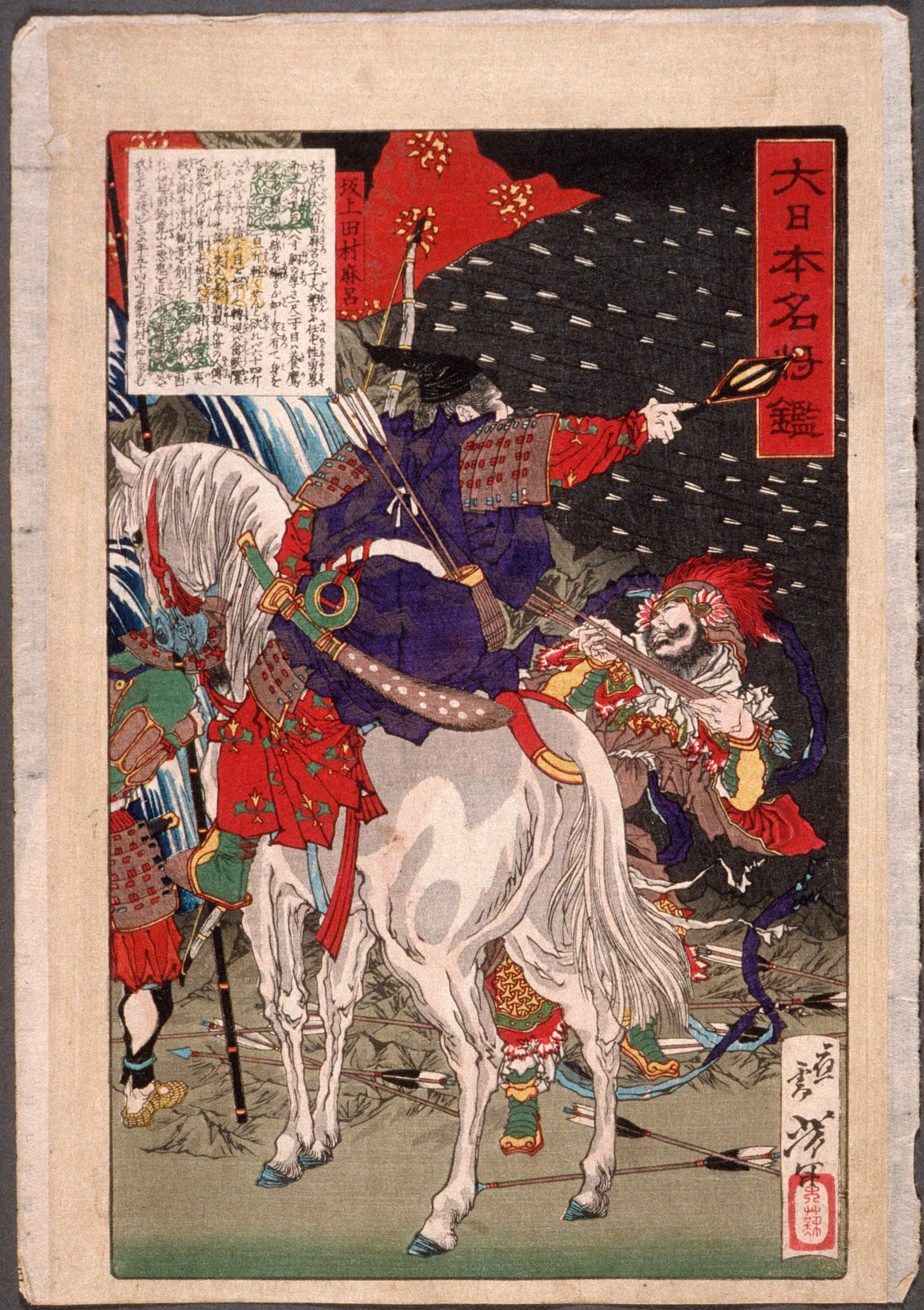
Sakanoue Tamuramaro in Rain of Arrows1876

Not on view
Japanese woodblock print of a battle scene with a rearing white horse, three armored warriors, and a rain-streaked black background in vivid red, indigo, and green

Tsukioka Yoshitoshi, Sakanoue Tamuramaro in Rain of Arrows, 1876, Los Angeles County Museum of Art, Herbert R. Cole Collection, photo © Museum Associates/LACMA

Artist or Maker
Tsukioka Yoshitoshi
Title
Sakanoue Tamuramaro in Rain of Arrows
Place Made
Japan
Date Made
1876
Period
Meiji period (1868-1912)
Medium
Color woodblock print
Dimensions
Image: 12 5/8 × 8 1/8 in. (32.07 × 20.64 cm) Sheet: 14 × 9 3/16 in. (35.56 × 23.34 cm)
Credit Line
Herbert R. Cole Collection
Accession Number
M.84.31.248
Classification
Prints
Collecting Area
Japanese Art
Curatorial Notes
When an event of great importance in the world occurs, it is said that the grave of Sakanoue Tamuramaro shakes mysteriously, a superstition arising from Sakanoue's central role in Japanese history. As Japan's first shogun in the late 8th century, Sakanoue served three different emperors with unfaltering fidelity. His legend was especially popular during Yoshitoshi's time, when the Meiji government promoted the emperor as a living emblem of Japanese culture and encouraged the country to serve him in any way possible. Here, we see Sakanoue directing a dense line of arrows toward an unseen enemy, most likely the Ainu, whom his emperor intended to force into submission. The rain of arrows in the name of the emperor symbolizes the intense nationalism of Meiji Japan as well as illustrating Sakanoue's potency as a military leader.