- Title
- Vessel with Applied Designs
- Date Made
- middle Jōmon phase, circa 3000-2000 B.C.
- Medium
- Coil-built earthenware with incised, modeled, and applied decoration
- Dimensions
- 22 × 10 in. (55.88 × 25.4 cm)
- Accession Number
- M.81.62.1
- Curatorial Notes
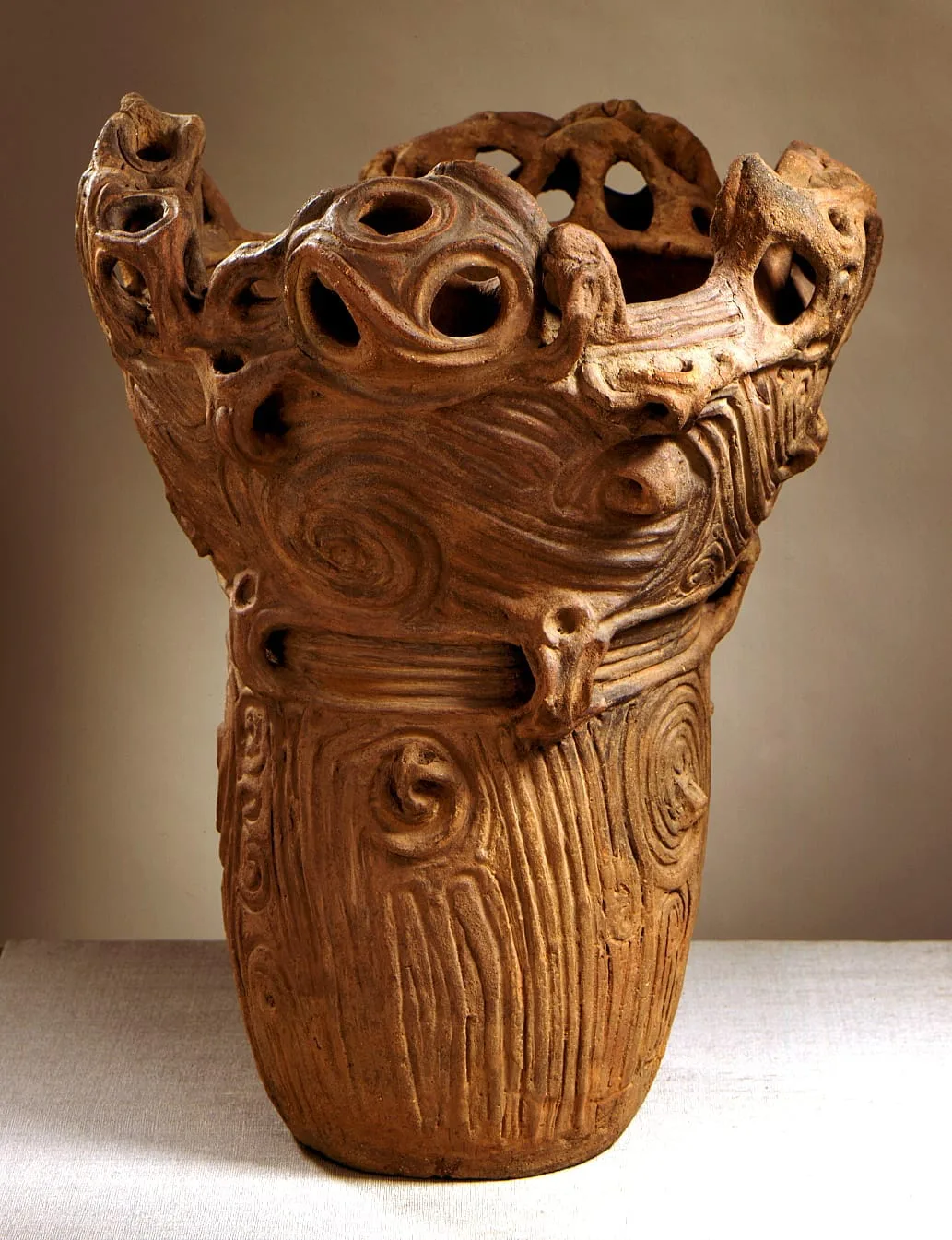
This impressive pottery vessel of the middle Jomon period (c. 3000 2000 b.c.) was made during Japan's earliest ceramic culture and is one of the most intriguing Neolithic works in the Los Angeles County Museum of Art. Such flamboyant pottery vases elaborately adorned with castellated rims and bold, textured surfaces were created in central Japan and found in the prefectures of Nagano and Niigata. Its grooved; meandering lines, loops and spirals produce a rich interplay of light and dark, and positive and negative space, which create an engaging work of sculpture. The vessel's surface is composed in registers, with vertical spirals at the bottom, a band of horizontal lines and vertical lugs and loops in the middle, and horizontal wavelike patterns and small, open loops in the swelling shoulder area. The top register breaks into open loops between horizontal bands around the rim. Series of swirls run between the shoulder and rim registers.
- Selected Bibliography
- Davis, James E.; Hawke, Sharryl Davis. TOKYO. Milwaukee, Wisconsin: Raintree Publishers, 1990.
- Los Angeles County Museum of Art. New York: Thames and Hudson, 2003.