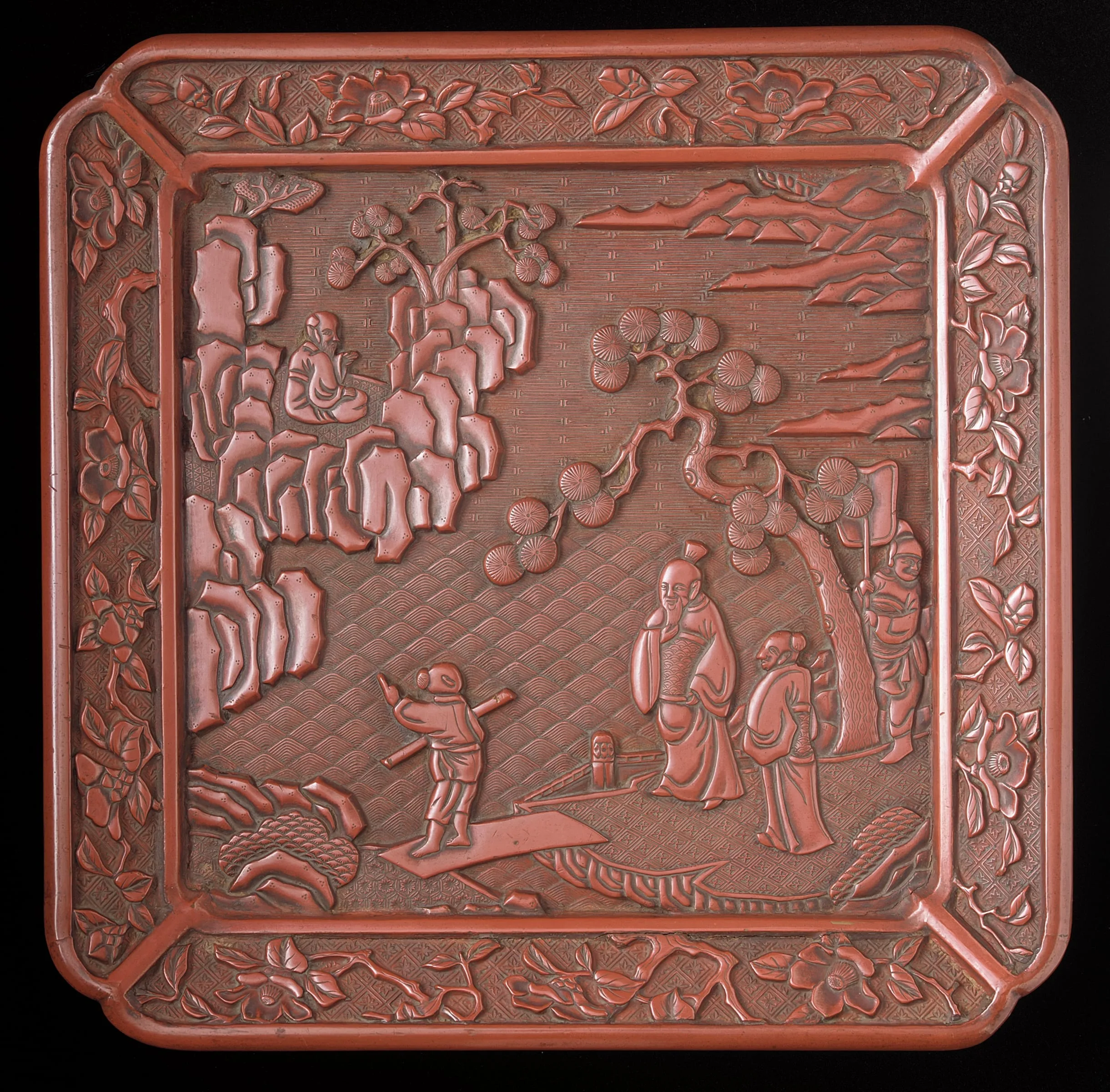
During the Muromachi period (1336−1573), Chinese objects were fashionable and in great demand in Japan, inspiring Japanese artists and artisans to emulate imported artworks and wares. Among the Chinese treatments explored by Japanese artists was a lacquer technique that involved the application of multiple coats of lacquer onto a substrate, building up a thick base into which a design was carved. Japanese artists reversed the process, first carving the design into a wood substrate and then applying mulitiple coats of lacquer.
Although the new Japanese technique was employed on this square tray, the design is very much in keeping with Chinese models. In the foreground, two figures stand on a lakeside garden terrace; a section of fence railing and post is visible to their right. Behind them, beside a pine tree, an attendant holds a large fan. A boy crosses the water on a small bridge and points to a sage meditating in a secluded rocky landscape. The entire scene is bordered by branches of blossoms and leaves. The ground of each section of the tray—sky, water, terrace, outer border—is carved with a different diaper pattern, a type of surface decoration composed of connecting geometric shapes such as squares, circles, or diamonds. It was a popular decorative treatment in both China and Japan, used on a range of objects, such as ceramics, lacquers, and textiles.
2025