- Title
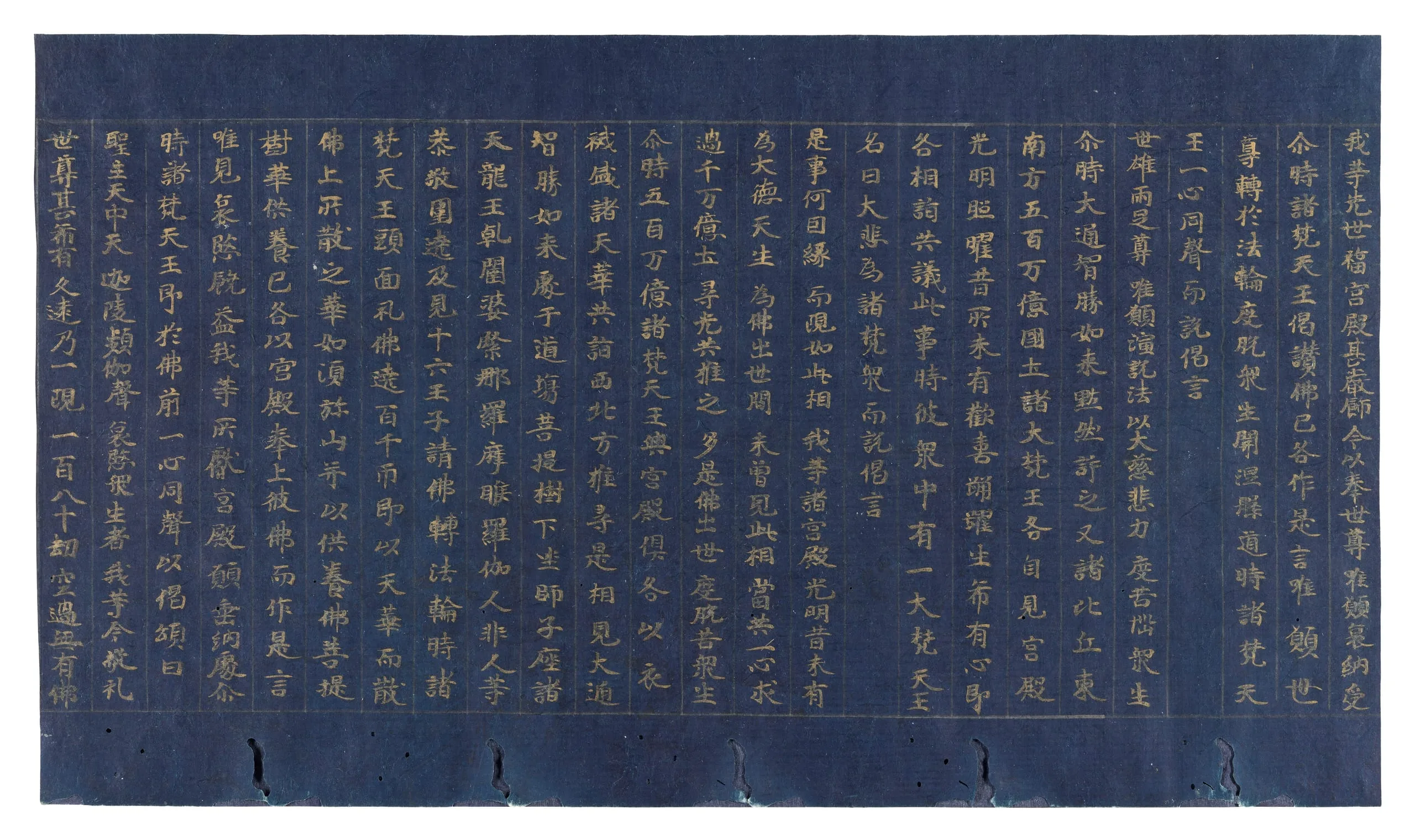
- Section of a Variant Version of the Lotus Sutra
- Date Made
- unknown date
- Medium
- Metallic ink on indigo-dyed paper
- Dimensions
- Image: 10 × 17 3/8 in. (25.4 × 44.13 cm)
Sheet: 10 × 17 3/8 in. (25.4 × 44.13 cm)
- Accession Number
- M.79.152.543
- Curatorial Notes
In Buddhism, the act of transcribing and transmitting sacred teachings, known as sutra, is an important means to accumulate religious merits. The Lotus Sutra (Skt. Saddharma Pundarika Sutra) preaches one’s rebirth in the Western Paradise or Pure Land where the Buddha Amida (Skt. Amitabha) resides. The teaching therefore garnered popular appeal, especially by the end of the Heian period (794–1185) and into the Kamakura period (1185–1333). Originally much longer, this excerpt is from the sutra’s seventh chapter, known as Kejōyu in Japan. It introduces the karmic connection between the Buddha and all living beings from the past. The use of luxurious materials, such as gold ink on indigo-dyed paper, initiated in Tang-dynasty China and later adopted in Korea and Japan, reflects the devotion embodied in these carefully written, splendid scriptures.
Rika Hiro
2025