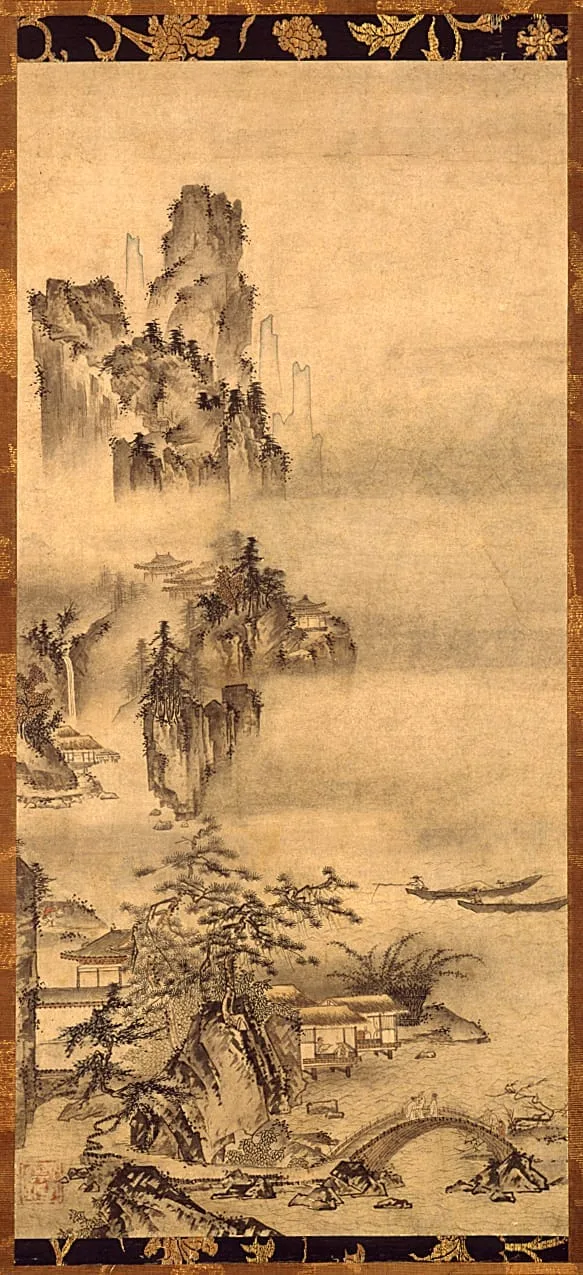
Sokan is identified as the painter of this landscape by a seal in the lower left corner. Nothing is known of Sokan's life, but on stylistic grounds, he can be placed in the second quarter of the sixteenth century. The painting is within the tradition of monochromatic ink painting established by Tensho Shubun (fl.1414 63) based on his study of recent and contemporary Korean painting. Its closest model, however, appears to be the work of Gakuo Zokyu, who was active in the first two decades of the sixteenth century. Gakuo's style is brought to mind by a number of factors. Foremost is the complicated spatial treatment that gives the impression of a two-dimensional presentation of the fore-, middle, and background. Gakuo's style is also notable in the preoccupation with atmospheric voids, isolation of peaks within the landscape, and layered brushstrokes creating striking tonal contrasts. Elements typical of the Muromachi period include using arbitrary scale, weighting the composition to one side, and contrasting strongly vertical land masses with voids. The harmonious arrangement of a multitude of visual elements within a complex, tripartite composition reveals a talented artist of the late Muromachi period.
Paintings of scholars or philosophers surrounded by remote pinnacles, tall pines, waterfalls, and mists, with no company except that of country people, reflect ideals familiar in Western literature and paintings of the eighteenth and nineteenth centuries. These themes of isolation, reflection, and simplicity are conventions that Japanese artists and scholars, emulating the lifestyle and aesthetic preoccupation of their Chinese mentors, readily adopted. This reflective, somewhat romantic ink landscape includes pale touches of red and yellow, which enhance its lyrical quality.