LACMA

ShopMembershipMyLACMATickets
LACMA
Los Angeles County Museum of Art
5905 Wilshire Blvd.
Los Angeles, CA 90036
info@lacma.org
(323) 857-6000
Sign up to receive emails
Subscribe
© Museum Associates 2026
  • About LACMA
  • Jobs
  • Building LACMA
  • Host An Event
  • Unframed
  • Press
  • FAQs
  • Log in to MyLACMA
  • Privacy Policy
© Museum Associates 2026
Collections

Unknown
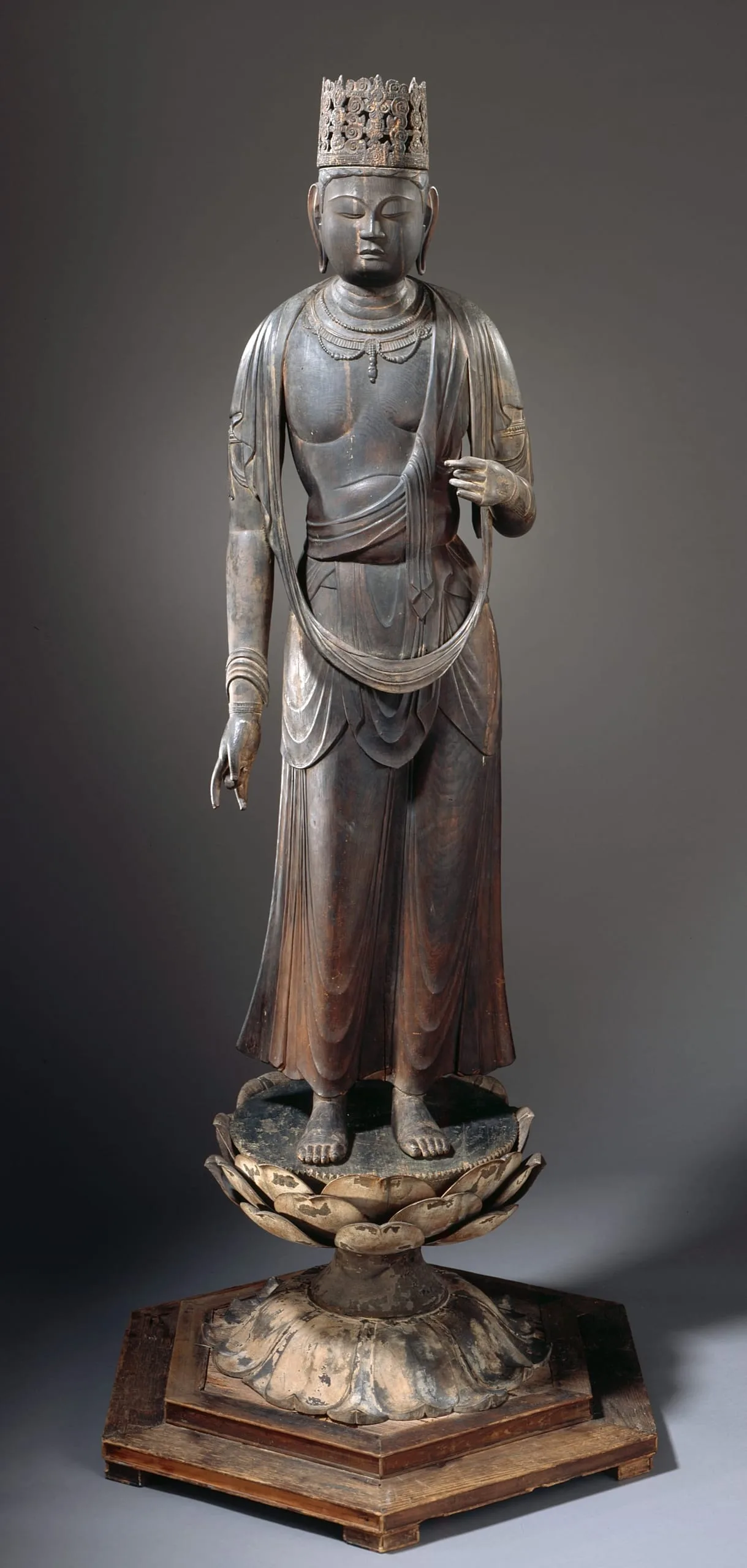
The Bodhisattva Kannon12th century

On view:
Geffen Galleries
Tall carved wood sculpture of a standing robed figure wearing an openwork crown, standing on a carved lotus base atop a hexagonal wooden pedestal

Anonymous, The Bodhisattva Kannon, 12th century (alternate view), Los Angeles County Museum of Art, Mr. and Mrs. Allan C. Balch Fund, photo © Museum Associates/LACMA

Artist or Maker
Unknown
Title
The Bodhisattva Kannon
Place Made
Japan
Date Made
12th century
Period
Heian period (794-1185) or Kamakura period (1185-1333)
Medium
Carved wood
Dimensions
(.a-.c) 85 × 32 1/2 × 36 in. (215.9 × 82.55 × 91.44 cm)
Credit Line
Mr. and Mrs. Allan C. Balch Fund
Accession Number
M.62.6a-c
Classification
Sculpture
Collecting Area
Japanese Art
Curatorial Notes

This butsuzо̄, or sculpture of a Buddhist deity, depicts the Bodhisattva Kannon (Skt. Avalokiteshvara). Among the bodhisattvas (J. bosatsu), deities who have delayed their entry into nirvana to guide others to enlightenment, Kannon is worshipped above all for boundless compassion. Because of this, Kannon is arguably the most beloved and popular Buddhist deity in Japan.

Kannon could be depicted in male or female forms, but after the eighth century in Japan, images of the bodhisattva tended to be feminized. Depictions of Kannon are countless and diverse, with iconography dependent on the preferences of the commissioning body, whether clergy or aristocracy, and the busshi (sculptor of Buddhist figures). Details consistently associated with Kannon, but not always evident, are: (1) a miniature figure of Amida (Skt. Amitabha), Buddha of the Western Paradise, mounted in the bodhisattva’s crown (not seen here); (2) the raigо̄-in, or welcoming gesture, where the tips of the thumb and middle finger touch (seen here); and (3) a lotus stem gripped in the hand or fingers, a lotus being the symbolic representation of a being rising above the filth of life and reaching enlightenment (probably lost). Here, the crown could be a later replacement. Kannon’s visage is impassive though gentle, in the manner of the late Heian period (794−1185). The figure would have been carved from a single block of wood. The lotus pedestal and crown were carved separately and attached using metal joiners and wood pegs.
Selected Bibliography
  • Hopkins, Henry T., ed. Illustrated Handbook of the Los Angeles County Museum of Art. West Germany: Bruder Hartmann, 1965.
  • Dobbins, James C. Behold the Buddha: Religious Meanings of Japanese Buddhist Icons. Honolulu: University of Hawai'i Press, 2020.
  • Little, Stephen, Tushara Bindu Gude, Karina Romero Blanco, Silvia Seligson, Marco Antonio Karam. Las Huellas de Buda. Ciudad de México : Instituto Nacional de Antropología e Historia, 2018.
  • Little, Stephen, and Tushara Bindu Gude. Realms of the Dharma: Buddhist Art across Asia. Los Angeles: Los Angeles County Museum of Art, 2025.