- Artist or Maker
- Tōsensai
Japan, active 19th century - Title
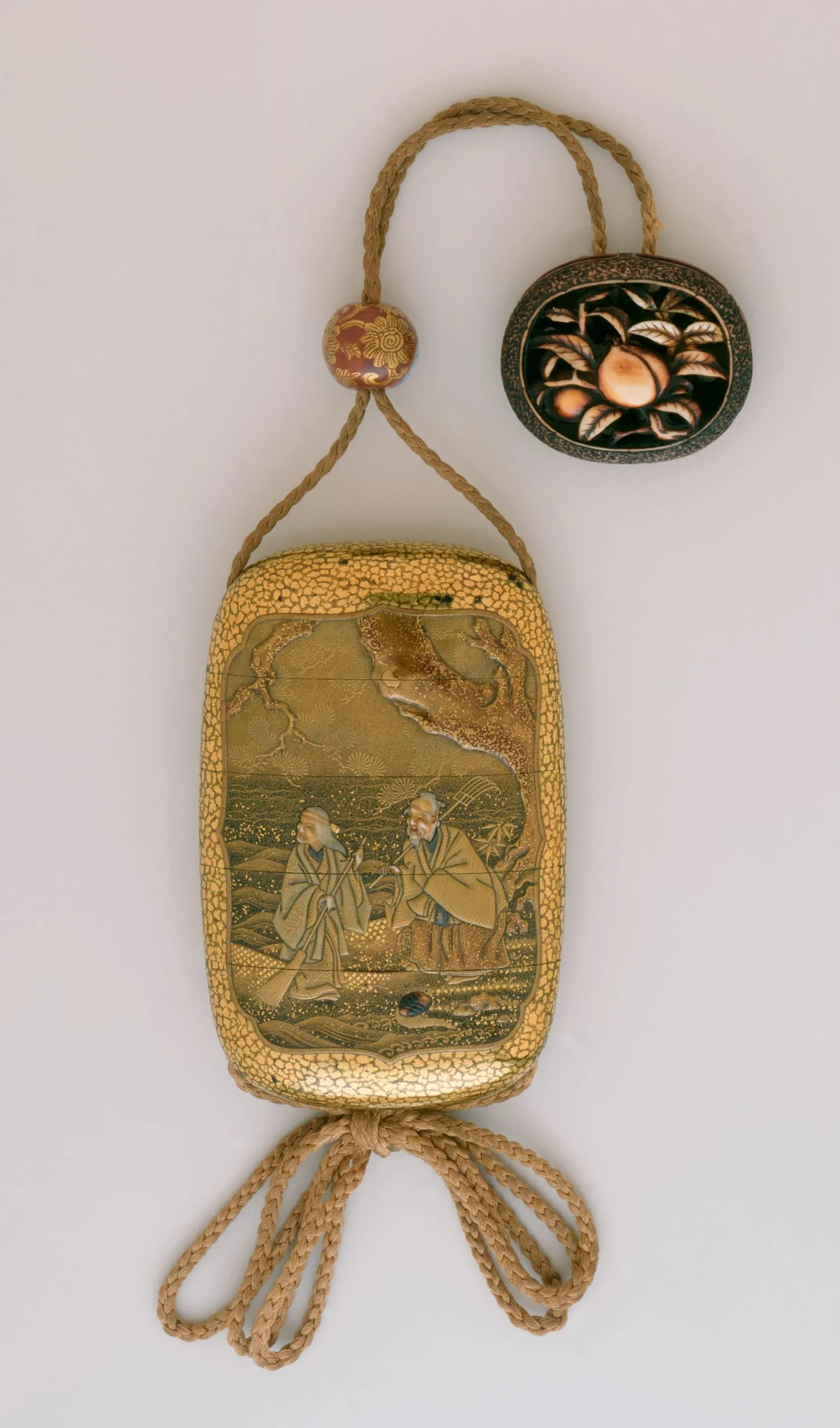
- Jō and Uba (Inrō/Ojime/Netsuke Ensemble)
- Date Made
- early 19th century
- Medium
- [inrō] Gold takamakie, hiramakie, nashiji, and togidashi lacquers with ivory and tortoiseshell(?) inlays; [ojime] porcelain with cobalt underglaze and overglaze enamels; [netsuke] ivory with staining
- Dimensions
- a) inro: 3 7/16 × 2 5/16 × 11/16 in. (8.8 × 5.8 × 1.8 cm)
b) ojime: 1/2 × 9/16 × 9/16 in. (1.3 × 1.5 × 1.5 cm)
c) netsuke: 1 5/16 × 1 9/16 × 3/8 in. (3.3 × 3.9 × 1 cm)
- Accession Number
- M.39.2.324a-c
- Curatorial Notes
The Japanese legend of the pine trees at Takasago and Sumiyoshi is told in the popular Noh play titled Takasago, in which the spirits of the trees manifest as an old married couple, Jō and Uba, and narrate the story of the “Twin Pines.” Having enjoyed a long and happy life together, the couple symbolize longevity and conjugal harmony. They are said to visit the lakeshore on moonlit nights to gather pine needles, Jō with his rake and Uba with her broom. In Japanese artworks, the scene invariably includes other symbols of longevity, such as a pine, a long-tailed turtle (minogame), and a crane.
Here, the couple face left gazing at a crane that flies overhead on the reverse side of the inrō. A long pine branch likewise continues onto the back. In the foreground, a minogame sits at the water’s edge. The ivory ryūsa-style netsuke with a design of peaches reiterates the longevity theme. Jō, Uba, and the pine’s trunk and branches are executed in a raised lacquer technique called takamaki-e (high-relief picture). The inrō’s sides and ends are covered in large flakes of gold (gyōbu nashiji). The heads and hands of both figures are inlaid with ivory, with detailed carved modeling of the facial features and the addition of colors for the eyes, mouth, and hair. The minogame’s carapace is inlaid with tortoiseshell. The image on both sides is enclosed in a cartouche, the curvilinear shape of which is commonly found on inrō.
2024