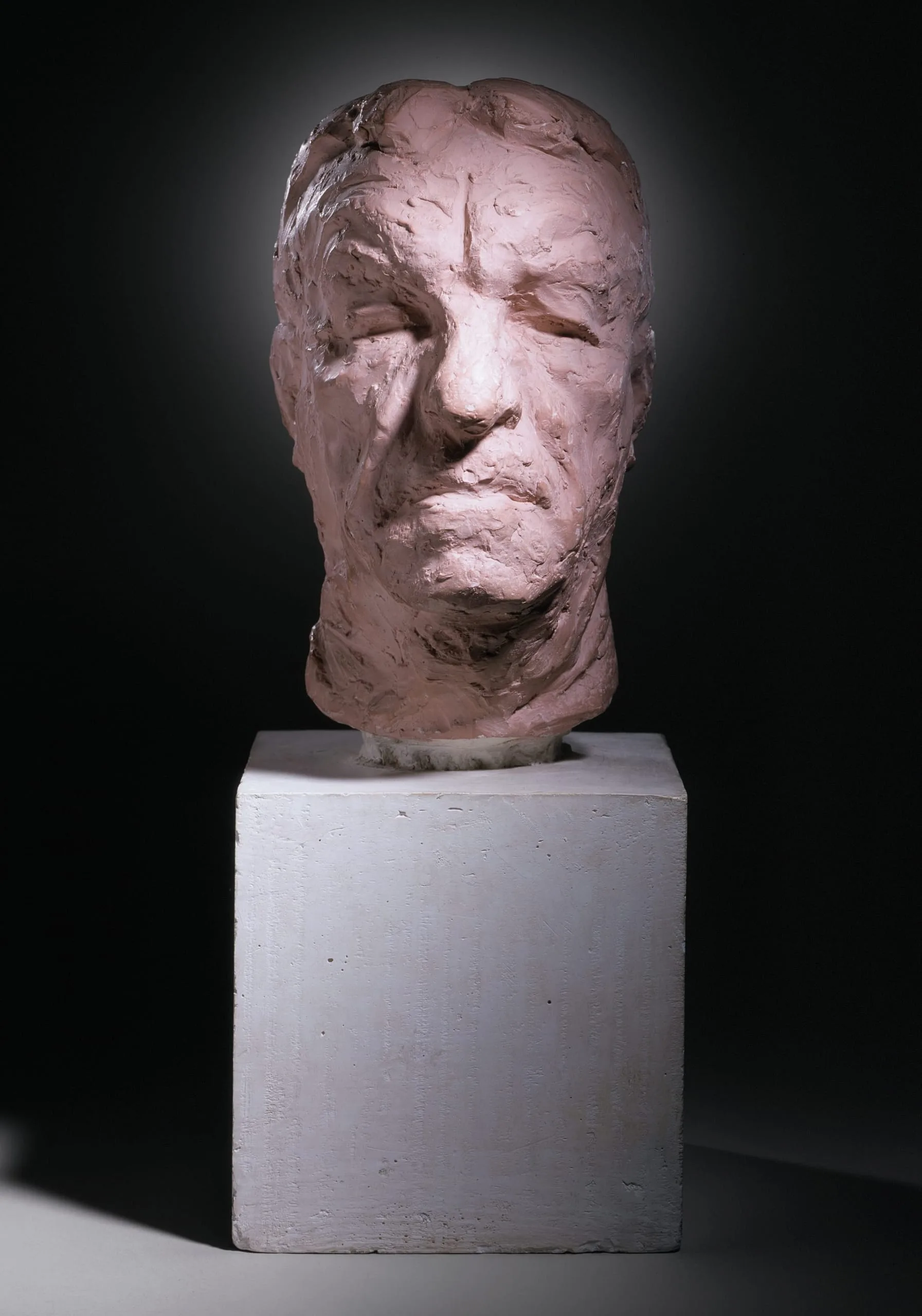
Figural elements have informed approximately one-third of Noguchi’s art. Inspired by the example of his teacher, the academic sculptor Onorio Ruotolo, Noguchi began making portrait heads in the late 1920s and immediately won critical praise for the strength of his portrayals of the sitters’ personalities. Although portrait commissions supported his more progressive work and financed his travels, many of the heads were of friends and fellow artists, among them Berenice Abbott, 1929 (National Portrait Gallery, Smithsonian Institution, Washington, D.C.), R. Buckminster Fuller, 1929 (Buckminster Fuller Institute, Los Angeles), Martha Graham, 1929 (Honolulu Academy of Arts), and José Clemente Orozco, 1931 (San Francisco Museum of Modern Art). On a trip west with Arshile Gorky (1904-1948) in 1941 Noguchi visited Los Angeles, where he modeled a few portrait heads, among them Leger’s. The two artists may have met earlier in Paris or during one of Leger’s visits to New York. In November 1940, after France fell to the Nazis, Leger set up a studio in New York, and the following year he taught summer classes at Mills College in Oakland, California.
Noguchi used a variety of materials and styles for his heads, but they have strict frontal poses and somber gazes in common. Leger’s head differs from many in that it does not have a long, tubular neck. Like Noguchi’s head of Orozco, that of Leger is quite realistic and vigorously modeled, with a rough, unfinished, claylike surface. The head was tinted pink while the base was left unpainted.