- Title
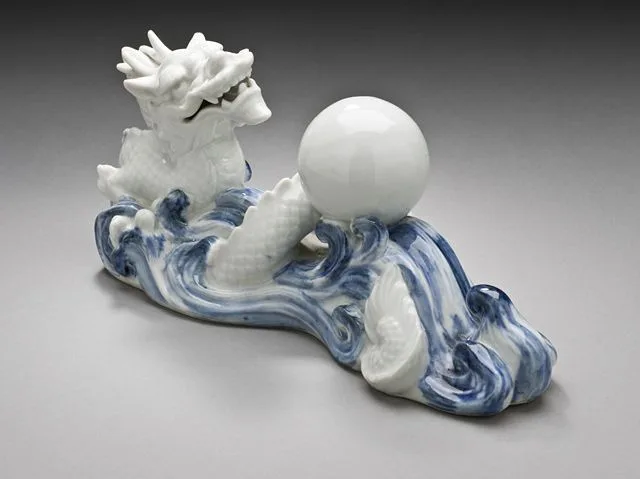
- Okimono in the Form of a Dragon and Jewel Amid Waves
- Date Made
- 19th century
- Medium
- Hirado Mikawachi ware; porcelain with blue underglaze
- Dimensions
- 4 3/8 x 9 1/16 x 3 9/16 in. (11.0 x 23.0 x 9.0 cm)
- Accession Number
- AC1998.115.15
- Curatorial Notes
This small sculpture is an ornamental object known as an okimono. A combination of oku (to place or put out) and mono (thing or article), the term identifies decorative objects meant for display, in particular small figurines or statues admired purely for their beauty and skill of craftsmanship. In the eighteenth century, Japanese artisans began making okimono for display in tokonoma, the alcove in the traditional Japanese home originally designed to showcase hanging scrolls. Made in a range of sizes and various materials, okimono took the shape of figures as well as countless plant or animal subjects, mythical creatures (AC1997.273.20), and religious motifs.
In the nineteenth century, Western demand for Japanese artworks and wares fueled the production of okimono. Artisans explored new subjects and reimagined traditional ones in order to accommodate foreign tastes and how these small decorative sculptures would be shown in European or American homes. Nineteenth-century Westerners favored imagery that portrayed Japan as the “exotic” faraway land of their imaginations. The dragon (M.2002.147.3a-b), a revered subject in Japanese art for centuries, quickly found favor with foreign audiences.
2025