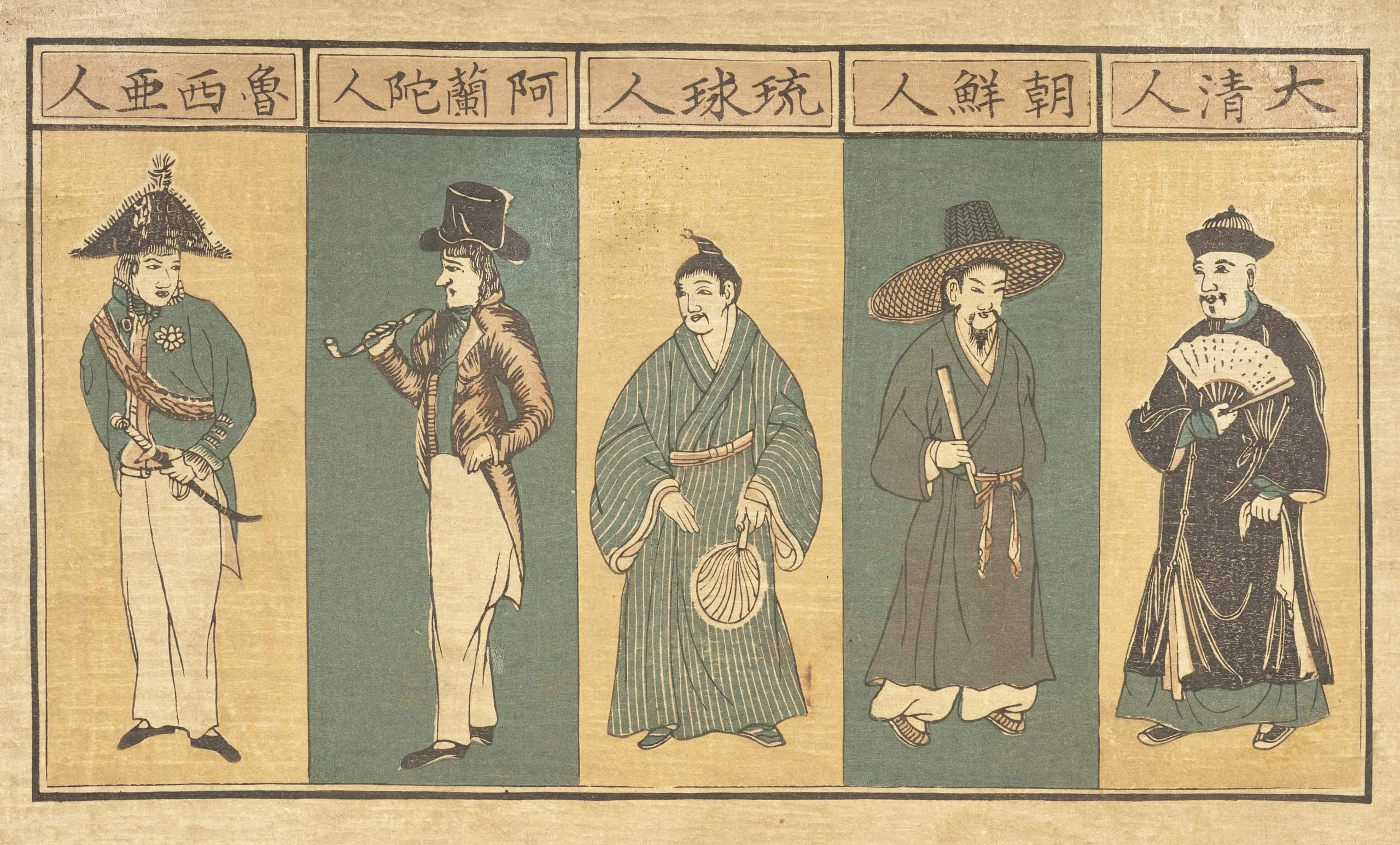
Nagasaki-e (Nagasaki pictures) are a category of Japanese woodblock prints, paintings, and woodblock-printed books that focus on foreigners and foreign life in the port city of Nagasaki. They were inexpensive and popular souvenirs purchased by visitors to Nagasaki and other Japanese curious about the foreigners living in Japan. Chinese and Dutch subjects were most common in Nagasaki-e, though individuals from Russia, Korea, the Ryūkyū islands, Britain, and France were also portrayed. In the present example, above each figure is a label identifying their nation. From right to left, they are Chinese, Korean, Ryūkyūan, Dutch, and Russian. Depictions of Westerners went beyond what one could observe in Nagasaki, and artists combined any number of attributes regardless of accuracy. Clothing and accessories such as collars, hats, shoes, and fabric patterns were routinely an amalgam of features from different cultures.
Located on the island of Kyūshū, the southernmost of the five main islands that make up the Japanese archipelago, Nagasaki was the site of maritime trade during the Edo period (1615−1868). For much of that time, the Dutch East India Company (VOC) was the sole Western entity with official trade privileges. VOC officials and workers, however, were confined to a small man-made island in the bay and their movements highly restricted. These elusive Westerners created great excitement anywhere they were seen. Chinese traders were also present in Nagasaki; in other nearby areas of Kyūshū, the Japanese traded with Koreans and merchants from the Ryūkyū Kingdom (present-day Okinawan islands).
Nagasaki-e were produced from roughly the 1740s to the 1860s. In 1853, a fleet of American ships led by Commodore Matthew Perry (1794−1858) arrived just south of Yokohama, ushering in the end of Japan’s exclusion period. With the opening of Japan came a flood of foreigners from far and wide along with things and information from and about the West. By the end of the decade, the arrival of goods and ships and the activity of foreigners shifted from Nagasaki to the new treaty port of Yokohama. The production of Nagasaki-e thus declined over the course of the 1860s.
2025