- Title
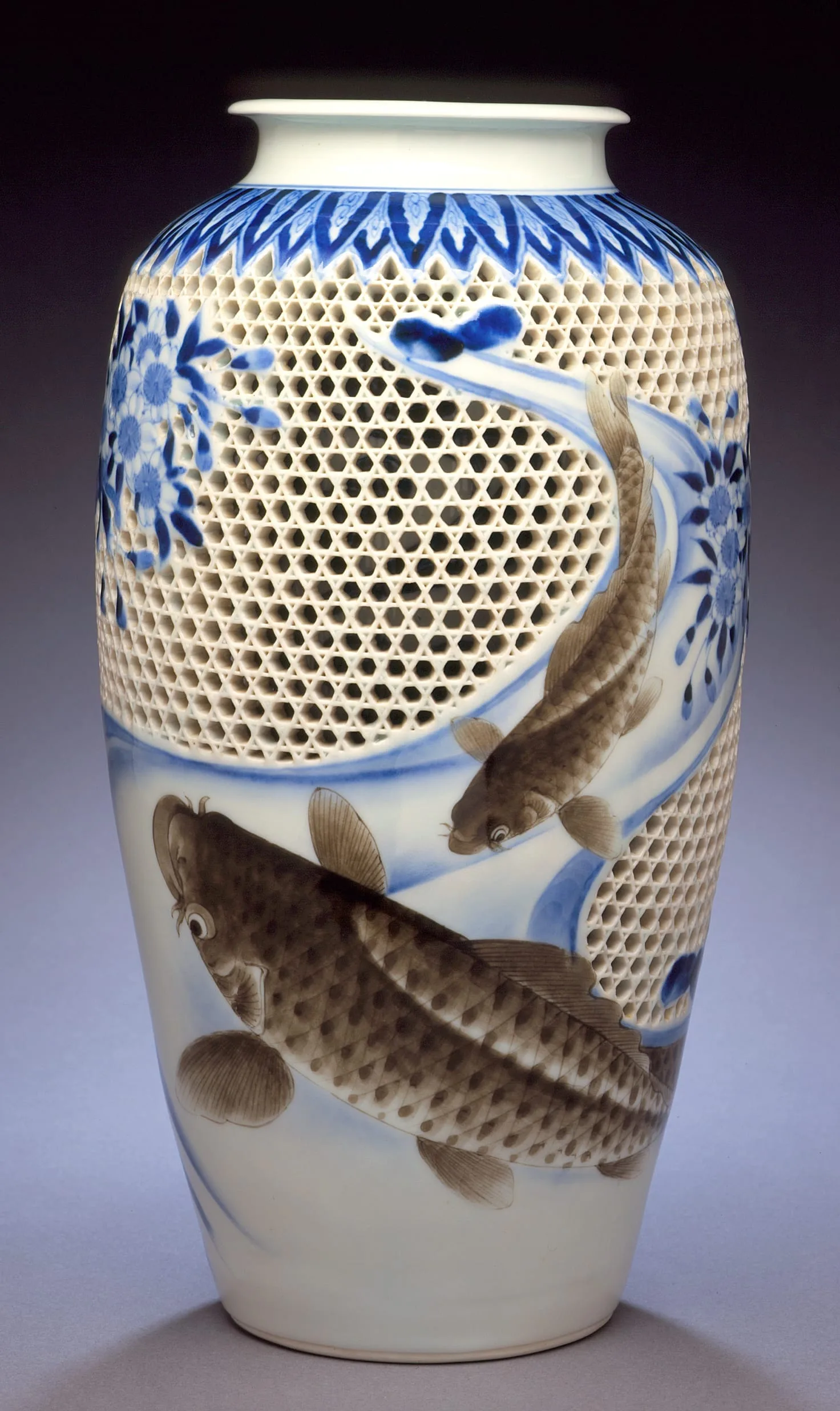
- Vase with Open Work, Blossoming Cherry, Carp, and Stream
- Date Made
- early 20th century
- Medium
- Hirado Mikawachi ware; porcelain with underglaze blue and iron
- Dimensions
- 11 3/4 x 5 3/4 (shoulder Diameter) in. (30 x 14.5 cm)
- Accession Number
- AC1997.273.56
- Curatorial Notes
The porcelain kilns of Hirado were established in the first half of the seventeenth century and relocated to an area called Mikawachi in 1650. Extremely strong and pliable, Hirado clay accommodates modeling and intricate carving, and the discovery of finer-quality kaolin in 1712 resulted in works of even greater whiteness for which Hirado Mikawachi wares came to be known.
A hallmark of Meiji-period (1868−1912) Hirado ware is the technically advanced openwork pattern seen on this vase, which mimics a hexagonal plaiting technique used by Japanese basketmakers. In basketmaking, the shape of the openings is formed by the arrangement of six overlapping strips of bamboo. This type of bamboo plaiting became the foundation of other decorative techniques and often formed the walls of flower baskets (M.88.238.2). It was also used to make baglike enclosures, called gabion (jakago), that were filled with rocks and placed in lakes and rivers to control erosion. Gabion appear in water-themed designs in a variety of Japanese mediums, including paintings (58.26.3), textiles, metalwork, and printed design manuals. The openwork pattern on this vase, imitating a woven flower receptacle and suggestive of gabion, is thus an ideal background for its design of cherry blossoms, water, and carp. Other Hirado vases of comparable size and shape share the openwork ground and decorative shoulder band seen on this example. The water and fish wrap around the vessel form, prompting the viewer to examine it from all sides. The vase was likely intended for the Western market, where it would have been placed on a table to allow for viewing in the round.
2024
- Selected Bibliography
- Singer, Robert; Hollis Goodall. Hirado Porcelain of Japan: From the Kurtzman Family Collection.
Los Angeles: Los Angeles County Museum of Art, 1997. - Foxwell, Chelsea, and Bradley M. Bailey. Meiji Modern: Fifty Years of New Japan. Lexington, MA: Japanese Art Society fo America, 2023.