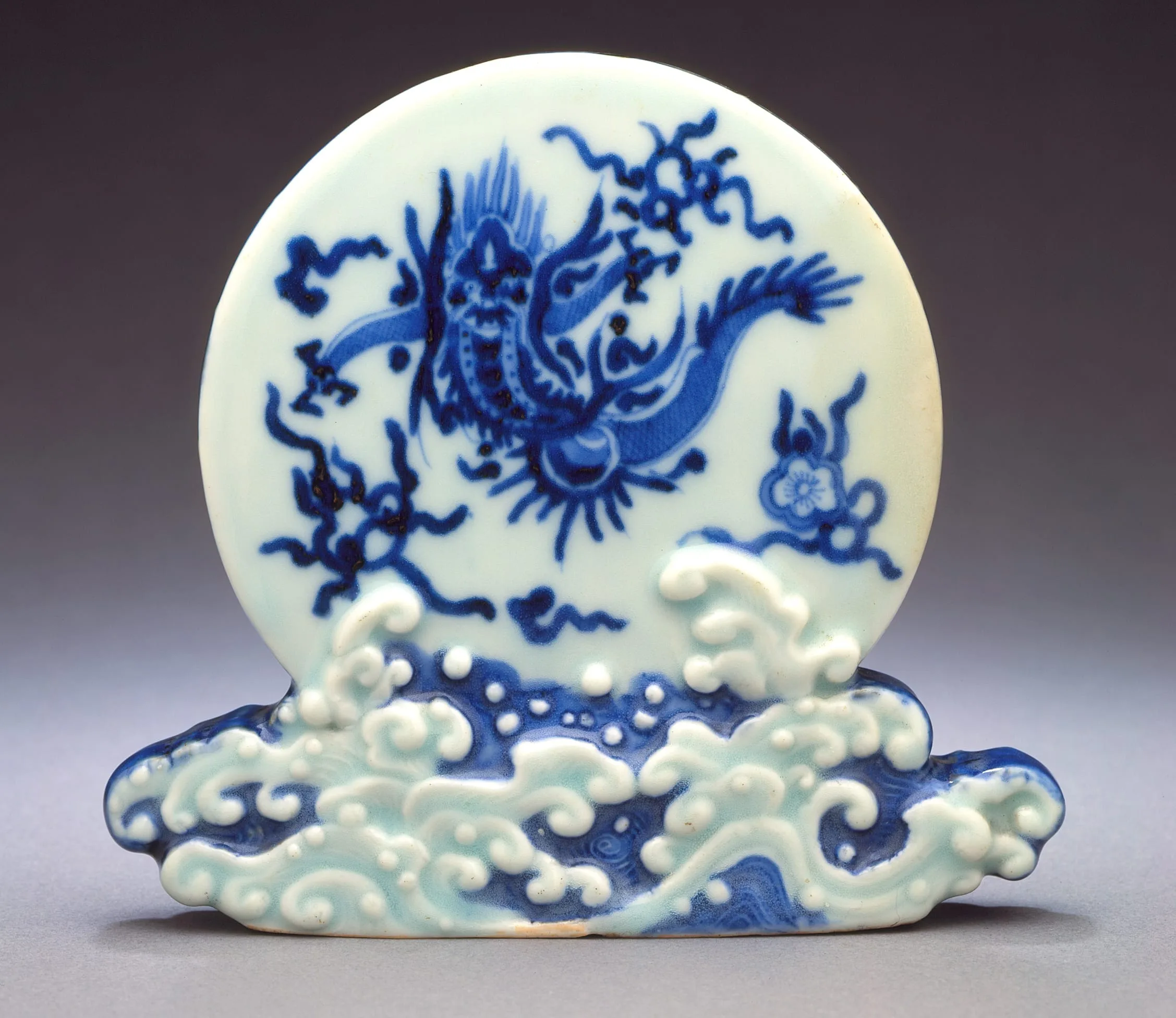
According to the tenets of Chinese Confucianism, poetry, calligraphy, and painting were requisite skills of a cultured and scholarly individual. In Japan, Confucianism fostered interest in Chinese literati culture and the adoption of Chinese-style furnishings such as desk arrangements and writing implements. Brushes were placed on rests or in a holder (M.2001.193.7) or box. Paperweights were employed to hold a book open or keep papers from being disturbed by a breeze. Water droppers (AC1997.273.47) were used to drip water onto an inkstone, where it was then mixed with carefully ground ink. Desk screens protected the ink from dust and prevented it from splattering on the desk. Decorative motifs on screens, typically related to scholarly activities or virtues, provided imagery for inspiration and contemplation.
Though it was not uncommon for the front and back of a desk screen to bear the same design, in many cases the imagery was different. Here, one side of the disk is decorated with a scene of Sakurai Futamigaura, a pair of large rocks located off the coast of Itoshima Peninsula on the island of Kyūshū. Roughly 37 feet tall and joined by a sacred rope (shimenawa), the rocks are part of the nearby Sakurai Shrine and are revered as a sacred place dedicated to two deities from Japan’s creation mythology. It is said that these deities live in the rocks and that the shimenawa denotes their connection. Known as the Meoto Iwa (married rocks), the scene came to symbolize marital bliss and the bond between husband and wife.
The shimenawa is also said to mark the entrance to the undersea Dragon Palace, the place where the gods reside. Dragons live in the water and preside over the heavens. The other side of this screen is rendered with a three-clawed dragon, a mythical beast associated with water, rain, storms, and clouds. The dragon rises above the waves carrying the jewel with which it rules the tides.
2025