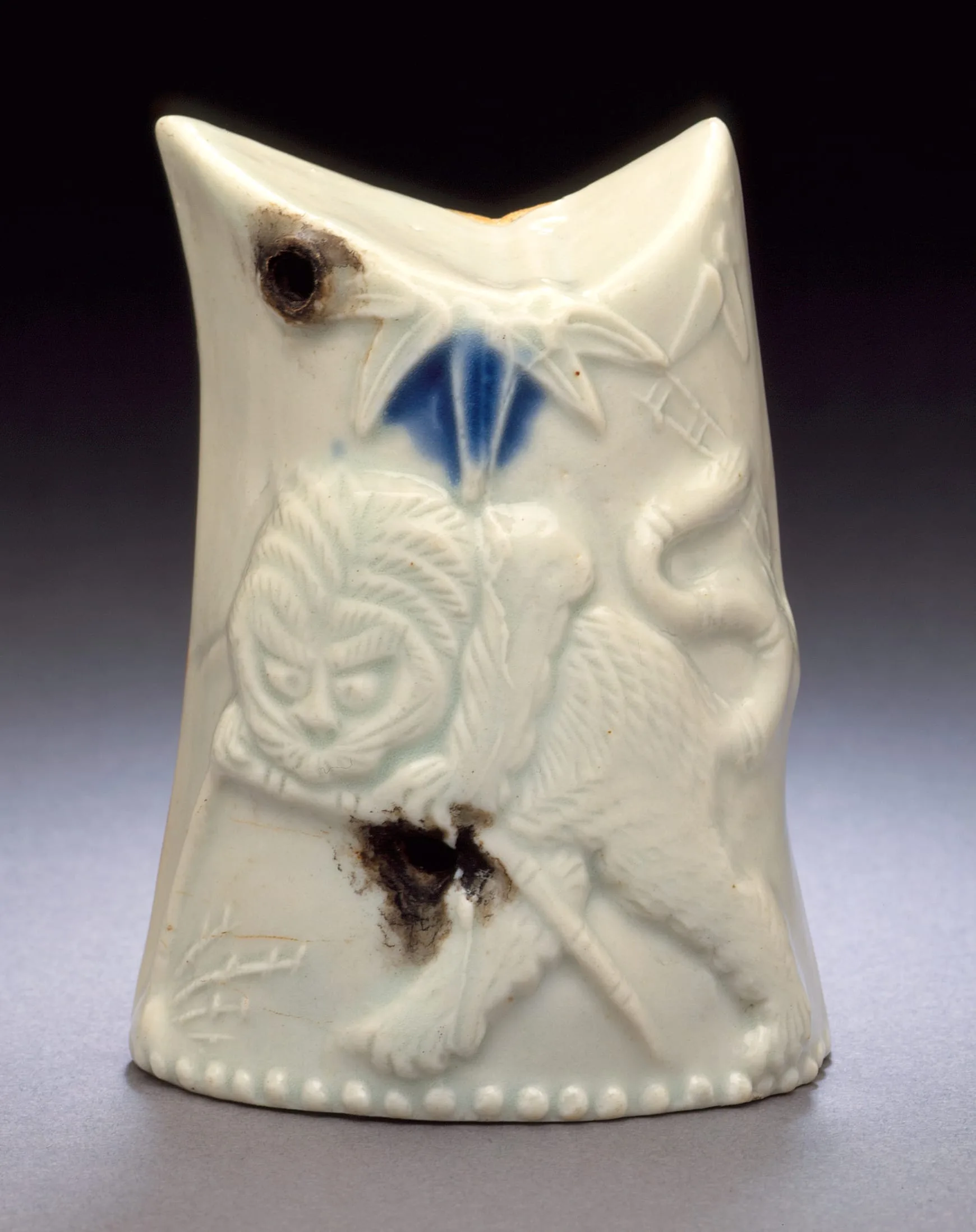
In China, ink painting, calligraphy, and poetry were considered accomplishments that defined a scholar-gentleman, a theme that was transmitted to Japan. Writing implements were part of the scholar’s desk and included brushes, a brush pot, a brush rest, an ink stick, and a water dropper. In addition to functioning as writing utensils, these items were visually appealing, with imagery or scenes that promoted contemplation and motifs that offered inspiration. As such, scholars’ objects were typically decorated with designs associated with scholarly pursuits or in the form of various auspicious subjects. Surface decorations included mythical beasts, revered religious and historical figures, and landscapes. Water droppers were rarely simple forms but instead akin to miniature sculptures and typically modeled on various plants and animals, particularly those associated with auspicious meaning. The animal or figure would be composed in a way that accommodated the two holes needed to fill and pour water from the dropper.
This water dropper is decorated with an image of a tiger. Initially modeled on Chinese examples, tigers, symbolic of power, became a popular subject in Japanese painting starting in the fifteenth century. They were often depicted amid bamboo, a plant that bends in the strongest of winds without breaking. The combination of tiger and bamboo, emblematic of strength and flexibility, has a long history in Japan.
Tigers are not indigenous to Japan. Prior to the Meiji period (1868−1912), a few tigers were imported into the country, but otherwise opportunities for firsthand observation were rare. Consequently, Japanese artists and craftsmen used whatever visual clues were available, such as paintings, prints, and woodblock-printed books, which were themselves copies of other pictorial works. Historically, tigers in Japanese art were commonly rendered with misunderstood proportions and fanciful features such as bulging eyes, oversized paws, and elongated tails.
2025