- Title
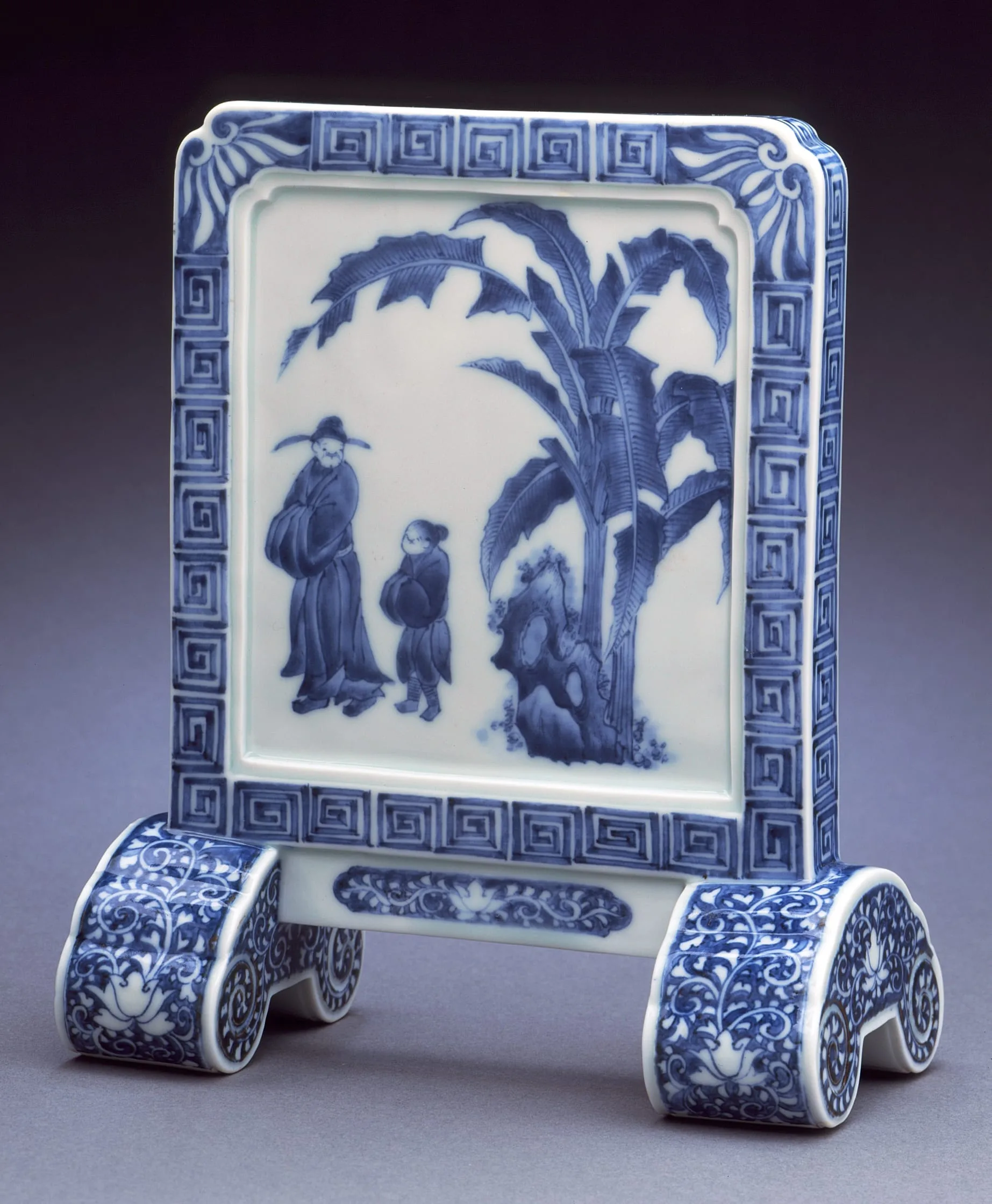
- Desk Screen with Scholar and Attendant under Banana Plant
- Date Made
- 19th century
- Medium
- Hirado Mikawachi ware; porcelain with underglaze blue
- Dimensions
- 7 1/8 x 6 x 3 in. (18 x 15.2 x 7.5 cm)
- Accession Number
- AC1997.273.34
- Curatorial Notes
In Chinese art, scholars are often shown in gardens or outdoor settings surrounded by trees and plants. They might be seated at a table with writing implements or strolling with an attendant. Many renderings of these outdoor scenes include banana plants, which symbolize a scholarly life and self-discipline. Artists in Japan adopted the theme of Chinese scholars and generally retained this traditional representation of them, as seen on this small screen, an object commonly found on a scholar’s desk. While small screens were functional—preventing drafts from blowing onto wet inked paper—they also provided decorative imagery for inspiration and contemplation. Motifs typically included themes and symbols related to scholarly activities or virtues.
The borders and edges of this porcelain desk screen are lavishly decorated with a diaper pattern of repeating connected squares. Each side of the feet bears a single lotus blossom surrounded by a karakusa design of interlacing vines and leaves. Though imagery on a screen’s two sides is often different, here the front and back bear the same design. Desk screens might also be assembled from separately produced pieces of various materials, such as a slice of stone showing its natural grain or an intricately carved panel of lacquer or jade fitted into a carved wood stand made specifically for that panel (see M.85.274a-d).
2024
- Selected Bibliography
- Singer, Robert; Hollis Goodall. Hirado Porcelain of Japan: From the Kurtzman Family Collection.
Los Angeles: Los Angeles County Museum of Art, 1997.