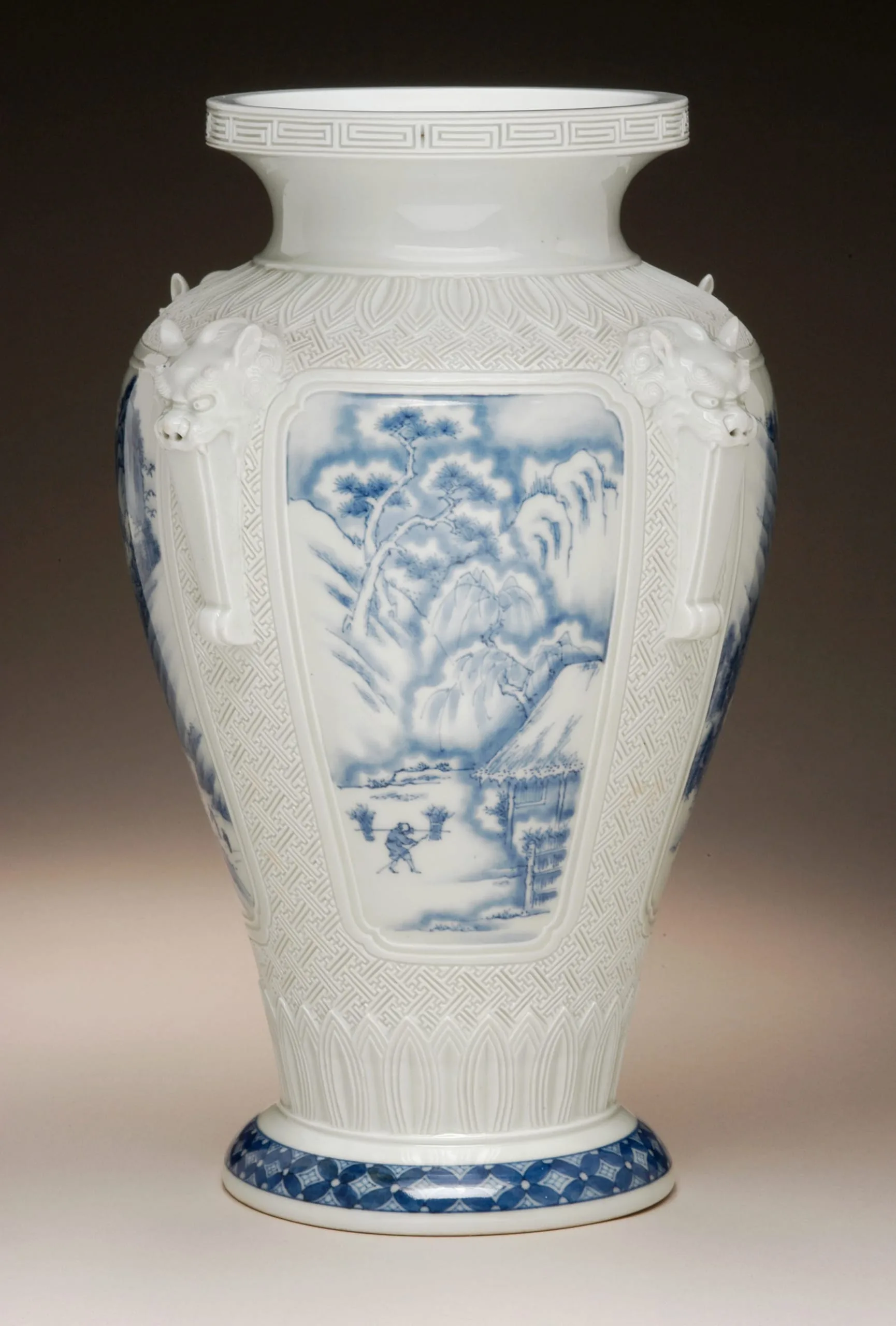
The basic form of this vase originated in China during the Tang dynasty (618−907) and became known as the meiping, or “prunus vase.” Originally a lidded wine storage jar, the meiping form has a small mouth, wide shoulders, and a body that tapers to a small foot. During the Song dynasty (960−1279), the elegant shape was coopted for the display of branches of blossoming plum, a practice from which its name derives. The meiping form was adopted in both Japan and Korea, where it evolved over time to express the aesthetic sensibilities of each culture.
Blue-and-white porcelain wares were part of the lucrative Japanese export trade to the West. The growing foreign demand for Japanese wares of all kinds in the nineteenth century played an increasingly influential role in dictating the forms, subject matter, and decorative treatments employed by Japanese artists and artisans working in all media. Hirado artisans adapted the traditional meiping form, transforming it into a vessel that bore little resemblance to its original design but would have been a shape popular with Western consumers.
This vase dates to the “golden age” of Hirado porcelain, which is generally thought to be from roughly the mid-eighteenth to the mid-nineteenth century. Though crafted for export, it is embellished with patterns and motifs that had been used in Japanese art for centuries. The lip and entire surface of the body are carved with a decoration composed of repeating and connected small geometric shapes known as a diaper pattern. The leaf-shaped border designs on the neck and foot and the use of enclosed panels are other treatments seen in earlier Japanese ceramics (63.15). Though purely ornamental, the four sculpted monster masks mimic the small lug handles on traditional storage jars (M.2007.226.23). The overall approach here seems to have been popular, as evidenced by the number of similarly decorated forms made at the Hirado workshop (M.2002.147.1a-b).
2025